
Akash Network is a cloud computing (AI, storage) based blockchain that allows you to buy and sell unused computing capacity. It is similar to Amazon Web Services (AWS), Google Cloud and Microsoft Azure but is decentralized and built on Cosmos Hub (SDK). Anyone with unused servers or IT infrastructure can become a provider on the Akash network. Providers provide their computing capacity (CPU, GPU, memory and storage). Developers and businesses who need computing capacity can buy resources on the Akash network. You can launch and manage distributed applications, run machine learning models, build websites, etc. With the introduction of the Akash Console feature, the infrastructure has become more user friendly.
HOW IT WORKS
Anyone with unused IT infrastructure or servers can become a provider on the Akash network. Providers basically provide their computing capacity (CPU, GPU, memory and storage). Users who need computing capacity can buy resources on the Akash network.
Akash Network works as a marketplace where customers and providers can interact directly without intermediaries. Providers offer resources and customers bid to use them. This model, through an auction mechanism, reduces costs compared to centralized cloud providers.
Akash is managed through smart contracts that regulate the agreement between provider and customer in a secure way, ensuring that both parties respect the agreed terms. Payments are made through Akash's native token, AKT, which is used to pay providers.
Data is distributed across the network nodes, ensuring resilience and security. Since there are no central servers, downtime compared to traditional centralized clouds is zero, furthermore there is no censorship since no single entity can control or interrupt services on the network.
The differences compared to classic solutions are:
1) Lower costs (resource prices are lower than centralized cloud providers)
2) Higher security and no censorship
3) Higher privacy
With this infrastructure you could:
🤖 Build and train your own AI
🧠 Large scale machine learning
👾 Decentralized bots (for automation, trading, social)
🎮 Run a Minecraft server, multiplayer games and eSports servers
📡 Game streaming
📲 Edge computing applications (for IoT devices and AR games)
🎞️ Audio/video streaming
📺 VOIP (Asterisk) and video conferencing (Jitsi) servers
🖥️ Host and manage dapps and smart contracts
➿Containerization (similar to virtual machines) and Kubernetes (deployment and scaling)
⚙️ Run CI/CD pipelines (continuous integration/deployment) for decentralized software development
🖼️ Rendering 3D models
∞ Physical and mathematical simulations
🔒 Running a VPN
⛏️ Running miners and validator nodes
📊 Big data processing jobs
🖧 Database servers (MySQL, PostgreSQL, and decentralized databases)
🔢 Data processing and management infrastructure (Filecoin, Storj)
🌐 Website hosting
📧 Decentralized email servers
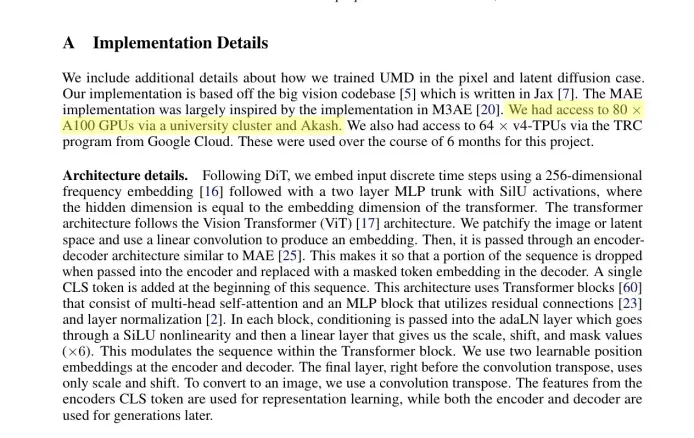
All of this can be done using less computing power and theoretically spending less. There are already applications, for example the work described in the published paper (Texas, USA) below, was implemented using a cluster of NVIDIA A100 GPUs accessible from the Akash Supercloud.
For example, providers on Akash that own servers with NVIDIA GPU can offer resources to users on the network. This allows developers and businesses to rent GPU-based computing power to run AI operations without having to purchase expensive hardware. NVIDIA GPU are ideal for massively parallel computation, making them great for training and inferencing machine learning and deep learning models. On Akash, these GPU are also used to manage large databases or run inference efficiently. Developers can run complex AI models like convolutional neural networks (CNN) or natural language models (NLP) by leveraging the power of NVIDIA GPU through Akash.
As mentioned, the Akash Network reduces the cost of cloud computing through an auction mechanism. By using NVIDIA GPU through Akash, users can run AI operations at a potentially lower price than centralized cloud services like Amazon Web Services or Google Cloud, which offer GPU but often at a higher rate. Kubernetes is often used in conjunction with NVIDIA GPU to deploy AI and machine learning workloads.
Are you interested in ways to earn crypto bonus? Check it out here: Some Sites To Earn Crypto Bonus (Old & New)






