The Clarity Act aims to be what MiCA is for Europe. In a long article, I highlighted many controversial points of the Clarity Act, if you'd like to read it: Clarity Act Rejected: Is It Really Bad for the Crypto Sector? It Depends.
In any case, users in the US, Asia, Africa, and generally outside the EU (e.g., the UK, Switzerland, Oceania, etc.) don't know what MiCA has brought to the EU.
These were the regulations:
- Ban on exchanges that haven't purchased/obtained the MiCA license (exchanges that have been operating for 6-7-8-9-10 years without any problems. Except for the typical issues that centralized entities may have, and which could still happen today, regardless of whether they have obtained the license or not).
- Strengthening KYC to combat AML (in this regard, it should be noted that the accumulation of sensitive data poses a risk to the customer in the event of a data breach: the $5 Wrench Attack) and reporting of all transactions/movements (this has led to serious repercussions in France, as a tax agency employee sold this data to criminals).
- Travel Rule (when withdrawing at least €1,000 from an exchange, you must provide information on the recipient's address).
- Stablecoins must have European authorization (reserves, controls, collateral bank deposits, etc.).
- Ban on USDT and other overcollateralized stablecoins (e.g., DAI) from MiCA exchanges.
- Ban on receiving interest on stablecoins for both USDC and other stablecoins (this also applies to regulated exchanges).
- Transaction restrictions if used as a means of payment/exchange. If the European area simultaneously exceeds 1 million transactions per day and €200 million in average daily value related to its use as a means of payment/exchange, the issuer must stop issuing the token and take measures to reduce its use.
- A stablecoin can be classified as "significant" (ART/EMT) if it reaches a certain size (over 10 million holders, over €5 billion in market cap/asset reserve, over 2.5 million daily transactions, and €500 million in average daily value). It would then be limited with strict criteria.
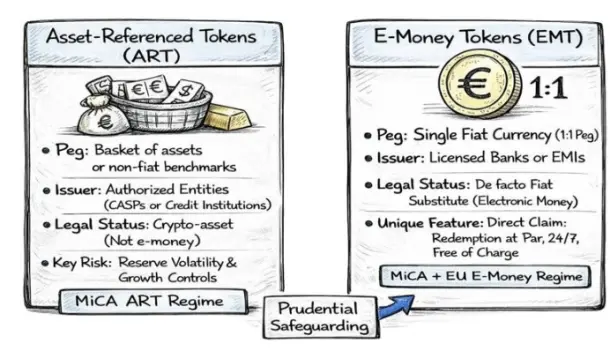
- It was ECB President Christine Lagarde who reportedly blocked Binance's MiCA license in the EU (for trivial reasons related to past infringements). The big problem is the exchange's size, which could evidently reduce banks' earnings.
- Delisting of privacy coins (Monero, Zcash, etc.) from exchanges, this is actually promoted by the EU and has been in place for years (fight against AML). They would like to further tighten things up starting in 2027, even though banning the use of Monero on-chain (or Bitcoin, which would be even worse) is impossible.

Some rules they're debating (September 2026):
- Ban on receiving interest from lending/borrowing/earnings (deposits) on stablecoins.
An initial proposal that didn't pass:
- Many people have forgotten, but the MiCA originally included a ban on mining (Proof of Work). Yeah, Bitcoin. Why? The usual energy and pollution excuse.
WHAT IS THE ULTIMATE GOAL?
On September 21, 2026, the ECB launched Pontes, an infrastructure that connects the Eurosystem payment system to blockchain-based financial markets. The idea is to allow the settlement of tokenized assets using central bank euros, instead of private stablecoins. And at the same time, it's working on the digital euro, with the goal of a possible retail launch in 2029. This technology will allow for better control over funds and enable them to be blocked in seconds, certainly more efficient than what banks can currently do, IMO. The rich must stay rich, the poor must stay poor. This is the moral of regulations.
Article always updated with all the possibilities of on-chain farming (airdrop): Some Sites To Earn Crypto Bonus (Old & New)