KYC: Know Your Customer or Kill Your Customer?
The DAC8 directive came into force on January 1, 2026. All crypto-asset service providers operating in the EU must collect and transmit detailed data on their users to national tax authorities: name, surname, home address, tax code, wallet value and transaction amounts. This data will be automatically exchanged between member states by September 2027. Declaring Bitcoin and cryptocurrencies means providing the state (of each nation) and potentially criminals with proof that you own easily transferable assets and that the holder can be reached at a specific address. The stated goal is to combat tax evasion. The practical effect is the creation of a centralized database of cryptocurrency holders with their name, surname, address and assets, accessible to thousands of officials in 27 countries. If criminal groups know that you have $1M in $BTC and know your home address, they can come visit you, threaten you, and steal your funds!
In Saint-Martin-le-Vinoux, on February 5, 2026, four masked men broke into the home of a crypto startup CEO. His wife and 66-year-old mother were kidnapped, tied up and held captive for 30 hours in a garage in the Drôme region. The kidnappers demanded one million euros in $BTC. The two women were only able to free themselves thanks to the intervention of a neighbor. Six arrests were made.
A week earlier, in Voiron, a 74-year-old retiree had his hand cut off to extort three million euros from his son, suspected of working in the blockchain sector. Three arrests were made.
On February 12, three armed men attempted to break into the home of David Prinçay, CEO of Binance France. They entered the wrong apartment, attacked other residents and fled with two phones. They were arrested in Lyon a few hours later.

Yesterday, March 9th, there was another case in France where a husband and wife were victims of a home robbery, held prisoner in the house and lost 900k. In this case, the criminals identified themselves as the police.
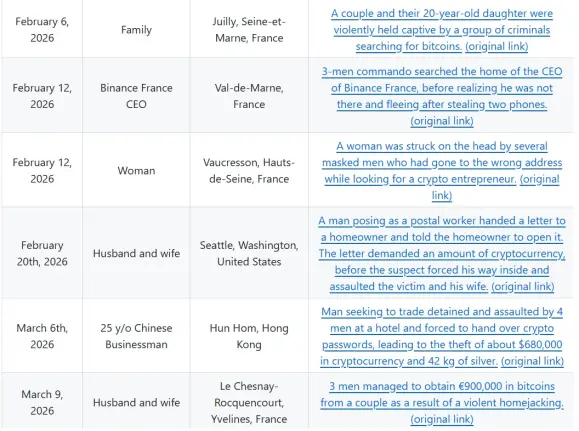
These are four of the latest cases to hit France. Approximately 70 "$5 Wrench Attacks" were documented in 2025. According to CertiK, there were 72 incidents, 25 kidnappings, 3 murders and over $40 million in losses. France recorded 19 in 2025 (more than double the number of the United States). In 2026, as of mid-February, 11 of the 14 wrench attacks documented worldwide occurred on French soil. 25% of the attacks were home invasions, 23% were kidnappings. 51% were classified as "serious" (armed robbery or kidnapping), 21% as "severe," involving torture. 5% ended in the victim's death.
Why is France so affected? Ghalia C., an employee of the French tax agency, was arrested on June 30, 2025 and charged with complicity in assault on a public official and criminal conspiracy. Investigations revealed that, for months, he had been using the tax software "Mira" to search for information on crypto investors, extracting addresses, declared assets, and capital gains. He sold the data to organized criminal groups for approximately €800 per transaction. French authorities are investigating whether other tax officials were compromised by the same criminal network.

In January 2026, Waltio, a French platform used by 150,000 users to calculate cryptocurrency taxes, suffered a cyberattack. The hacker group Shiny Hunters stole the data of approximately 50,000 customers (emails, 2024 tax reports, etc.) and attempted to extort a ransom. Waltio exists because European regulations require citizens to declare their crypto assets. Its users are ordinary people who have followed the law. Now their data is potentially in the hands of criminals.
Waltio's CEO: "Some attackers could use contextual elements, such as the existence of a tax report or aggregated information, to target victims"
Every custodial exchange, every tax reporting platform, and every tax agency becomes a potential point of vulnerability. A corrupt employee, a cyberattack, a security breach: and the data of thousands of citizens ends up in the hands of criminals and ruthless gangs.
According to cypherpunk circles: "KYC is the illicit activity". Know Your Customer, the requirement for financial institutions to identify their customers, is presented as a crime-fighting tool. But in practice, it creates exactly the infrastructure criminals need: centralized databases of people with digital assets, complete with personal information and addresses.
Are you interested in ways to earn crypto bonus? Check it out here: Some Sites To Earn Crypto Bonus (Old & New)