
As you may know, on September 15, 2026, the Senate rejected the procedural vote to advance the Clarity Act: 60 votes were required. The measure is not technically dead and could be reworked and reintroduced.
Before discussing the pros and cons of a (future) approval, let's look at the main changes to the final text (which was rejected).
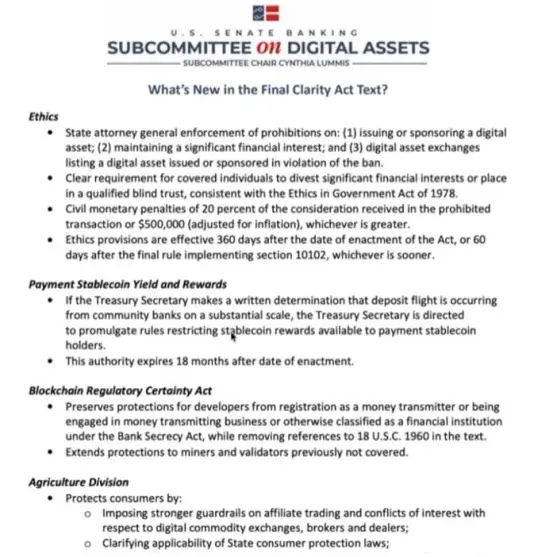
- Ethics: If a politician or entity covered by the law violates certain prohibitions, it wouldn't be just the DOJ/federal government that could intervene: state regulators would also have the tools to enforce these rules. This greatly increases the legal risk for a politician seeking to exploit their position to further their own crypto project.
- Obligation to sell or blind trust significant financial interests. If you have a significant financial interest in certain cryptocurrencies/issuers, you must divest or blind trust them.
- Penalty: 20% of the transaction or $500,000. Whichever is greater applies. So, if a prohibited transaction generates $10 million: 20% = $2 million, not $500,000.
- Yield cap on stablecoins. If the Treasury Secretary determines that a significant flight of deposits from community banks to stablecoins is occurring, the Treasury may impose restrictions on stablecoin rewards. This authority lasts for 18 months.
- Developers, miners (proof of work), and validators (proof of stake) should not automatically be considered a money transmitter or financial institution because they do not control customer funds.
- Limitations on conflicts of interest between exchanges, affiliates, brokers/dealers, and traders operating on the same market.
- Distinction between decentralized and centralized DeFi protocols. If a DeFi protocol is effectively controlled by an identifiable person/company, it may be subject to CFTC registration and the Bank Secrecy Act and therefore regulated.
- The text clarifies that developer/DeFi protections do not automatically constitute an exemption from derivatives laws and should not be interpreted as a change in the regulation of prediction markets.
- Introduction of fairly strict limits on the ability to raise capital: a maximum of $50 million per year (and $200 million for life).
- Issuers must provide more information and, under certain circumstances, certify to the SEC that the token qualifies for treatment as an ancillary asset rather than a security. Disclosure, anti-evasion rules, resale restrictions, SEC powers in the event of fraud/manipulation, and the possibility of delisting after certain violations have also been strengthened.
- Increased controls: KYC, AML, suspicious activity reporting, sanctions compliance, and risk management.
- Front-end DeFi: Even if a protocol remains decentralized (smart contract), it can be regulated to gain access (front-end, therefore KYC in the US).
- Exchanges would have stricter requirements regarding: affiliate trading, conflicts of interest, disclosure, custody, testing of the ability to transfer assets, audited annual financial statements, and assets susceptible to manipulation.
- Bitcoin and Crypto ATM Restrictions: Registration, warnings, receipts, antifraud policies, monitoring, compliance officer, detection, holding periods, and withdrawal limits.
POSITIVES ASPECTS OF APPROVAL
- Distinction between the SEC and the CFTC: the distinction between securities and commodities for tokens would be clearer (this especially impacts altcoins. Bitcoin is now considered a digital commodity). This would also facilitate investments in altcoins and the tokenization sector (RWA) for funds and institutional entities. This would also make it easier for exchanges operating in the US to list tokens.
- It forces a project to be truly decentralized: validators, a better distributed percentage of the token supply, governance held by multiple addresses, domain control, developers, etc. This could also mean that distribution methods like airdrops could become strongly popular again.
- It limits conflicts of interest between exchanges and affiliates.
- It makes it easier for large funds like Blackrock, Fidelity, and JPMorgan to build regulated crypto infrastructure.
- It would bring more crypto companies back to the US (hindered by the SEC in recent years).
NEGATIVE ASPECTS OF APPROVAL
- It impacts the economic viability of exchanges and protocols, due to compliance. A large exchange like Coinbase certainly comes out on top compared to a small exchange that would have less funding to comply (licenses, audits, etc.). It therefore centralizes use on large exchanges.
- It negatively impacts privacy: increased AML controls and anonymity. Like all regulations.
- It could negatively impact DeFi protocols that are not truly decentralized. And as we know, this would be at the discretion of those who control it (it's not easy to determine how truly decentralized a protocol is, given that in DeFi, addresses are theoretically anonymous). For example, KYC could be required on the protocol's frontend, even if it remains permissionless (smart contract).
- It limits the funding received by projects (maximum $50 million per year and $200 million for life).
- It could also negatively impact exchanges like Hyperliquid (currently unavailable in the US) and similar platforms, due to compliance issues.
- It could harm/limit stablecoins (particularly yield) to prevent "deposit flights" from banks experiencing problems on DeFi lending platforms. One clause includes a yield cap if it's significantly more favorable than banks'.
- It limits Bitcoin and crypto ATM (increased oversight and shutdowns).
FINAL THOUGHTS
Contrary to what was claimed, regulations in Europe (MiCA) have not reduced scams, hacks, or market manipulation. They have simply imposed controls and sanctions on exchanges, forcing some to shut down after years of operation (whether this is good or bad is a matter of debate, but it is an objective fact). Remember, Bitcoin became Bitcoin because:
- It has no official team.
- It has no support service.
- It has no email address.
- It does no marketing.
- It has no social media page.
- It cannot be confiscated or blocked remotely by a government.
Anything less decentralized has led to scams. The Clarity Act seeks to penalize projects that aren't truly decentralized (such as certain DeFi protocols), yet it indirectly fosters centralization through increased oversight or by funneling liquidity toward specific platforms (in the name of compliance).
Article always updated with all the possibilities of on-chain farming (airdrop): Some Sites To Earn Crypto Bonus (Old & New)





