
Good day everybody,
Welcome to CryptoGod-1's blog on all things crypto. Today I will be continuing my series on Chart Patterns, which is an area all traders should ensure to familiarise themselves with. In this entry I will be focusing on the Harami.
The Harami
The Harami pattern is made up of two candlesticks, with the first one being a larger candlestick than the second one, and is considered a reversal indicator pattern. The second candle's body is fully contained within the first candle’s body. The idea behind it is that the first candle is the "mother" whose larger body is completely enclosing or embodying the smaller second candlestick, creating the appearance of a pregnant mother. The second candle can sometimes appear as a Doji or a Spinning Top, while the Harami pattern is found in two distinct forms: the Bullish and the Bearish Harmai. The Harami candlestick pattern is considered the opposite of the Engulfing Pattern.
How to Recognize the Harami
There are certain criteria which a trader should look out for when trying to identify a Harami pattern:
- There is a current prevailing trend in the market, although it does not matter whether it is an uptrend or downtrend.
- The first candle will continue in the trends direction, having the same colour as the trend and a long body.
- The second candle will be contained within the first candles body, can be of either colour, and its body being smaller than the first candles. The wicks are not important, only the body needs to be contained within the first candles body.
The Types of Harami
As mentioned above, there are two main forms which can appear when it comes to the Harami Candlestick pattern:
- Bullish Harami: this occurs in a downtrend and signals a bullish reversal pattern.
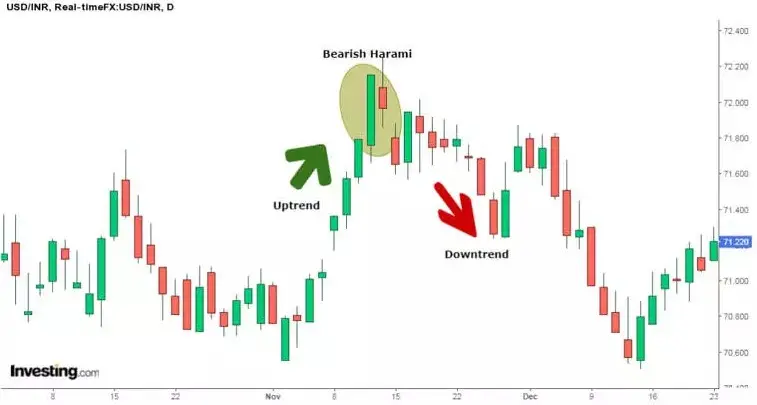
- Bearish Harami: this occurs in an uptrend and signals a bearish reversal pattern.
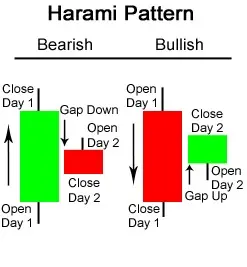
The below image from commodity.com shows the two main types of Harami, Bearish and Bullish.
Bullish Harami
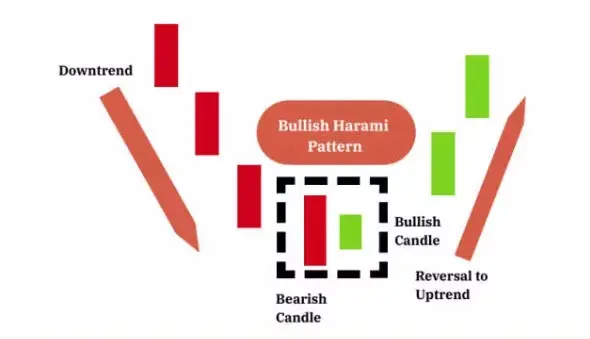
The Bullish Harami pattern is formed when a large bearish red candle appears, and is followed by a smaller bullish green candle. It is important to note that the colour of the second candle is not important, but generally it is green for the bearish Harami. The green candle, although smaller, indicates that the prices are being held up by the buyers and are unable to reach the lows of the previous bearish candle.
The key points of a Bullish Harami are:
- Price is trending downwards and the overall trend is establish as a downtrend.
- The first candle is a large bearish candle.
- The second candle is a smaller bullish candle. The wicks are not important, just the body.
- When the second candle opens, price gaps up after the first candle but its body is smaller than the body of the first candle.
The below image from elearnmarkets.com shows the formation of a Bullish Harami Pattern.
Bearish Harami
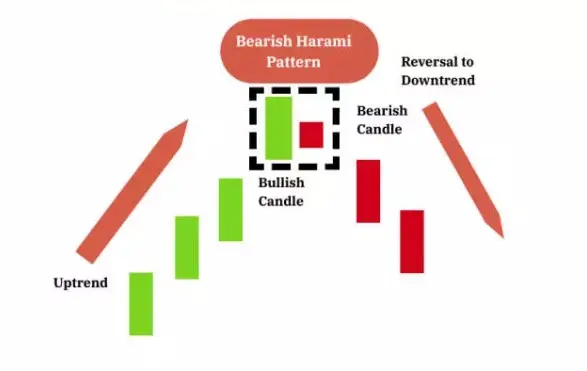
The Bearish Harami pattern is formed when a large bullish green candle appears, and is followed by a smaller bearish red candle. It is important to note that the colour of the second candle is not important, but generally it is red for the bearish Harami. The red candle, although smaller, indicates that the prices are dropping due to the sellers and are unable to reach the highs of the previous bullish candle.
The key points of a Bearish Harami are:
- Price is trending upwards and is established as an uptrend.
- The first candle is a large bullish candle.
- The second candle is a smaller bearish candle. The wicks are not important, just the body.
- When the second candle opens, price gaps down after the first candle but its body is smaller than the body of the first candle.
The below image from elearnmarkets.com shows the formation of a Bearish Harami Pattern.
Bullish and Bearish Harami Cross
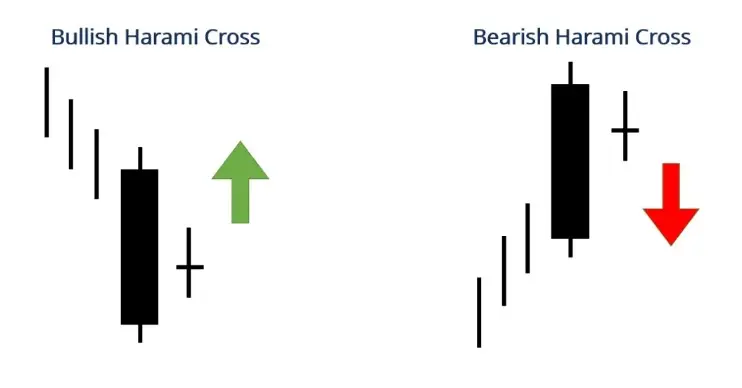
The third type of Harami incorporates the rules of the previous two as mentioned above, and comes in both bearish and bullish forms. The key difference and takeaway for this type of Harami however is that the second candle is a Doji instead of a smaller candle. The first candle still follows the existing trend and the Doji is fully contained within the body of the first candle. Generally, traders do not act on the pattern alone, instead waiting for the next couple of candles to confirm as the Doji can also sometimes represent a continuation of the existing trend. The location of this Harami can be of particular importance when making a trade, and is often most reliable when located near a Support or Resistance Level.
The below image from corporatefinanceinstitute.com shows the Bullish and Bearish Harami Cross.
How to Trade the Harami
When trading with the Harami patterns it is important to note where the Harami appears within the overall trend. If the existing trend is a bullish trend and the Harami appears near the resistance level or trend line, then it is more significant that a Harami which appears in the middle of an uptrend. The Harami, as noted above, suggests indecision, which is often followed by a surge of activity.
A way of trading the Harami would include making use of the price action along with the pattern. This would involve looking for the key components of the pattern, including the existing trend, the larger and then smaller candles as part of the pattern, and the reversal. It is important to make use of a confirmation candle to ensure the pattern has indeed resulted in a reversal. For example a bearish candle after a Bearish Harami which breaks below the original bullish (first) candle would be an indication that the reversal is taking place. Other things such as resistance levels can also help to ensure the bearish candle is indeed a reversal.
In terms of a stop loss in this sort of trade, a user could wait to see if there is an pattern during the impending downtrend which would result in a slowing down or reversal in their trade. They could also set a specific target based on existing Support and Resistance Levels.
A trader could also make use of other technical indicators while trading, such as Bollinger Bands or a Moving Average, and note when a Harami takes place in or around one of these indicators, it adds more strength the the pattern. For example a Bearish Harami at the top of a Bollinger Band would make the likelihood of a bearish reversal stronger.
The below image from elearnmarkets.com shows an example of trading a bearish Harami, with the pattern appearing during an uptrend and resulting in a reversal into a downtrend.
Risks of Using the Harami
It is important when trading with a Harami pattern to wait for a confirmation candle (or two) after the pattern has formed. This is because the candles and price action alone can be unreliable, meaning the pattern could appear before a continuation of an existing trend.
Treaders often like to add technical analysis along with the pattern, as the Harami alone gives a lack of solid indicators. A trade should not be made with the available information alone, confirmation candles and other indicators are crucial to confirm the potential paybacks of this indicator.
It is also imperative to understand the context of the existing trends and price action when looking at this pattern. If the price is in a strong existing trend. the Harami can be a good indicator of a reversal, especially when it appears around Support and Resistance Levels. It is important to factor in that without context, the Harami is just a couple of candles which are practically insignificant. A false Harami could appear and mislead a trader if they do not understand the overall market conditions.
The Harami pattern also gives no indication of ideal take profit or stop loss levels. Some traders like to use the first candle in the pattern for a stop loss level, for example in a Bullish Harami they could place the stop loss at the top of the first candles shadow. This can be risky however as the first candle may be quite large and would leave a lot of room to see your position closed if the trend does not reverse as expected. Therefore making use of other Technical Analysis in this situation to confirm a good take profit and stop loss level is important.
Conclusion on the Harami
The Harami pattern is a trend reversal indicator pattern, which can appear in both Bullish and Bearish forms. It is a common pattern for traders to look for when searching for bullish and bearish reversals in the market. It is formed by have a first candle which follows the existing trend, followed by a second candle which is smaller and contained within the body of the first candle. Often it is the opposite colour of the first candle and overall trend, but this is not a requirement.
The candles indicate a reversal, but it is important to make use of a confirmation candle to ensure the reversal is happening, along with other Technical Analysis to read the overall conditions of the market. Making use of the Harami along with Bollinger Bands, Moving Averages, Trend Lines, and Support and Resistance Levels are advised, along with understand the context of the overall market trend.
You can find the previous parts to the series here:
Chart Pattern - Part I - Understanding Candles
Chart Pattern - Part II - Doji
Chart Pattern - Part III - Marubozu
Chart Pattern - Part IV - Hammer / Hanging Man / Shooting Star
Chart Pattern - Part V - Spinning Top
Chart Pattern - Part VI - Engulfing
If you would like to check out the previous series I did, which focused on Technical Analysis, you can find it here: Recap of the Technical Analysis Series - Parts I - XXV
Have a great day.
Peace. CryptoGod-1.
Referral links:
Publish0x - https://www.publish0x.com/?a=olejZqrzej
Binance - https://accounts.binance.com/en/register?ref=143611368
NFT Market Sales
Opensea - https://opensea.io/RNabc
Follow Me :)
Twitter - @RNabc123






