
Good day everybody,
Welcome to CryptoGod-1's blog on all things crypto. Today I will be continuing my series on Chart Patterns, which is an area all traders should ensure to familiarise themselves with. In this entry I will be focusing on the Engulfing patterns.
The Engulfing Pattern
An engulfing pattern is often seen as a opportunity for traders to enter the market, as it is taken as a signal of an impending reversal in the existing trend. The pattern involves two candles, with the second candle ‘engulfing’ the entire body of the candle before it. By this it means the entirety of the second candle is larger than the first candle, including the first candles top and bottom shadows. The engulfing candle can be both bullish or bearish and it depends on where it forms in relation to the existing trend. They are considered to be popular candlestick patterns because they are easy to spot and therefore easy to trade.
How to Recognize the Engulfing Pattern
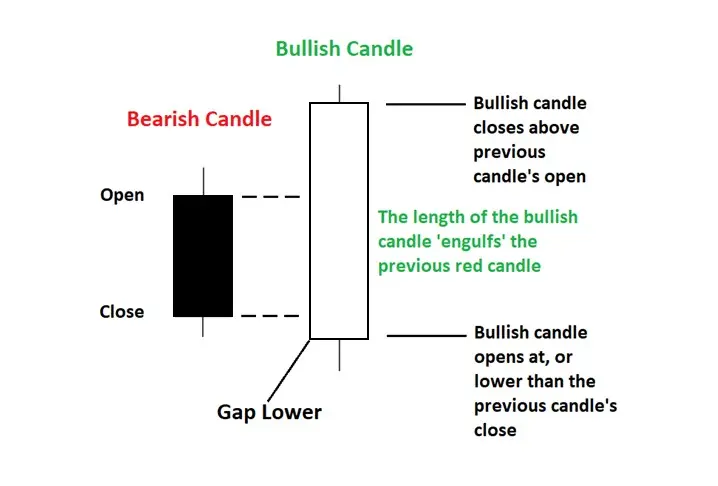
A trader can spot the engulfing pattern by looking for two candles, with the first having a relatively small body with short shadows, and the second candle having a real body which engulfs the previous candles along with longer shadows. The second candle completely overwhelms the prior candle, with the ideal situation seeing the closing price of the second candle being higher (if bullish) or lower (if bearish) than the higher or lower shadow on the previous candle. The engulfing pattern comes in both bearish and bullish, and its location in the overall trend is an important factor in recognising the overall meaning of the engulfing pattern.
The image below from babypips.com shows how the formation of an engulfing candle looks, and these rules can be applied for both the bullish and bearish engulfing candles.
The Types of Engulfing Pattern
There are two main types of the engulfing candle pattern, as mentioned above. The bullish and the bearish engulfing candles, which as their names allude to, are signals for either a bullish or bearish reversal in the trend. Traders can also look for an engulfing pattern to support the continuation of the existing trend, for example, if a trader spots a bullish engulfing pattern during an uptrend then it provides more conviction that the trend could continue.
Bullish Engulfing Candle
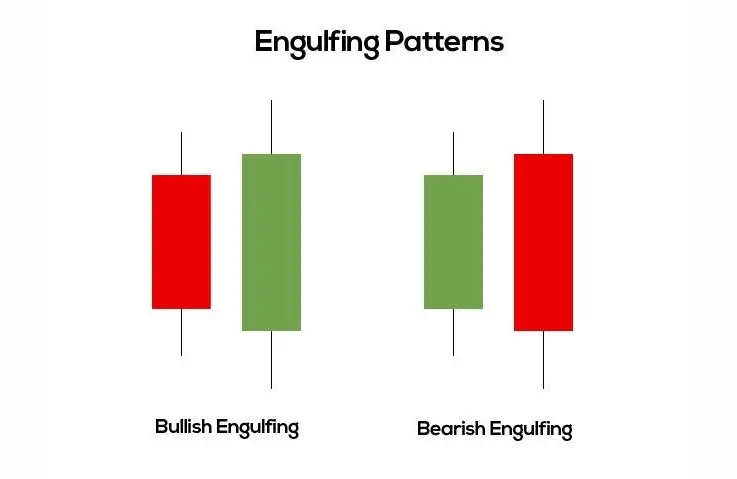
This signal is generally strongest when it appears at the bottom of a downtrend, and it indicates a surge in buying pressure. The bullish engulfing pattern triggers a reversal of an existing downtrend as more buyers are entering the market and driving the price upwards. The pattern involves the first candle being bearish, or red, and the second candle completely engulfing it and being green.
The price action must show a clear downtrend when the bullish pattern appears, with the large bullish candle indicating that the buyers are putting pressure on the market to move upwards. This provides an indication that further upward momentum should follow and traders can look for a confirmation to this reversal in trend with the use of other indicators, key support and resistance levels, and the price action following the engulfing candle.
Bearish Engulfing Candle
This signal is generally strongest at the top of a uptrend, and indicates a drop off in buying pressure with a surge in selling. The bearish engulfing pattern triggers a reversal of an existing uptrend as more sellers are entering the marking and pushing the price down. The pattern involves the first candle being bullish, or green, and the second candle completely engulfing it and being red.
The price action must show a clear uptrend when the bearish pattern appears, with the large bearish candle indicating that the sellers are putting pressure on the market to move downwards. This provides an indication that further downward momentum should follow and traders can look for a confirmation to this reversal in trend with the use of other indicators, key support and resistance levels, and the price action following the engulfing candle.
The below image from thinkmarkets.com shows examples of both the Bullish and Bearish Engulfing candles.
How to Trade the Engulfing Pattern
Traders like to formulate their own strategies when trading, and two of the more common ones which can be used and integrated when trading from an engulfing candles are:
- Engulfing Candle Reversal Strategy
- Engulfing Candle Trend Trading
Engulfing Candle Reversal Strategy
This strategy involves a trader looking for an engulfing candle pattern which is going against the existing trend. If in an uptrend, the trader waits for a bearish engulfing candle, and in a downtrend they wait for a bullish engulfing candle. Once the engulfing candle pattern has been established, the trader waits for confirmation before entering the trade. This is to ensure the trend is indeed reversing. The guide for trading on this strategy would be:
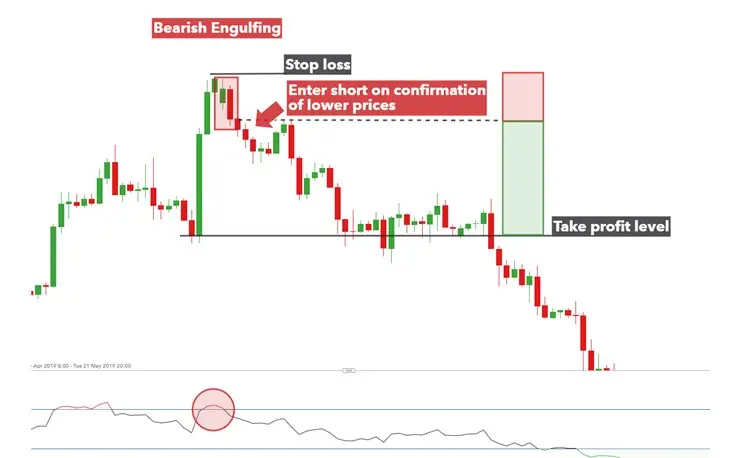
Entry point: The traders determines this once the engulfing candle has closed and the following candles confirms the trend has reversed. Some recommend waiting for the first candle after the engulfing candle to close as a confirmation before entering the trade, while others would considering waiting for a minor retracement before entering a trade.
Stop Loss: A stop loss can be placed above (or below) the swing high (or low) of the previous trend. Considering the engulfing candle is often a reversal at the high point (or low point) of the trend, the stop loss will likely be at most the high (or low) point of the previous candle or two.
Take Profit Level: This is more difficult to be assured of, as the engulfing candle gives no determined target. A trader can look for a previous support or resistance level and determine that for their profit target, or set a strategy risk to reward ratio and determine their levels from there.
The below image from dailyfx.com shows how to determine where to open your position while also where to apply the stop loss. This is the reversal strategy, and the risk to reward ratio is depicted by the green and red rectangles.
Engulfing Candle Trend Trading
With this strategy a trader applies the notion that engulfing candles do not always appear at the end of a trend. Instead, these patterns can appear within a strong trend and the trader can use it as a confirmation that the pattern is indicating a continued momentum in the direction of the existing trend.
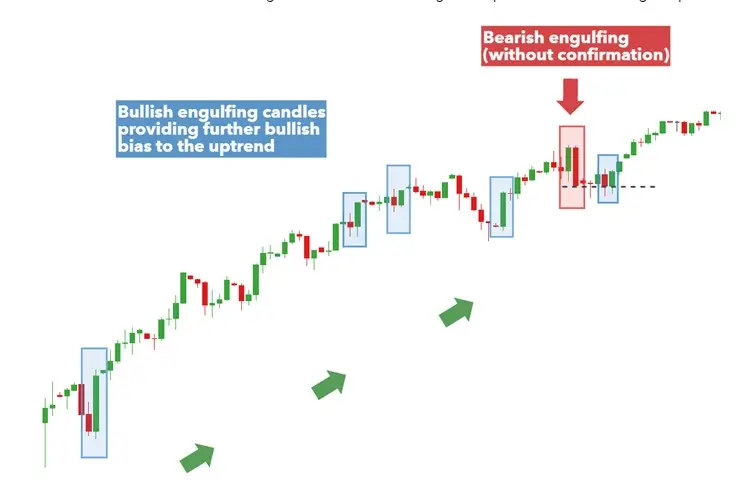
This pattern can appear multiple times, all in the direction of the existing trend, and they add more conviction to the overall strength of the trend. A trader can also note that a reversal pattern may appear within a litany of confirmation patterns, and it can be an indication that the trend is change or it can be a false indication. This can happen with a momentary shift in trading bias, before a continuation of the overall existing trend. This can be confirmed by the candles following the pattern not breaking above / below the engulfing candles open or close price. Therefore it is important to make use of the candles after the engulfing candle as confirmation.
The below image from dailyfx.com shows how a confirmation can be key in using the pattern, while a false pattern may emerge without a confirmation. The bullish engulfing candles during the uptrend are also a confirmation that the existing trend may continue for a trader. This is the trend trading strategy.
Risks of Using the Engulfing Pattern
It is important to have a clear trend, being an uptrend before a bearish engulfing candle, or a downtrend before a bullish engulfing candle. If the market is choppy in terms of the price action then the significance of the engulfing pattern is diminished since it is a fairly common signal. This is because the overall shift in momentum will not be a significant change when the market is choppy or ranging.
It is also important to understand that the second candle can be very large, meaning if a trader makes use of it for a stop loss that they can be in a bad position from it, meaning a trader should assess each engulfing candle on an individual basis on whether or not to apply a stop loss with the candles from the pattern. The potential reward from the trade may not justify the risk.
Figuring out where to close the trade can also be difficult with the engulfing pattern, as this candlestick pattern does not provide a price target. Traders instead need to make use of other methods such as trend analysis when selecting a price target or determining when to get out of a profitable trade.
These risks apply to both bullish and bearish engulfing candles.
Conclusion on the Engulfing Pattern
The engulfing pattern is a very important and easily recognisable pattern for traders. It often appears at the high point in a trend and can signify a reversal in the trend, although it is important to ensure a confirmation candle confirms this. An engulfing candle comes in both bullish and bearish forms, with the basic principle of the pattern being that a small candle is followed by a much larger candle which engulfs it. A trader with note whether it is a bullish or bearish engulfing candle, and also note whether or not it is a continuation of the existing trend when trading with it. The pattern is common and useful, although it provides no price target and therefore a trader should make use of other means for determining where they would take profit on a trade made from an engulfing candle. This can be through the use of other technical analysis, or through key support and resistance levels.
You can find the previous parts to the series here:
Chart Pattern - Part I - Understanding Candles
Chart Pattern - Part II - Doji
Chart Pattern - Part III - Marubozu
Chart Pattern - Part IV - Hammer / Hanging Man / Shooting Star
Chart Pattern - Part V - Spinning Top
If you would like to check out the previous series I did, which focused on Technical Analysis, you can find it here: Recap of the Technical Analysis Series - Parts I - XXV
Have a great day.
Peace. CryptoGod-1.
Referral links:
Publish0x - https://www.publish0x.com/?a=olejZqrzej
Binance - https://accounts.binance.com/en/register?ref=143611368
Medium - https://medium.com/@1r3n9project
NFT Market Sales
OpenSea - https://opensea.io/RNabc
Follow Me :)
Twitter - @RNabc123






