
Simon Erickson, 7Investing: “Ethereum has a lot of competitors. Do you think there is interoperability between blockchains? Or do you think that these are those “fat protocols”, where we’re using Ethereum as the go-to for smart contracts and using whatever other blockchain for a very specific application?”
Spencer Randall, CryptoEQ: “There’s a lot of layer ones being built. But if these ecosystems are siloed, how useful can they really be to the real world? But there have been projects created that are laser-focused on interoperability between blockchains. So when Ethereum started to really gain traction, I would say that some of the first steps with projects focused on interoperability started to happen. Projects like Polkadot and Cosmos are two projects focused on interoperability.
On top of projects that are dedicated specifically to moving between blockchains, you’ve also got projects like Cardano, which are launching with Ethereum in mind. So Cardano, you know, in an effort to increase adoption, increased traction with smart contracts going live on the 12th of September. With going live on the 12th, they’ve actually built out things that will allow people to roll over and migrate their Ethereum dApps and programming into the Cardano ecosystem, they call it an ERC 20 converter.”
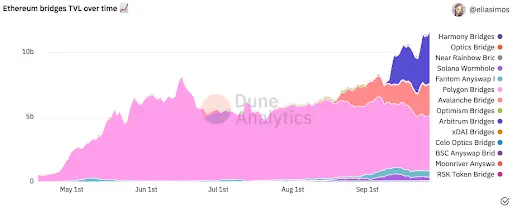
Interoperability between siloed blockchains has been a known problem for years in the crypto ecosystem. Only over the last six months have real solutions been brought forth, ranging from “bridge” to sidechains to competing Layer 1s (L1s). Alternative L1s are competing with Ethereum for liquidity and total value locked (TVL) while Ethereum gas prices remain prohibitively expensive for most use cases. A dashboard on Dune Analytics displays the current bridges to the Ethereum network like Polygon and rollups, Arbitrum and Optimism. As of September 28, 2021, there is ~$10B in TVL bridged from Ethereum to other networks, presumably looking for cheaper fees and/or higher yield. Polygon has received the biggest TVL bridged from Ethereum thus far (~$4.5B). However, recently launched Arbitrum is already in second place, having ~$3bn bridged over, despite being live for about six months less than Polygon.
Source: Dune Analytics
Other projects, rather than try and scale Ethereum, have built their own Layer 1 blockchains to compete with Ethereum and its smart contract use cases. Dubbed “Ethereum Killers,” Cardano, Solana, Avalanche, and Terra, are altcoins that look to improve upon Ethereum’s lack of scalability by tweaking the underlying technology. Since Ethereum has taken years to only begin to scale and transition to Eth2, other competing chains have gained traction due to cheaper fees.
Cardano is now the fourth-largest token in the world by market cap (~$70+ billion). The smart contract platform achieved this milestone despite not actually being able to execute smart contracts. However, the project launched its smart contract functionality on September 12, 2021, leading to its significant price run-up over the last month.
Additionally, Emurgo, the venture studio of Cardano, is investing $100 million to bootstrap and accelerate DeFi, NFTs, and education projects for the Cardano ecosystem to help it compete with other L1s that have seen significant growth in these sectors over the last quarter.
Cosmos, an interoperability blockchain aiming to connect Layer 1 projects, has taken a different approach and continues to grow everyday. There are now 12 zones connected to IBC and ~50 active channels to pass messages through between IBC-connected blockchains. There have been ~32,000 IBC transfers to-date (mainly through Cosmos and Osmosis).
Earlier this year, Cosmos released its Cosmos Hub Roadmap 2.0, aimed at enhancing key areas like liquidity, economic security, and usability. Included in the roadmap are two liquidity projects that focus on capital allocation and cross-chain token transfers.
Gravity DEX, which will allow users to swap digital assets across the network, is anticipated to be released in 2021 with a testnet launching in Q2 2021. The hope is that having a native DEX will help bring DeFi activity to Cosmos. The Gravity Dex Upgrade will create an Automated Market Maker (AMM) on the Cosmos Hub, similar to Uniswap on Ethereum. This will increase the on-chain transactions that the Hub will need to facilitate and provide more exchange fees for stakers.
The free flow of assets between chains will continue to expand with the launch of the secure decentralized Gravity Bridge that connects the Hub (and other Cosmos chains) to Ethereum and EVM-compatible chains. Gravity Bridge, an Ethereum-Cosmos bridge, is also planned for 2021. A proposal was passed in April 2021 which provides 100,000 ATOM to fund and develop the Ethermint project. Ethermint is a layer that runs atop Ethereum and is compatible with both the Cosmos and Ethereum ecosystems. Interchain Staking is planned for late 2021. A chain name service (CNS) is also planned for 2021. Staking derivatives are expected to be introduced in 2022.





