
Syncing the Bismuth Version 2 Blockchain from Scratch Has Gotten Easier with the Availability of the Bismuth v2 Snapshot
The Bismuth blockchain has come a long way since its inception in May 2017. Bismuth v2 is the latest iteration of the blockchain that has undergone a series of improvements and updates to make it more efficient and user-friendly. One of the challenges that users have faced while syncing the Bismuth blockchain is the amount of time it takes to download and synchronize the blocks. However, with the recent release of the Bismuth v2 snapshot, syncing the blockchain has become easier and faster.
The Bismuth v2 snapshot is a tar.gz file that contains the complete blockchain since the first block was mined on May 1st, 2017, up until February 2023. With this snapshot file, syncing the Bismuth blockchain becomes faster as users can download and import the blockchain data rather than waiting for the entire blockchain to sync from scratch. The Bismuth team has made this snapshot file available to make it easier for users to start using Bismuth and enjoy its benefits.
The Bismuth team has made significant improvements to the blockchain with the release of Bismuth v2. The core code has been consolidated, organized, and cleaned, making it easier to understand and maintain. The documentation has been improved, making it easier for developers to work with the code, structures, and custom architecture. The team has also improved functional isolation with the help of core modules, making it easier to test the blockchain with both unit tests on core modules and end-to-end tests using the local regmode.
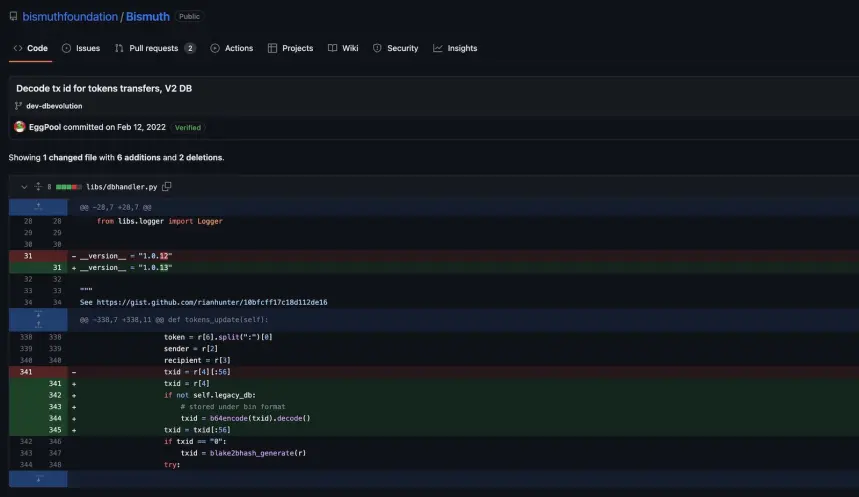
Another significant improvement in Bismuth v2 is the way amounts are stored. Amounts are now stored under integer format instead of decimals, which allows for a smaller ledger, faster balance queries, and no more complex rounding handling. This change has made the blockchain more efficient and faster. Signatures and public keys are stored as binary instead of hex, which means that less database space is required.
The startup sequence has also been fully reworked with "solo mode" on initiation, which means that users can run a Bismuth node on their own without having to connect to the network. This feature makes it easier for users to use the blockchain for their applications without having to worry about the network being available all the time. More sanity checks have been added at startup, making the blockchain more secure and robust.
Finally, the Bismuth team has reorganized and refactored the code under logical units, making it easier to understand and maintain. These changes have made Bismuth v2 more efficient, faster, and user-friendly.
In conclusion, syncing the Bismuth blockchain from scratch has become easier with the availability of the Bismuth v2 snapshot. This snapshot file contains the complete blockchain data since the first block was mined on May 1st, 2017, up until February 2023. Bismuth v2 has undergone significant improvements, making it more efficient, faster, and user-friendly. These changes have made Bismuth a viable blockchain for developers and users alike.
Link: Bismuth v2 Snapshot





