While it's cliché to say "they go together like X" to describe the sweetest, most endearing, enviable and nauseating couples, we can at least make the cliché itself less nauseating by being creative with what we choose for X -- and the list is long!
Do not use -- cliché on top of cliché:
- a wink and a smile
- sugar and spice
- two peas in a pod
- Romeo and Juliet
- peanut butter and jelly
Ok to use:
- copy and paste
- Nutella and anything
- Mentos and Coke
- Tom Hanks and a volleyball
- a quiet room and a fart
- bathtubs and a toaster
- alcohol and bad decisions
- breaking and entering
- toilet paper and #2
Ok, so my list went a little off the far end there. Anyhow, ume and shiso definitely deserve a place somewhere in either list. It is one of the most common flavour combinations is Japanese cooking. There's ume shiso onigiri, ume shiso pasta, ume shiso chazuke, ume shiso maki (which we'll make today) and you can even buy ume shiso paste in a bottle. (If Bubba were Japanese...)
But before you go becoming a nauseating "ume and shiso" couple, just remember that while umeboshi ("ume", which just means "plum", in most culinary contexts, is short for "umeboshi", which means "pickled plum") are red and round and cute, they are also extremely sour and salty. Shiso is the minty and cool one, although somewhat coarse. If you can't decide which of you is the ume and which is the shiso, it's time to re-evaluate your relationship. Or just disregard what a silly blog says.
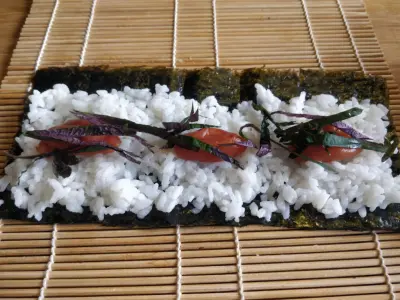
While ume shiso maki is the star of this show, its 2 sidekicks have no problem holding their own.
Kanpyo Maki
What can I say about kanpyo? It's not well known in sushi restaurants in the West, but it's one of my favourites. It's almost never on the menu and when I ask for it, 50% of the time they don't even have this ingredient. I've always associated kanpyo with a homey feel, but apparently it has a deep history.
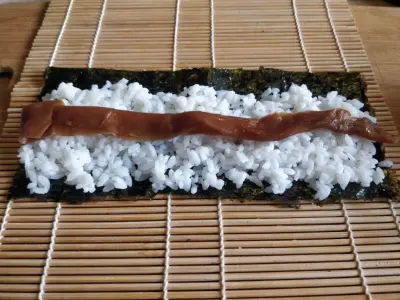
Perhaps my feeling comes from a scene in one of my favourite Japanese dramas Shota no Sushi, which is based on a comic by the same name. The drama follows Shota, a young sushi apprentice who decides that instead of learning the art of sushi making in his father's restaurant, he'll set off to learn in the most famous restaurant in the big city. This is a big deal, as continuing the family tradition is expected in Japanese culture. But with the blessing of his father, Shota, in this scene on the train to Tokyo, is eating the kanpyo maki his father made him which brings him to tears. Makes me want to cry too...and eat kanpyo maki.
I forgot how cute Takashi Kashiwabara is. I think I just moved a bit on the Kinsey Scale...
Oshinko
Takuan is pickled daikon which has one of the best "crunches" of any food. Takuan maki is called "oshinko". Another maki sushi that has a special name is "kappa maki", which is cucumber maki. "Kappa" means turtle, so I guess it makes sense because it's green. Or an alternative explanation I've heard which I prefer is that apparently turtles like to eat cucumbers. I'm not sure why some basic maki have their own name, but they do occupy a certain space in the sushi world. They tend to be preferred by children and ordered as a kind of kid's meal.
Be careful to enunciate properly when you order oshinko, because it's very close to another word, "oshikko", which means "pee pee". The bright yellowness of the takuan of course adds to the hilarity.
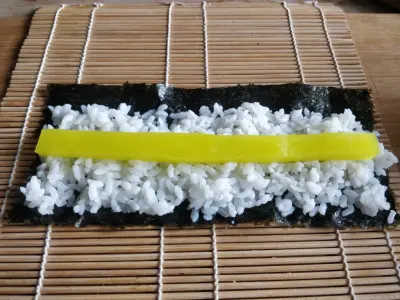
On that note, let's get rolling!
Ingredients
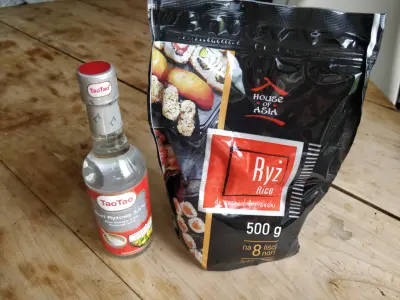
- 2 cups short grain rice -- It has to be short grain for the right stickiness and plumpness.
- 0.5 cup rice vinegar
- 3 tsp sugar
- 1 tsp salt
- 3 sheets of nori
- 3 umeboshi
- 2 shiso leaves
- 2 strands of kanpyo
- 2 strips of takuan
- gari -- Not your hip friend "Gary" and his "special" spelling -- it's the Japanese word for pickled ginger. (Has anyone hip ever been named "Gary"?)
- soy sauce
Method
Sushi Rice
- Cook the rice in your rice cooker. If you don't have one, buy one! They're extremely useful and versatile and a good one will last forever. You don't need to get a fancy one that talks to you about your problems or does your calculus homework -- a basic 1 button one will do. But whatever you do, don't do this.
- Mix the vinegar, sugar and salt until sugar and salt are dissolved.
- When the rice is cooked, leave it in the rice cooker for an extra 5 minutes so some of the moisture steams off.
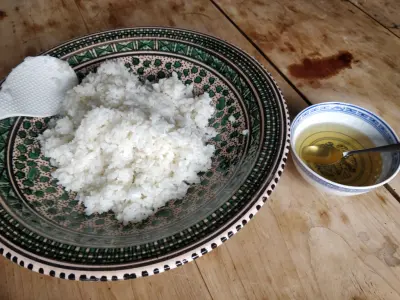
- Pour the rice into a wide dish. This will help it cool and help the moisture evaporate.
- Pour the vinegar mixture over the rice evenly. It helps to pour it onto your rice paddle. It's important to do this while the rice is still hot or it won't absorb the vinegar well.
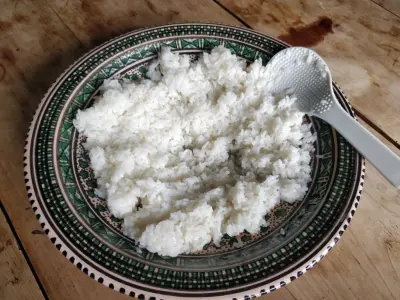
- Holding the rice paddle horizontally, mix the vinegar into the rice using a side to side slicing/fluffing motion. Try to be gentle and not break or squish the grains or else the rice will get mushy. Also try not to over mix -- it doesn't have to be perfectly mixed. Don't worry if the rice seems kind of wet. The vinegar will absorb into the rice and it will dry as it cools.
- Let the rice cool for 30-60 minutes.
Fillings
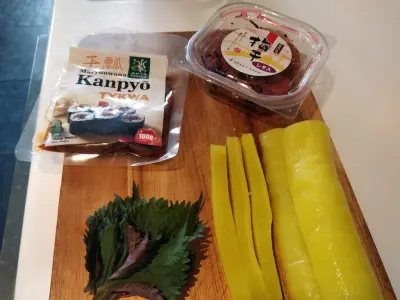
- Cut the umeboshi in half and remove the pit. Suck on the pit, then pucker up and kiss someone!
- Cut the shiso into thin slices.
- Cut the kanpyo to a length equal to the width of the nori sheet.
- Cut the takuan into 1 cm square prisms of length equal to the width of the nori sheet.
- We're making small maki, so cut the nori sheets in half. An easy way to do this is to fold them in half, then insert your knife in between the layers and cut it like you're opening an envelope.
Rolling
- Keep a bowl of water near to keep your hands wet. Otherwise, the rice will stick to them.
- Place a nori sheet on a bamboo rolling mat. If you don't have one, you can tie a bunch of chopsticks together. Just kidding. I'm not sure that would work, but it would be cool!
- Grab about a handful of rice and spread it roughly across the nori sheet.
- Gentle press the rice down until it is spread evenly, while leaving a 1 cm space at the top. Try not to mush the rice.
- Place 2 umeboshi halves evenly spread across the middle of the rice.
- Place some sliced shiso along with the umeboshi.
- Now the tricky part! While holding down the filling, roll the near side of the nori over while tucking in the fillings. Try to get the rice closer to you to touch the rice on the other side of the filling. Make sure the edge of the nori on the near side curls the correct way. You can tuck it in with your fingers.
- Once rolled, give the roll a light squeeze to make it a square shape.
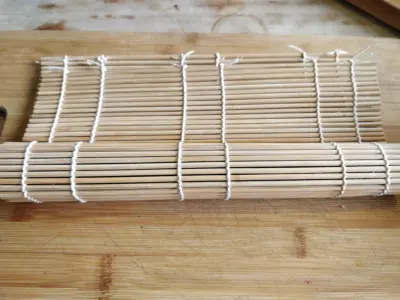
- Remove the roll from the mat and set it aside.
- I think you know what to do with the kanpyo and takuan. It might feel like a lot of work, but once you get on a roll, you'll be rocking. You saw that coming, didn't you? Rolling your eyes yet? I wonder how many of these I can roll into one bit. Should I just roll over and die? Somebody stop me already!
- Grab a roll (I have to use it this time!) and slice it in half. Line up the 2 halves and slice them into thirds. You'll want to wet your knife when you do this, otherwise it will stick.
- Plate your rolls with some gari and soy sauce. You can use wasabi if you like, although I feel like wasabi doesn't really go with non-fish sushi.
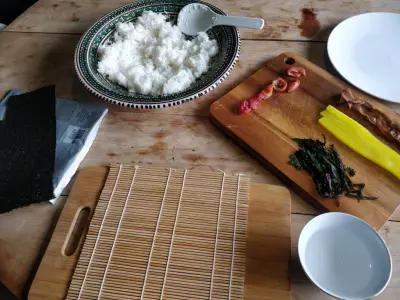
While most people will eat maki sushi with chopsticks, I've heard that maki sushi was invented so gamblers had something they could easily eat with their hands. If so, using chopsticks would be like eating a sandwich with a fork and knife?
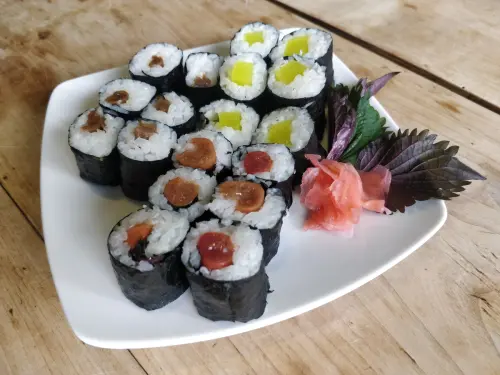
Following the Western restaurant influence of making "rustic" dishes, there's a trend in Japan to make "rustic" sushi, which I have done here. Not! (Doesn't that bring you back?) Japanese don't do rustic, they do precision and consistency. "Rustic" is a disguise for incompetence!
This post is getting really long, so...I'll just make it longer!
Onigiri
I first mentioned onigiri in my post about Japanese breakfast -- it's the humble homemade food that's great for using up leftovers, so that's what we'll do with our maki sushi leftovers!
There's this fancy word that fancy chefs in fancy restaurants use to describe this fancy thing that they do: deconstructed. It's when you take all the ingredients from one dish and assemble them in a different form. So actually, we're making "maki sushi deconstructed". Not so humble anymore, eh? And if you think about it, maki sushi is onigiri deconstructed. That would make onigiri "onigiri deconstructed deconstructed". But since onigiri is maki sushi deconstructed, we're actually making "maki sushi deconstructed deconstructed deconstructed". But...
And I wonder why this post is so long.
Ingredients
- leftovers from making maki sushi
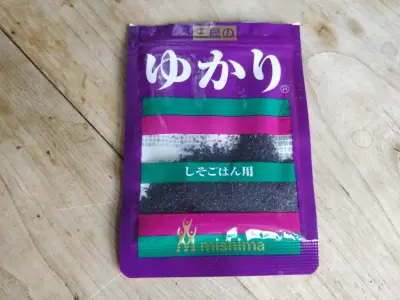
- furikake -- This is a seasoning mix very popular in Japan specifically for onigiri. They come in all sorts of flavours and the one I have is a shiso flavour.
Method
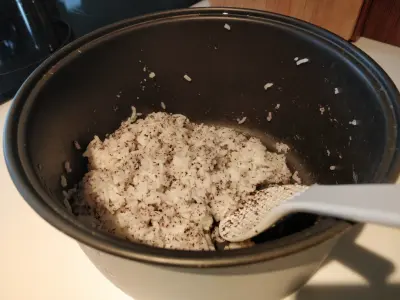
- Sprinkle the furikake liberally into your leftover rice and mix it evenly.
- Cut the umeboshi, shiso and kanpyo into small pieces.
- Like when making maki sushi, wet your hands so the rice won't stick.
- Take a handful of rice and form it into a ball.
- Press a hole into the middle of the ball.
- Fill it with some umeboshi and shiso.
- Close the hole.
- This part needs a little practice. Bend one hand into a sharp angle to squeeze one side of the ball into the point of a triangle, while simultaneously squeezing the sides with the other hand to flatten it. Rotate the onigiri (maki sushi deconstructed) and repeat to form the other points of the triangle.
- Repeat with the kanpyo.
- Wrap a piece of nori around the bottom of each onigiri.
- Takuan doesn't go so well in onigiri, so cut it into semi-circles as is customary for a garnish.
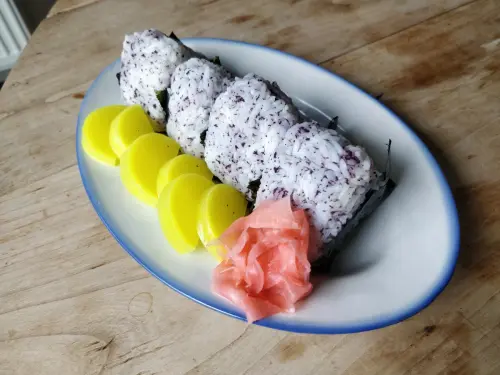
As you can see, my onigiri are also rather rustic. Hope yours turn out better!






