
I first discovered Japanese style breakfast while on vacation in Hawaii. I didn't know there were so many Japanese people in Hawaii, but it has a long history of Japanese immigrants.
I do love my scrambled eggs and hashbrowns and toast in the morning -- in fact one of my favourite breakfasts is the Big Breakfast at McDonald's (yes, I realize I just used the "M" word in a blog about food and culture, which is undoubtedly blasphemous and I have most certainly gotten myself excommunicated for liking it, but hey, #rebel) -- but Japanese breakfast takes a completely different approach. While western breakfasts are comforting while you eat them, eastern breakfasts are soothing and comforting in how you feel after eating -- they don't feel heavy.
Miso Soup
The only must have component of any Japanese breakfast is miso soup. The savoury warmth is an instant pickup in the morning. There are hundreds of varieties of miso soup and each region in Japan has its own specialty, but I think you could put almost anything you want in it. The one pictured above has kombu, wakame, and daikon. I think it is mandatory to top it with fresh green onions though, as it balances out the saltiness. Beside the miso soup is rice topped with lightly boiled edamame, green onions and katsuobushi, which is dried bonito fish shavings. The base of miso soup is, by the way, dashi, which is made by boiling katsuobushi!
Onigiri

Another common item in Japanese breakfast is onigiri which are rice balls (although they are typically triangles). The Japanese verb "nigiru" means to squeeze in the hand. Hence we have "nigiri sushi", the type with the fish on top of the rice, and "maki sushi" which is rolled. The prefix "o" in Japanese is often honorific, to denote something of importance, although the reality of onigiri is it isn't that glamorous. It's one of the things busy Japanese workers often grab on the go at any convenience store.
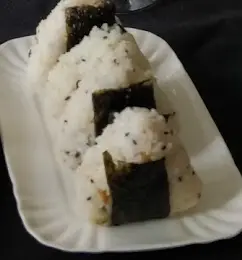
At home, it is most often what is made with leftover rice. And what do you do with the other leftovers? Roll it inside the rice ball! Like miso soup, there are hundreds of varieties of what can be inside. One of my favourites is tuna and mayonnaise. But then again, I do love my tuna sandwiches. Come to think of it, onigiri is pretty much the Japanese version of a sandwich in terms of form and functionality. In fact, it's often wrapped with a sheet of nori to make it more convenient to hold, as well as to add flavour and texture.
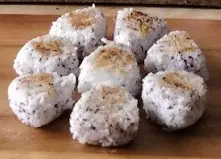
The rice is also often mixed with sesame seeds or other seasonings like shiso flakes. At the Japanese supermarket, there are hundreds of different little packages of seasoning you can buy for just this purpose.
But the ultimate is yaki onigiri, when the rice on the outside is toasted crispy. Just like sandwiches, toasted bread is better!
Natto
I would argue that the most Japanese thing is not ninjas or anime or even satoshi. It's natto! Natto is fermented soy beans and the smell is...intense. If anyone is eating it, you can smell it throughout the house. People who love it, really love it, to the dismay of those who don't who will run for the mountains. If you've never tried it before, it is definitely an acquired taste.
Before eating, it is stirred vigorously with a pair of chopsticks to make it frothy and its "strings" of stickiness are infamous -- you could probably stretch them across the room. You can tell if someone is an experienced natto eater by the way they expertly handle these strings with twirling motions of their chopsticks.
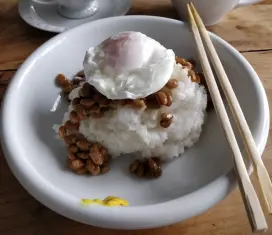
Most typically, it is served on rice with either a poached or raw egg and often accompanied by a bit of karashi, or Japanese hot mustard.
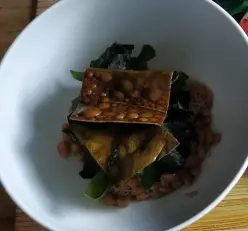
This is my version with wakame and topped with a few pieces of fried kombu.
Well that was a very brief introduction, but I hope to follow up in later posts with some actual recipes. じゃね! (Ja ne!)






