On November 12, 2026, Humanode told USDC holders on its EVM chain that the dollar they hold is being replaced. ChainPort issued the current USDC on Humanode when users bridged from Ethereum, and ChainPort backed it. The new one will come from Base through Humanode’s own Hyperlane-built bridge, backed one-to-one by USDC locked on Base. The new pools will use only the new token, so anyone holding the old one has to move it off-chain.
The ticker stays the same, but what stands behind it changes, and every holder gets homework. The team was candid about the old route, too: buying HMND meant bridging USDC through ChainPort, landing on Humanode EVM, swapping on a DEX there, and adding a wrapping step for anyone who wanted to stake.
That is the part of cross-chain moves most tutorials skip. Nobody wakes up wanting “to use a bridge.” The real job sounds like this: I have value on one network, and I need an asset on another network that the place I’m sending it to will accept, without turning it into a weekend project. Whether that asset arrives as a native coin or a wrapped representation determines how many steps you take and what you can rely on afterward.
Short answer. If you want the same token to keep working inside one ecosystem, a cross-chain bridge does the job. If you want the coin that actually lives on the destination network, such as BTC on Bitcoin or USDT on Tron, a swap that delivers the native asset is usually the shorter path.
Why assets don’t really “move” between chains
Blockchains can’t read each other’s ledgers. The Ethereum.org developer docs on bridges put it plainly: blockchains exist in siloed environments and have no natural way to communicate with each other.
So every cross-chain transfer is two separate events on two separate ledgers. Something happens to your asset on chain X, and something matching happens on chain Y. A bridge links those two events and decides what you receive at the end.
How a lock-and-mint cross-chain bridge works
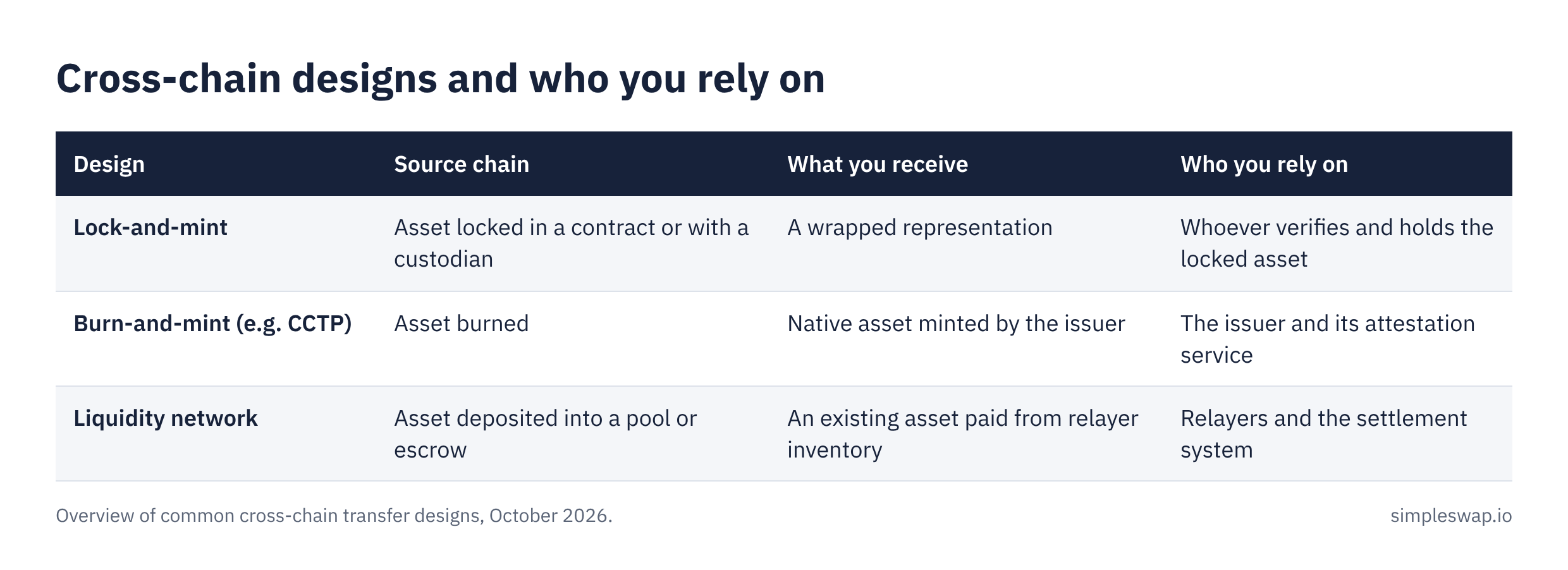
Lock-and-mint is the oldest bridge design and remains widespread among third-party token bridges. The flow has four steps:
Lock. You send a token to a bridge contract or a custodian on the source chain, where it is held.
Verify. The bridge’s verifiers, whether a validator set or a custodian, confirm the deposit.
Mint. A contract on the destination chain mints the same amount of a new token, representing what you locked, to your address.
Burn and release. To return, you burn the representation on the destination chain, and the bridge releases the original on the source chain.
Wormhole’s documentation describes wrapped token transfers in these terms: assets are locked on the source chain, Wormhole mints wrapped “IOU” tokens on the destination, and burning those tokens unlocks the originals.
Wrapped Bitcoin (WBTC) shows the custodial version of the same idea. A user goes through an approved merchant; the BTC goes to the custodian, and after the Bitcoin transaction gets six confirmations, WBTC is minted on Ethereum. On redemption, the merchant burns WBTC, and the custodian waits for 25 Ethereum confirmations before releasing BTC.
Two other bridge designs worth knowing
Burn-and-mint (issuer-native). When the token issuer controls minting on every chain, nothing needs to be locked. Circle’s Cross-Chain Transfer Protocol (CCTP) burns USDC on the source chain, Circle’s attestation service confirms the burn, and native USDC is minted on the destination. Circle’s docs on finality and block confirmations list Standard Transfer at 15 to 19 minutes on Ethereum and L2S, while Fast Transfer settles in seconds on most routes for a fee that Circle’s CCTP fee table sets by source chain. This only works for assets whose issuer runs it. Chainlink’s Cross-Chain Token Standard gives token issuers a similar choice between burn-and-mint and lock-and-release pools.
Liquidity networks and intent-based bridges. Here nobody mints anything for you. You deposit on the source chain, and a third party pays you out on the destination from its own inventory. Across Protocol’s docs explain that relayers front their own capital on the destination chain and get reimbursed later through settlement. You receive an asset that already exists on the destination chain, but only for the tokens and routes where that liquidity is available.
Wrapped token vs native: what’s the difference?
A wrapped token is a token on one chain that represents an asset held elsewhere. A native asset is issued directly on its own chain, either by the protocol itself (BTC on Bitcoin, SOL on Solana) or by its official issuer (Circle’s USDC on Arbitrum, Tether’s USDT on Tron).
Same-chain wrapping is a different thing
WETH is a wrapper, but not a bridged one. Ethereum.org describes WETH as a contract that takes ETH and mints an ERC-20 token for the same amount. It exists because ETH predates the ERC-20 standard many apps expect. You can unwrap it on the same chain, and you still pay gas in ETH. Bridged wrapped tokens like WBTC on Ethereum depend on something outside the chain you are using: a custodian, or a bridge on another network.
The differences that matter in practice
Who stands behind it. Native USDC is issued by Circle. Circle’s own explainer on USDC vs USDC.e says third parties that move dollars between chains issue USDC.e, not Circle. A wrapped token is a claim on the locked original, so its value rests on whoever holds that original. The Humanode case above follows the same logic: one USDC was backed through ChainPort, the next one through USDC locked on Base.
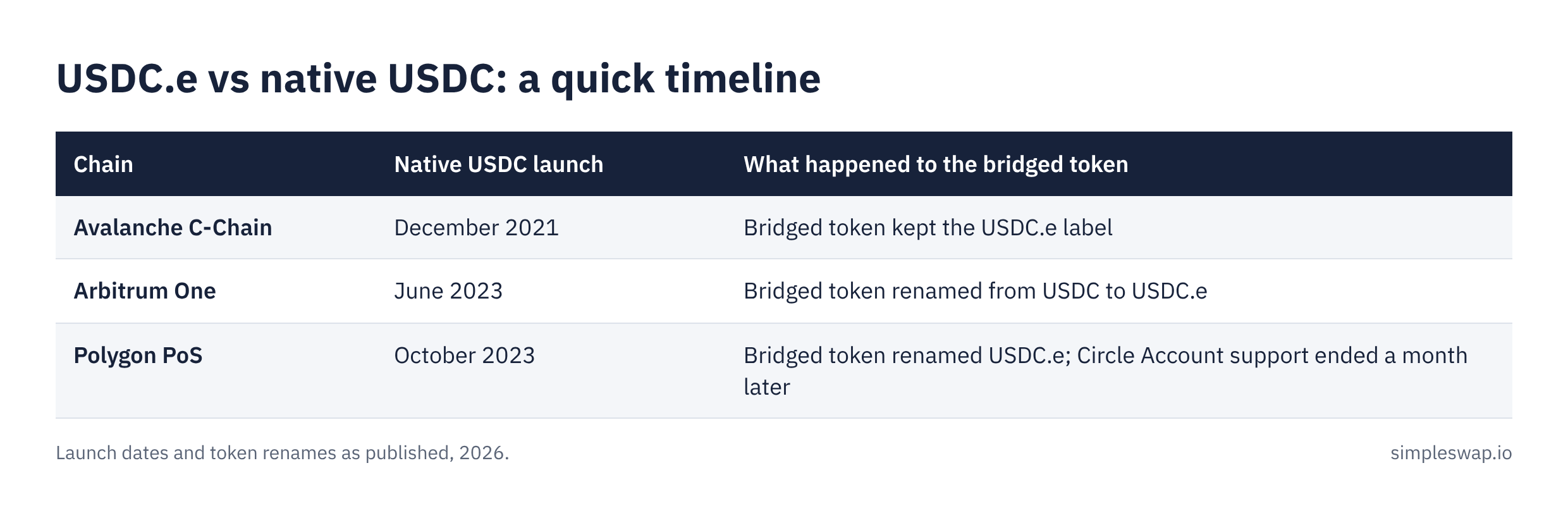
Different contract addresses. On Arbitrum, native USDC and bridged USDC.e live at two different addresses. Same ticker family, two different tokens.
Several versions of one asset on one chain. Avalanche’s support center lists bridged tokens such as USDC.e and WETH.e alongside native assets. Each bridge can create its own representation, so a single chain can carry several “USDC” tokens that are not interchangeable at the contract level.
Not every venue accepts every version. When native USDC came to Avalanche, Circle stated that its products do not support USDC.e. On Polygon PoS, Circle ended deposits and withdrawals of bridged USDC.e in Circle Account a month after native USDC launched, and warned that USDC.e sent there afterward may not be recoverable.
Liquidity splits. Two versions of one asset means two sets of pools. Optimism’s documentation for the Bridged USDC Standard notes that bridged and native USDC lead to fragmentation, which is why Circle designed the standard so a bridged token can later be upgraded in place.
Price can drift. A wrapped token tracks its underlying through redemption and arbitrage. If the redemption path is slow or liquidity is thin, the representation can trade slightly away from the original.
Getting back takes steps. Circle’s guidance for USDC.e on Avalanche was to unbridge it back to Ethereum through the Avalanche Bridge first, then deposit native USDC.
USDC.e vs native USDC: a quick timeline
When a bridge makes sense
A bridge is the right tool in these cases:
You keep the same asset in one ecosystem, for example, moving ETH from Ethereum to an L2 through that network’s official bridge.
A DeFi position needs a specific token contract, and the bridge provides that version.
The issuer runs its own transfer rail. Moving USDC between CCTP-supported chains gives you native USDC on the other side, not a wrapped copy.
You already hold gas on the destination chain and don’t mind confirming a second transaction to claim or redeem.
When a swap into the native asset is simpler
A swap that pays out the native asset on the target network tends to win in these situations:
You want the real coin, not a representation. USDT on Tron is officially issued: Tether lists Tron among its supported protocols.
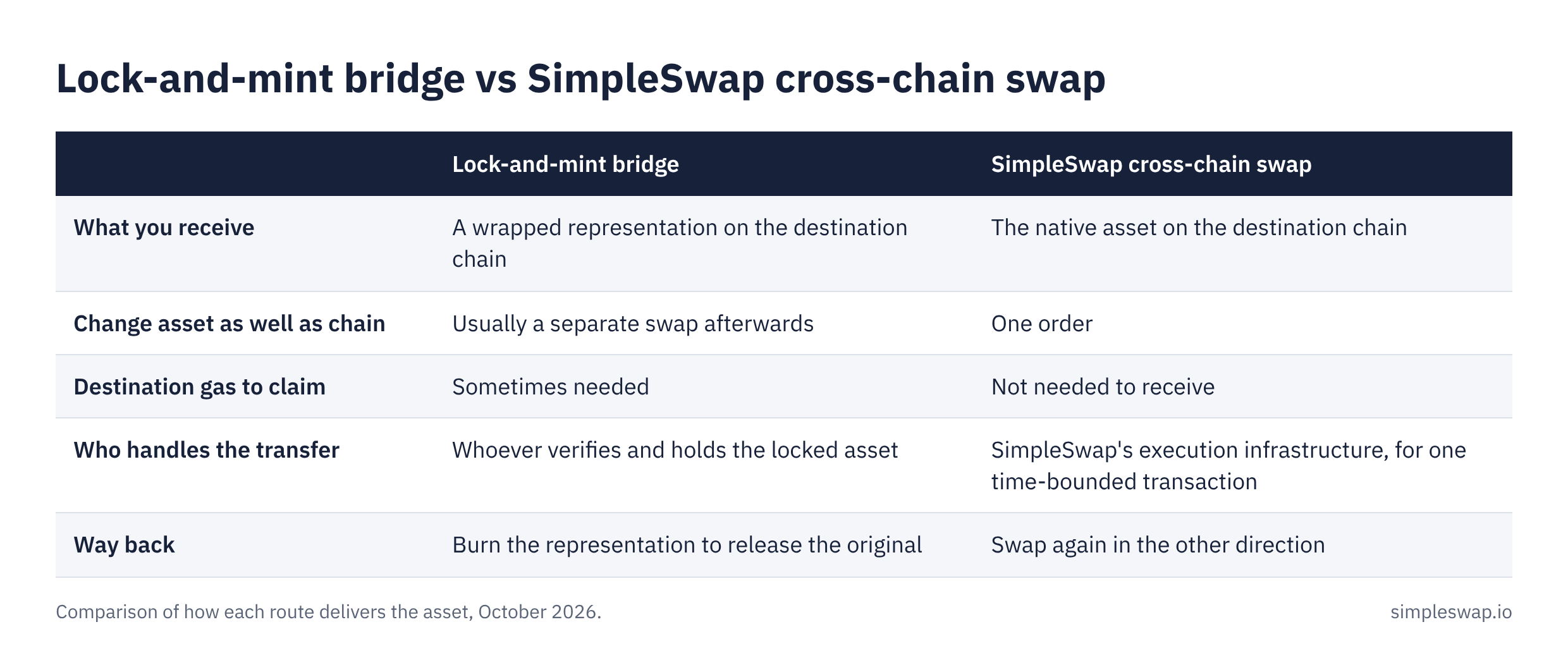
You have no gas on the destination chain. Some bridge routes need a transaction on the destination to finish. Wormhole’s manual route requires one transaction on the origin chain and another on the destination. If the swap delivers the destination chain’s own coin, that coin is your gas.
You want to change the asset and the chain in one step. Bridging from ETH on Arbitrum to SOL on Solana usually means bridging, then swapping, often with a wrapped token in between. A cross-chain swap does it as one order.
The asset can’t be locked in a contract on its home chain. Bitcoin’s scripting language is too limited to run the kind of contract an EVM bridge relies on, so WBTC depends on a custodian and approved merchants.
The destination expects the native asset. Wallets show native coins by default; other tokens must be added by contract address, and exchanges may credit only one version.
Crypto bridge vs swap: where SimpleSwap fits
In practice, SimpleSwap is also a bridge: you send asset A on chain X and receive asset B, or the same asset, on chain Y. The difference is what arrives. SimpleSwap delivers the native asset on the destination network straight to your wallet, so you don't need to claim anything with destination gas or unwrap it later. A wrapped token arrives only if you choose it as the output.
It is not a smart-contract bridge. Your deposit passes through SimpleSwap’s execution infrastructure while the swap is processed, and the output is sent from there to the address you provided.
How a swap works on SimpleSwap:
Choose the pair you are sending and receiving.
Pick a rate type. A fixed rate locks the price for 20 minutes; a floating rate follows the market at the moment of execution.
Enter your receiving address and confirm the network.
Send your deposit to the unique deposit address generated for that swap.
After the required confirmations, the swap is routed through the optimal provider, and the output is delivered to your wallet.
What sits behind it. SimpleSwap describes itself as a self-custodial, multi-source swap aggregator and has operated since 2018. It aggregates liquidity from 20+ CEX and DEX providers and supports 2,800+ assets across 3.2M+ trading pairs, including assets on newer ecosystems like Sui and Base. It keeps no long-term user balances: trust is tied to a single transaction, and funds move from one wallet you own to another you own. Its swap engine is also integrated into 6,000+ partner products, including Exodus and Tangem.
Cost and timing. Fees are bundled into the quoted rate. The service fee starts from 0.2% and may vary by pair, liquidity, market conditions, and loyalty level. Blockchain network fees apply separately. On fast networks like Solana, swaps usually complete in under a minute; Bitcoin and Ethereum swaps usually take 10 to 30 minutes, depending on congestion. Most crypto-to-crypto swaps need no account. KYC may be required for transaction security and compliance.
Your part. Check the receiving address and select the correct network before you send. Confirmed blockchain transactions cannot be reversed.
A short checklist before any cross-chain move
Confirm the destination network and the token contract address, not just the ticker.
Check whether the receiving wallet or exchange accepts that exact asset version.
Decide whether you need gas on the destination chain to use what arrives.
For a first transfer on a new route, send a small amount before the full sum.
FAQ
What is the difference between a crypto bridge and a swap?
A crypto bridge moves the same asset from one chain to another, often by locking it and minting a wrapped representation on the destination. A cross-chain swap exchanges one asset for another across networks and can deliver the native asset on the destination chain in a single order.
Is a wrapped token the same as the native asset?
No. A wrapped token tracks the value of the original, but it is a separate token with its own contract, backed by an asset held by a bridge or custodian. The protocol or official issuer issues the native asset directly on its own chain.
What is the difference between USDC.e and native USDC?
Circle issues native USDC directly on a chain. USDC.e is bridged USDC: USDC locked on Ethereum and represented on another chain by a bridge. They have different contract addresses, and some services, including Circle’s own products, accept only native USDC.
Do I need gas on the destination chain?
For some bridge routes, yes, because claiming or redeeming requires a transaction on the destination chain. With a swap that delivers the destination chain’s native coin, you can use the coin you receive to pay for later transactions.
Is SimpleSwap a cross-chain bridge?
In practice, it works as one: you send an asset on one network and receive the native asset on another, wallet-to-wallet, in one time-bounded transaction. It is not a smart-contract bridge and doesn't mint wrapped tokens; SimpleSwap’s execution infrastructure processes the swap.
This article is for educational purposes only and is not financial advice. Fees apply; current details are on the website. Service availability is subject to SimpleSwap’s Terms of Use and may be limited by jurisdiction. SimpleSwap’s only official domain is simpleswap.io.