
A virtual/phantom seed or mnemonic is a seed or mnemonic, which does not exist in the real world most of time. For this reason it can not be damaged, stolen, hacked, broken, confiscated, etc. when it does not exist in the real world.
Virtual/phantom seeds or mnemonics are useful for defense/protection of crypto assets from hackers, thieves, misfortune, natural disasters, etc. The most typical use cases are: private key loss conundrum (see [1]); avoiding confiscations or hacks of private keys from physical or electronic devices; avoiding confiscation of private keys during searches in airports, checkpoints, border crossings, etc.; avoiding restrictions or confiscations from abuse of laws, administrative errors, etc.
New law grants US president power to block digital asset access (see [2]). If some analyst, computer program, AI bot, marks your transaction as suspicious, your access to you digital assets can be blocked if you use proprietary hot/online/software or cold/hardware crypto wallets. To avoid such type of problems you should use virtual/phantom crypto wallets (see [3]) or open source software wallets (see [4]) with virtual/phantom seeds or mnemonics.
In this post, we consider how to create virtual seeds or mnemonics for bitcoin crypto wallets, using a dynamical passwords generator and a special converter.
On the first step, a dynamical passwords generator (DPG) is used to generate super strong passwords/strings from easy to remember parameters (key and date). On the second step, a virtual key is created from those passwords. Only a user knows how to create the virtual key. On the third step, a converter is used to convert the generated virtual key into a virtual seed or mnemonic.
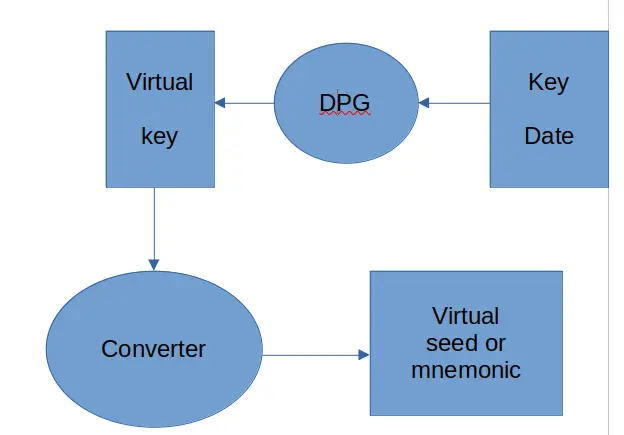
Let us consider an example. As easy memorable inputs, we select Taylor Swift’s name and birthday (December 13, 1989)
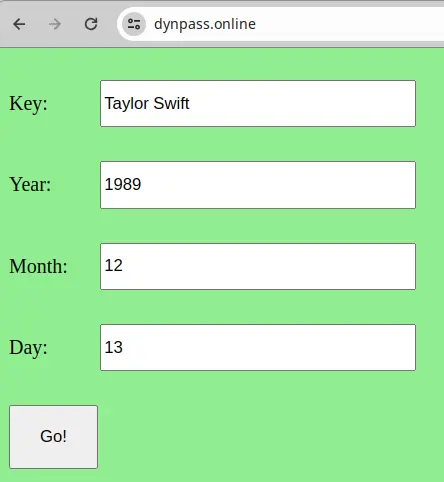
Step 1. As a DPG we use dynpass.online. We enter Taylor Swift as a key and her birthday as a date and click on the “Go!” button. For security reasons, it is recommended to use private DPGs, instead of public DPGs on this step.
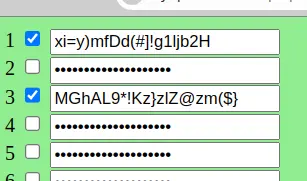
Step 2. Now, from the 20 output strings we select 1st and 3rd (digits of the day of the birthday) and combine them to form a virtual key: xi=y)mfDd(#]!g1ljb2HMGhAL9*!Kz}zlZ@zm($}. A user can use any other rule or rules to construct her/his virtual key. Only the user knows this rule, therefore only the user is able to reconstruct the virtual key.
Step 3. We use this converter https://dynpass.online/demo/bw/conv/btc/btc_conv.html to create a virtual seed or mnemonic for BTC wallet. For security reasons, it is recommended to use an offline converter.
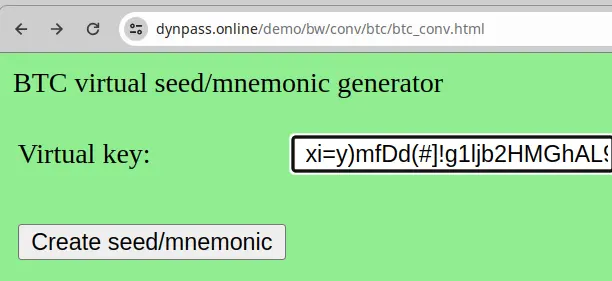
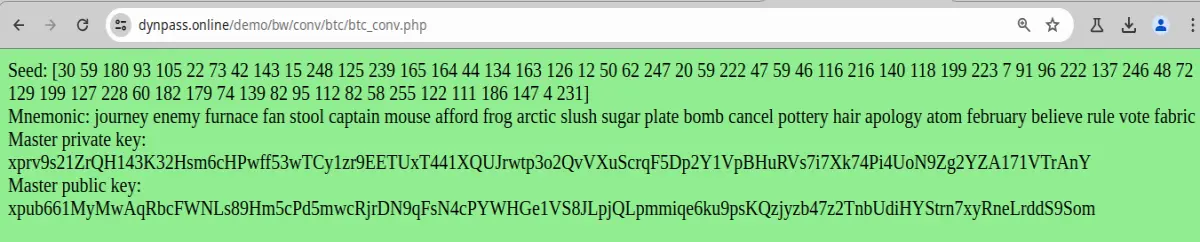
With this virtual seed or mnemonic we can reconstruct our bitcoin wallet and make some transactions. After that, we secure delete/destroy the wallet and all info (seed, mnemonic, private and public keys). Now, there are no our seed/mnemonic/keys and the wallet in the real world.
This method can be used for creation and reconstruction of other crypto currency wallets, as well.
Over 55% of hacked digital assets were lost to private key leaks during 2023, according to Merkle Science’s 2024 HackHub report.
References:
[2] https://cointelegraph.com/news/new-us-law-block-digital-assets
[4] https://www.securities.io/best-open-source-wallets/





