
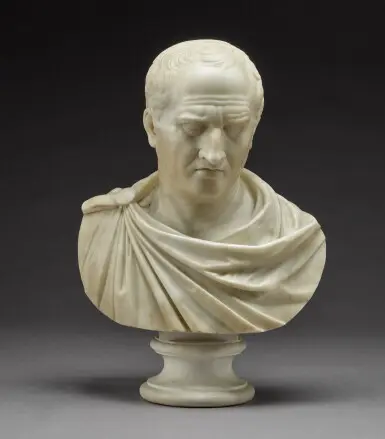
Cicero
From now on I was ignorant of what was happening to the rest of the world. But I guess it followed pretty much the events occurring in Oakland. When I began to wander the world a decade later, I could see that the outcome in coastal cities was everywhere the same. From now on our eyes and ears were focused, by necessity, on our local religious leaders. Each day the people were lectured and tasked and directed in their civic duties, mostly upon errands of destruction, since it was taken as a rule, that to build a glorious new world, we first had to tear down the old one.
Just one week prior to the demise of television the riots took place in which the books were burnt. A few days later hospitals were condemned. By a general order they were raided and their sickly residents taken away. Now the sick were free of being administered useless medicines, and were set out in the cold, open air to receive the balm of inspired oratory. The equipment, the medicines and even some of the doctors and nurses were thrown out the windows and burned. This was one of the last sanctuaries of science. All that was left was firmly in the hands of the Church and earmarked for destruction as soon as it ceased to aid them in their savage purposes.
When society had been cleansed of public evils it was time to tackle the private ones. A systematic search of all houses began, so that every home could be completely purified. I was in my own domicile at the time, still in shock over the recent rape of my books at the university. From the brutality I’d been seeing, I didn't hesitate to answer the knock on my door. Indeed, I half expected their coming.
In fact, in a brooding moment the day before I’d carefully packaged up all that remained of my precious manuscripts and books and buried the lot of them in my back garden. When my zealous brothers came in, I even assisted them in clearing my shelves and closets and drawers of every sinful color. Electrical appliances, dark pans and decorated plates were carted away to the garbage trucks waiting outside, and as they finished, I pointed out the watch on my wrist which they’d forgotten to confiscate. I bid them goodbye with a wave and an ironic smile, as they headed for my neighbor's house.
Fortunately my easy chair was white. It was all I had left, besides a mattress, a few white clothes, a few cans of food, and a small, white, marble bust of Cicero that was left staring at me from my white mantle. It was a thing to contemplate in an empty room, and so I sat there and thought about it late into the night. I wondered why they’d left him there, such a maker of books, and such a representative of culture. Obviously, they didn’t know what they were doing, these workers in white, and I wondered long and hard on where this madness would end.
I brooded and dozed to uneasy dreams until I heard a bullhorn in the street the next morning, commanding one and all to attend a general meeting, where instructions and food cards would be given out. I fell in with my neighbors all heading to a nearby park, and never saw my home again. At the park we were divided into rows by age and sex and questioned one by one as to our former professions. The business was quickly transacted. At the first table each was asked a few questions, then handed a card from a set of shapes and directed to another post for more instructions.
When my turn came, I answered the rude question of the officer with one word, "philologer." He didn’t seem to understand it, or relish my tone and gave me a card that I later found out meant the lowest classification possible. I found myself in a line with older women and men, and some who looked very sick and lame, a motley crew. We were told we were part of a "nutrition corps" at a downtown center. We were taken to a refitted office building and lodged in the small cubicles in groups of four.
Then began a drab, daily routine of rising for services early each morning, spending the day in a basement, a huge cafeteria, cleaning vegetables for soups, dishwashing through the afternoons and evenings, and finally retiring to my bunk, dead tired, with the three other almost speechless, old gentlemen who shared my sad room, and my sadder life.
This dismal cycle went on and on for the next two years. What I gathered of the world was heard through the bars of our basement window, which was set right above my workstation, looking out at the sidewalk of a main avenue. Besides what I sometimes overheard from the street, there were the official announcements at the services. Idle talking in our kitchen was forbidden.
Most of those I worked with lived in a sort of shell-shocked state, waiting for the end. Many found it, being older than myself and more a prey to the plague. They were taken away at the first signs by the daily inspectors who visited us. Replacements were brought in the next day and I sometimes gleaned a little news from them in low whispers.
One thing I couldn’t help notice was the rapid regimentation of our world. It was not four months before we were issued long, white uniforms with hoods, and I saw that everyone on the street wore a slight variation of this new clothing weeks before us. All but our aluminum pots and utensils had been removed and we were scolded whenever they were not brightly scoured.
I got my first sight of "lickers" one morning when a band of thirty of them went through our kitchen on their hands and knees, examining every odd corner and underside of the shelves and tables, licking and spitting their white paint with concentrated focus. One came crawling right between my legs as I washed vegetables and lifted up my feet to see if the bottoms of my sandals had been properly bleached.
Our sleeping quarters were also standardized. Wooden cots were brought in to replace metal ones. I wondered at this, since both types had been painted white, until I noticed that the wood wasn't just painted, it was white through and through, so that you could chip it and not change the color.
Besides our cots, our room contained a small table with a washbasin and a large can of white skin ointment. We had our sheets and towels and spare clothes and a shelf to hold them, but nothing else, except later in the year we returned from work one night to find a strange white box hanging on the wall. It had a little door to it and inside was a sheet of white paper, framed in white wood. We decided that it must be a shrine of some sort and paid no attention to it thereafter.
We had to eat standing at our posts and only attended the morning services, not the evening, because it was too much trouble to interrupt our work at that hour. But on certain, rare days our cafeteria was closed and we were led along with everyone else to the coliseum, now totally whitened, to listen to inspirational speeches, usually by visiting dignitaries. Afterwards there were parades to watch, no longer colorful, but with them bands playing marching music, delightful to our starving ears.
There were also contests with young athletes, races and jumps and pole-vaulting, though they were hard to follow visually, with so much white on white. I’d heard that other sporting events had been attempted, attended by those of higher rank than us. But one by one they were quietly discontinued. They all proved impractical. They were replaced with the shows we now saw.
I heard that there had been baseball games, but the whiteness of the field ruined the players performance. They tried to vary it, because, in the first months, the Church was eager to please its new converts. To give the players a better chance at hitting and catching, they added a loud buzzing mechanism in the ball, and renamed the game "buzzball". This seemed to work at first, though scores were tenfold what they had been. But soon a debilitating ringing developed in the ears of most players, leaving them more inept and off balance than ever. Our monochrome world was simply not geared towards feats of hand-eye coordination.
But even in these dire times, people could not live entirely without entertainment. Songs and chants became popular at the gatherings, along with speeches and parades by the various new guilds and work groups. Workers who had performed exceptionally well were led up to a stage and presented with silver emblems they could pin to their chests and show off as a mark of merit. For the most part the Church simply tried to keep everyone constantly busy, so that they wouldn’t have time to think about what they missed.
last post ...






