In this exciting era of re-designing and re-architecting the connected world, inventor of the World Wide Web Tim Berners-Lee has been working on a project that "aims to radically change the way Web applications work today, resulting in true data ownership as well as improved privacy by developing a platform for linked-data applications that are completely decentralized and fully under users' control rather than controlled by other entities." Becoming increasingly dismayed at seeing his invention being abused in all sorts of ways (by governments and big tech, among others), Berners-Lee felt that the Internet is in urgent need of repair and conceived of the Solid project as a (open source) step in that direction. Solid is actually very similar conceptually to Urbit and Holochain. Decentralized peer-to-peer networking is meant to be implemented in a way that adds more control and performance features than traditional p2p protocols such as BitTorrent. The central focus of Solid is to enable discovery and sharing of information in a privacy preserving way.
Linked-data as a kind of ontology format for expressing relationships between things (data) is central to this (and to things like the digital humanities). It allows for asking questions which bridge across different disciplines and other such fascinating general capabilities which we're also in urgent need of today. Renowned security expert and cryptographer Bruce Schneier has also joined the project.
Initially starting out at MIT, Solid has been transitioning from a research project into a startup-backed ecosystem(since in research once you produce a proof of concept/prove something works, you have to move on). Solid's mission is to reshape the relationship people have with data and the applications they use.
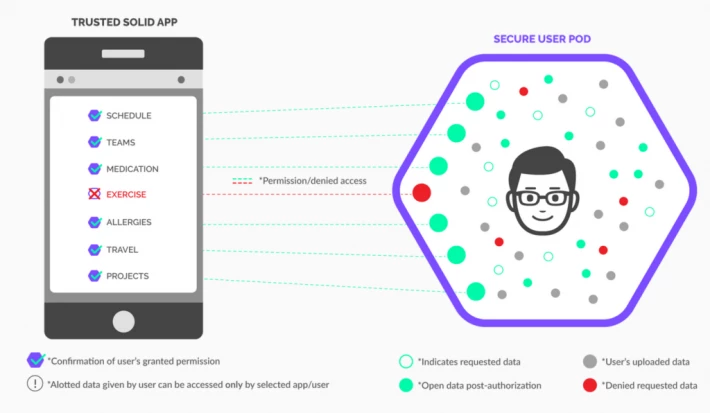
Central to this is the idea of a pod — a personal cloud server and data storage (again, similar to Urbit in that sense). You are allowed to store your data wherever you want, choosing which piece of data you create resides where. This creates a very different world from the one we have today.
Solid is not a company or an organization, neither is it just software, but rather an ecosystem (or standards enabling interoperability), a movement (of shifting app builders' mindset) and a community (of different people, companies and organizations which make use of it).
Solid clients are browser/native apps that read/write to your data pod— and you give various apps the permissions (or permissions to friends) with apps delivering a unified experience instead of a the siloed world of fragmented digital feudalism we have today.
Inrupt is the startup dedicated to accelerating Solid development — it maintains common ecosystem building blocks open source, creates tooling for developers and offers various services and apps.
"People think RDF is a pain because it is complicated. The truth is even worse. RDF is painfully simplistic, but allows you to work with real-world data and problems that are horribly complicated."
— Dan Brickley & Libby Miller
Anyone can build or host software for Solid — the Solid server acts as a data pod that stores and guards your data, it's really a regular web server but with support for access control and Linked-Data. It is application-agnostic, so one can build any app and the application-specific logic resides in the client.
There are two Solid server prototype implementations right now that can be found at solid.community and inrupt.net.
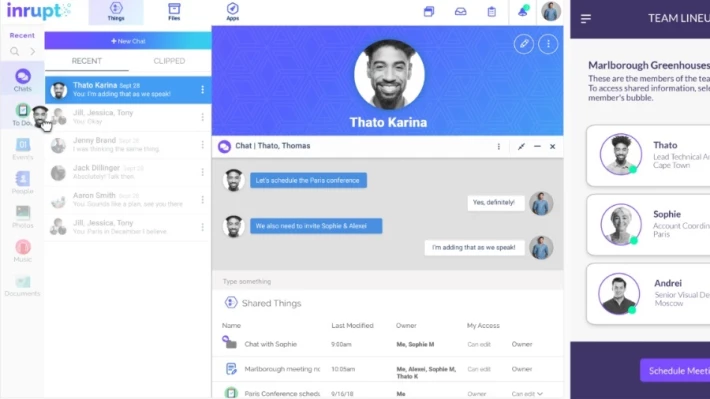
Solid is so conceived that decentralized p2p apps have may have many back-ends and back-ends may work with many different apps at the same time (meaning, it adopts more of an ecosystemic thinking, rather than strictly engineering one, much like Holochain does). The interoperability challenges have been solved through linked data in RDF (the Resource Description Framework, part of the Semantic Web concept, another one of Berners-Lee's earlier ideas). The logic is such that you can keep your data, but re-use apps. Integrating data from multiple pods (since apps may need to harvest data from a number of places) is solved that way (Linked-Data and RDF)— with JSON-LD every piece of data on the Web can link to any other piece of data (connecting data from disparate and diverse places on the web together through a grammar/syntax of meaningful relationships).
The old way of working with RDF following the old way of JSON APIs: gather input data -> send specific API call to the back-end -> parse response as JSON -> traverse JSON tree structure and finally update the DOM. LDflex is provided as a domain-specific language (DSL) for Javascript designed to provide simple and straightforward accessto data in Solid pods through LDflex expressions — you can read more about it here.
The philosophy is such that simple things must be simple and complex things — manageable. And managing organizational complexity and effective sense-making are really the fundamental problems which currently emerging technologies are trying to address and come up with a lasting solution to.
As I said, it's very similar conceptually to Urbit and Holochain — on one hand in how Urbit too is about overlaying the existing Internet and providing this calm, personal autonomous space where you choose what connections and associations to allow and how. And on the other hand similar to Holochain (as Urbit) in its agent-centric model, but also the semantic aspect of how meaningful associative connections are branched out in this growing, massive DAG topology and in its semantically composable and creative aspect which is meant to facilitate collective intelligence and sense-making at scale, discovery of new patterns of collective organization in the process, but also, Holochain stands out with its concept of currencies as "current-sees"— a concept which isn't as widely known (except some specific places, like for example Japan). Either way, both Solid and Holochain put a lot of emphasis on ontology engineering and expressive/grammatic capacities, while Urbit is more focused on minimalism, calmness and autonomy. What all three share, however, is how there cannot be any anonymity. You are you and you cannot escape from that — just like in real life. There is distinction between your private and your public space, of course, and your private space is private. And you do have full autonomy of what takes place and how you manage your data, but again, you cannot impersonate somebody else or stay anonymous.
On a somewhat related note, for a number of years now I've been really into/following so-called cliodynamics as an area of trans-disciplinary research. As defined by Wikipedia:
Cliodynamics (/ˌkliːoʊdaɪˈnæmɪks/) is a transdisciplinary area of research integrating cultural evolution, economic history/cliometrics, macrosociology, the mathematical modeling of historical processes during the longue durée, and the construction and analysis of historical databases.[1] Cliodynamics treats history as science. Its practitioners develop theories that explain such dynamical processes as the rise and fall of empires, population booms and busts, spread and disappearance of religions.[2][3] These theories are translated into mathematical models. Finally, model predictions are tested against data. Thus, building and analyzing massive databases of historical and archaeological information is one of the most important goals of cliodynamics.[4]
Cliodynamics research makes extensive use of and continuously builds upon and expands a global history databank called Seshat. I've previously made a cliodynamics-associated post with the title of the paper in question, "A History of Possible Futures: Multipath Forecasting of Social Breakdown, Recovery and Resilience". Seshat is structured in the above mentioned RDF format (the entire database downloadable in RDF here, too). Conceptual modeling and knowledge representation (sometimes also referred to as ontology engineering) is central to what is now referred to as the digital humanities:
Digital humanities (DH) is an area of scholarly activity at the intersection of computing or digital technologies and the disciplines of the humanities. It includes the systematic use of digital resources in the humanities, as well as the analysis of their application.[1][2] DH can be defined as new ways of doing scholarship that involve collaborative, transdisciplinary, and computationally engaged research, teaching, and publishing.[3] It brings digital tools and methods to the study of the humanities with the recognition that the printed word is no longer the main medium for knowledge production and distribution.[3]
So, pushing for and realizing these trends and tendencies of the ongoing technological revolution will have the side-effect of making access to a lot of information, knowledge and even wisdom public and make a lot of currently hidden and proprietary technologies (as concealed behind what we do online and otherwise geared and targeted against us, in exploiting and manipulating us, in controlling our emotional response, in extracting behavioral and other kinds of surplus from us for profit — trading the predictive-behavioral products they put together from the gathered raw data on markets which trade in human futures, as Shoshana Zuboff has investigated in so much depth and detail in her work "The Age of Surveillance Capitalism" — which amounts to a form of modern, technological-agorithmic, subtle and hidden form of slavery) a public service, accessible to all. Which would undoubtedly constitute an unprecedented paradigm shift.
So creating those bridges of interoperability and shared standards across all disciplines and data is really, I'd say, crucial to our sense-making, problem-solving and decision-making capacities, as a species, in the fairly near future ahead — perhaps even existentially so. (By the way, another recent post of mine that's also related to ontology engineering and data management across domains, disciplines and contexts on the internet, and relevant to putting together ad hoc methodologies and techniques to approach complex issues and problems was the Underscore protocol. And yet another, also similar in its designs and goals, was the Scuttlebutt off-grid p2p gossip and social networking protocol).
Overall, I am personally observing a tendency of returning to the essence of what the Internet used to be back in the day with protocols like USEnet and IRC, and maybe this is where we ought to dig into again. Simplicity, autonomy, control, decentralization, organically built communities, etc. And Solid is part of that tendency and movement.