
When it comes to making money from Crypto – and let’s be honest that’s why most of us are in the game – there are four basic ways to achieve this. The first and most obvious is to buy and sell using fiat currency that is held in a wallet. Secondly free crypto is readily available but painfully slow to acquire unless actively blogging on sites such as Publish0x. Thirdly staking can be used to grow the amount of crypto held. Finally crypto can be played off margins and one of the first lessons I learnt early on is that this is not necessarily about the money but about the amount of crypto held. Hodling is not a strategy in itself but is a relevant fact in all three approaches because it simply means holding.
Incidentally the word hodling actually came from a typo that somebody made when they meant to write holding and for some reason it just stuck.
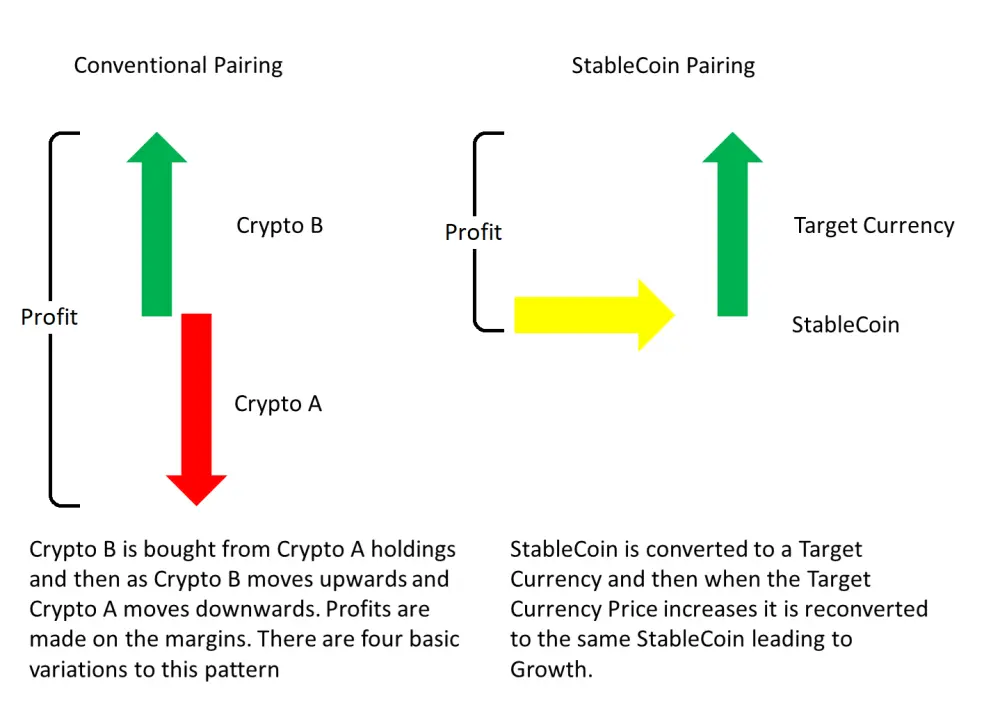
Today’s article is going to focus on stablecoin pairing and compare it to reliance on the margins generated by market volatility. With some variations (which I discussed in a very early article that I wrote back last summer) the general approach is to play the margins to the maximum and this is to look for your target currency to grow before releasing the profits into another currency that is low and going again. The fact is there are actually four variations to this but let’s for the sake of simplicity stick to the main one.
For the sake of the example I have kept the numbers simple and excluded gas fees and commissions.
Conventional Pairing
To start with I convert 10 units of Crypto A for £10 (@£1 per unit) to 5 units of Crypto B (@£2 per unit). Later when the prices shift I then convert back and the ideal situation will be when Crypto B’s price has increased and Crypto A’s price has decreased. Let’s say the Crypto A has halved and Crypto B’s has doubled.
Thus 5 Units of Crypto B bought at £2 each are now worth £4 each giving us a total of £20. Now if we take that £20 and buy back Crypto A @£0.50 each I suddenly find that I have 40 units of Crypto A or a fourfold increase. To achieve this kind of gain is quite incredible but relies on multiple factors as the trader is looking for the currencies to both move in the right direction. If they don’t you have to hodl or sell at a loss.
Please also note when pairing like in any trading no profit is made until it is cashed out. This also applies to StableCoin Pairing described below.
StableCoin Pairing
This works in a similar way and I have more than hinted in recent posts that this is a key strategy I employ. Undoubtedly you have read all those articles where I have converted 200 to DAI to a target currency and then sold again when it is greater than 200. The beauty of this is that commissions are pretty much irrelevant because I am growing the amount of DAI all the time. BTW I don’t have a problem with Tether or USDT it’s just that DAI stakes on Coinbase so why not leverage what you are holding any how you can?
The wonderful thing is that StableCoins don’t move about that much (or at all if you are holding dollars as your fiat currency). I am holding GBP so it moves in common with market rates that can be seen on any FOREX register. The point is even then it doesn’t move about too much.
With one currency staying still the point is that such a large amount of market volatility is unnecessary to release profits and especially if thinking in terms held currency. There are of course advantages and disadvantages to both strategies but to put it simply the more factors involved the greater the risk. As with all investment, the greater the risk the greater the profits. The comparative profits can even be seen in the simple graphic I have produced below.
Just thought I’d share a bit of my wisdom with you.
Some of my previous posts that might help have been referenced below.
Stay safe and stay well and more soon :)





