What if a president could buy shares of a company and then, days later, publish a message that helps boost investor confidence in that same company?
That’s the question dominating headlines after a recent CNN analysis revealed a pattern that is now placing Donald Trump’s Truth Social activity back at the center of a major controversy.
According to the investigation, Trump allegedly purchased shares in 21 different companies shortly before publishing favorable or celebratory posts about those same businesses on Truth Social. While no wrongdoing has been legally established, the overlap between personal investments and public praise is raising serious questions about conflicts of interest, market influence, and the future of financial transparency in the age of social media.
The Numbers Behind the Controversy
CNN’s analysis was based on Trump’s 2025 financial disclosure, which reportedly includes more than 21,000 transactions.
Among those transactions, investigators identified at least 44 stock purchases that were followed by positive posts about the related companies.
One of the most notable examples involves Nvidia (NVDA). Trump allegedly purchased between $200,000 and $500,000 worth of Nvidia shares in April. Just days later, he publicly praised the company’s plans for expanding development in the United States and promised to accelerate permits for Nvidia and similar firms.
For critics, this sequence is troubling because a president’s public endorsement can have a powerful effect on investor sentiment, media attention, and even stock prices.
Why This Is Different From Past Presidents
The Trump administration has denied any conflict of interest, insisting that Trump acts in the best interest of American citizens.
However, the situation differs from the standard practice followed by many previous U.S. presidents. Historically, presidents with significant stock holdings have often placed their assets into blind trusts — financial arrangements designed to prevent them from knowing or controlling their investments while in office.
Trump, by contrast, uses a trust managed by his son, Donald Trump Jr. Critics argue that this structure may not fully prevent the president from being aware of his holdings, which is why the controversy has become so politically sensitive.
Supporters of Trump point out that many of the transactions identified in the analysis had no corresponding Truth Social post, and in some cases Trump reportedly bought shares before later criticizing the companies publicly.
Still, the broader concern remains: a president has the ability to influence markets, regulators, permits, and public perception in ways that ordinary investors cannot.
The Truth API: A Potentially Explosive New Business
The controversy becomes even more significant because of Trump Media’s latest business plans.
The company is reportedly preparing to launch Truth API, a service designed to sell banks and financial operators faster access to Truth Social posts.
In practical terms, this means certain financial institutions could receive Trump’s posts — including potentially market-moving comments — before the general public sees them.
The company maintains that the product is legal. But politically, the idea is explosive.
Imagine a scenario where a major investment firm gains rapid access to a presidential post praising a company, announcing a regulatory change, or signaling support for a specific industry. Even a few seconds of early access could create a significant advantage in financial markets.
A New Era of Market Influence?
This controversy highlights a broader issue that goes far beyond Donald Trump himself.
Social media has already transformed politics, journalism, and public opinion. Now, it may also be reshaping how financial markets react to political leaders.
A president’s words can move billions of dollars in market value within minutes. When those words are published on a platform connected to the president’s own business interests, the ethical questions become far more complex.
Whether this story leads to legal consequences or fades into another political debate, one thing is clear: the relationship between political power, personal wealth, and social media influence is entering uncharted territory.
And if Truth API becomes widely used by financial institutions, the next presidential post on Truth Social might not just shape the news cycle — it could shape the stock market itself.
What do you think? Should a sitting president be allowed to own stocks in companies they publicly praise, or should stricter blind trust rules apply in the age of social media?
💎 Free Crypto Opportunities I Personally Follow🔥
1. GRASS — (DePIN/AI)
Grass is a decentralized network that lets you turn your unused internet bandwidth into crypto rewards!
Just install the browser extension, desktop app (2× rewards) or mobile app (3× rewards) — and start farming Grass Points automatically while you browse.
🔥 At the end of each season, your Grass Points are converted into $GRASS tokens — and Season 1 has already rewarded thousands of users (including me!).
👉 Farm Grass airdrop now: https://app.grass.io/register?referralCode=lNAoYuHQUPN22mF

2. UPROCK — (DePIN/AI)
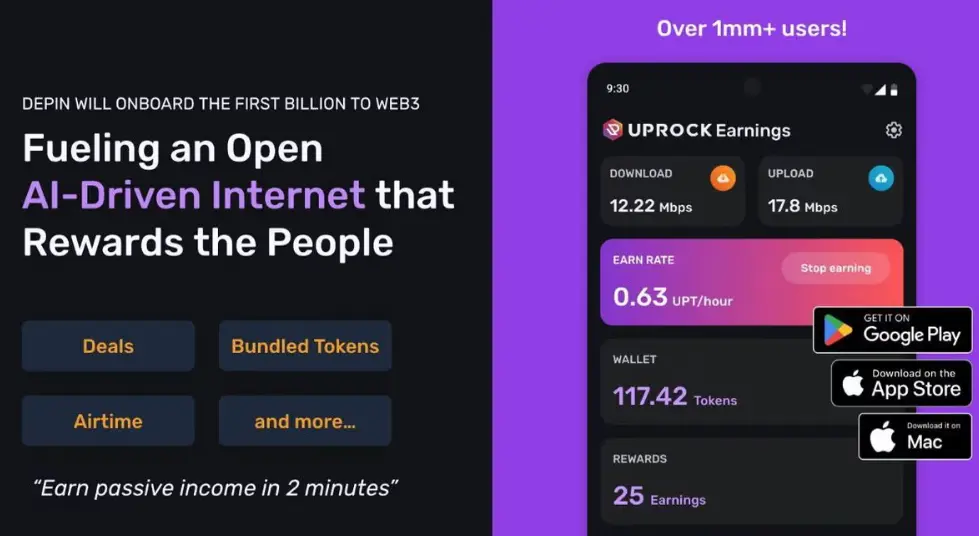
AI needs real-world data. UpRock is building the decentralized network that powers it — and participants earn $UPT rewards.
Help power the next generation of AI by contributing to a global decentralized data network while earning $UPT rewards through the UpRock ecosystem. You can also earn more $UPT sharing your unused internet (desktop & mobile), watching videos (mobile only), playing games, answering surveys and completing simple tasks.
👉 Start earning $UPT now: https://link.uprock.com/i/f38853d4