PUNZI WARS™
A Transparent On-Chain Mathematical Game
Technical Whitepaper
The PUNZI Papers Essay Twelve · PUNZI WARS Technical Whitepaper
This Whitepaper concludes The PUNZI Papers, a series of essays explaining the reason for our project, PUNZI WARS, and the potential we think it points to.
Visit us: https://punzi.xyz Follow us: Lens (Hey) · NOSTR (Primal)
Advisory: PUNZI WARS is a game and an on-chain research experiment. It is not an investment. Participate at your own risk.
___________________________________________________________________________
Abstract
PUNZI WARS is an on-chain game of 64 immutable bonding-curve markets across 21 primary EVM-compatible blockchains (plus Base), ranked against one another on a public leaderboard. Each market issues its own PUNZI token against a single crypto-token and pairs one of eight supply curves with one of eight support curves, so that every combination in an 8×8 grid (64 different tokens in total) runs under shared rules and mechanics.
The distribution of PUNZI tokens is simple. A purchase mints new tokens at a price set by a lifetime supply position that advances higher with every purchase and never retreats. When a purchase occurs, 100% of the collateral that enters the market to buy PUNZI tokens goes into the market’s treasury (a 1% buy fee is taken beforehand separately). When a sale occurs, it is paid from that treasury at a buyback level that recovers after every sale and rises as purchases advance the curve. Buyback prices are taken from the same supply curve, discounted by a spread and shaped by the support curve, less a 3% fee. At sale, the PUNZI tokens sold are burned, reducing that token’s supply. No sale can be paid more than the treasury holds. Ownership is renounced, every market starts from zero supply, and there is no pre-mine and no team allocation. No one, the developers included, holds a key to these contracts that could hide the books, raid a treasury, or switch a market off.
The 64 markets compete for seven crowns, and the overall leader is the Reigning PUNZI. Because the rules are shared, the leaderboard doubles as a running comparison of 64 different market designs. The name PUNZI is a portmanteau, being a “pun” on “Ponzi”, and both halves are intended: earlier participants can benefit from later inflows (which is the dynamic the game is built around), and every part of it is fully transparent, decentralised, and public.
At a Glance
Markets: 64: eight supply curves × eight support curves, each pairing once
Networks: 21 EVM-compatible chains, plus Base
Collateral: The chain’s native gas token in 17 markets, an ERC-20 token in 47
Fees: 1% on buys, 3% on sells, fixed in code
Treasury: Backed by 100% of the collateral that enters a market; always solvent
Buyback book: Recovers after every sale: over 30 minutes after a small sale, 90 minutes after a medium one, 9 hours after a large one
Spread: 3% once healed; medium sales widen it for 90 minutes, large sales for 9 hours (Storm Mode)
Sale sizes: Medium from 0.01% of supply to 0.3%, large from 0.3% of supply
Ownership: Renounced at deployment; no pause, upgrade or withdrawal function
Supply at launch: Zero: no pre-mine and no team allocation
Leaderboard: Seven crowns, 64 points down to 1 in each, one Reigning PUNZI
___________________________________________________________________________
Contents
1. Introduction
Part II: Technical Specification
9. Storm Mode & Support Recovery
10. Fee Mechanics
11. Game Theory
13. Security Model
15. Conclusion
16. Disclaimers
17. Authorship, Copyright, and Trademarks
Part I: The Game
1. Introduction
In 1920 the Securities Exchange Company of Boston, run by Charles Ponzi, said it was trading international postal reply coupons. When the Boston Post called in Clarence Barron, the financial journalist who headed Dow Jones, to examine the business, he calculated that it would need some 160 million coupons in circulation. About 27,000 were. The company did not survive the summer.
The PUNZI Papers trace versions of the same pattern through far larger and more respectable institutions: sovereign debt and fiat currency, the banking system, the Federal Reserve, retirement systems and pensions, the stock market, precious metals, the derivatives market, circular finance and venture capital (epitomised by the current AI boom), and the labyrinth we find ourselves trapped in of never-ending debt. In each, the PUNZI Papers find books that are opaque and difficult to parse, middle-men placed between the participants and the money with discretion over it, and an arrangement that depends on new money constantly arriving in order to exist.
Many financial structures depend on continued participation and growth in valuation: pension contributions help fund benefits, lenders refinance debt, and buyers sustain market demand. Their assets, obligations, and risks differ, and this dependence alone does not make them Ponzi schemes per se. What they tend to share is that the dependence and its linkages are difficult to see, and that they are often inefficient, whether through their own structure, the discretion of those who run them, or rules that change, all of which raise serious questions about how long they can last. PUNZI WARS approaches the problem from the other side, and asks whether a system built on complete transparency, immutability and efficiency, with a 100% collateral-backed treasury, and an internal market whose price support is enforced by code, can improve the strength and resilience of such a market while it grows.
PUNZI WARS keeps the structure and removes the hiding places. The books are a public blockchain. The collateral sits inside the contract that issued the tokens, and nothing in the contract lets anyone, the developers included, take it out other than through the internal market sell mechanism itself. The contracts are compiled, deployed, and then given up. Ownership is renounced, so no one holds a key to change a fee, pause a market, or rescue one. The dependence on later inflows is not hidden either. It is the game.
In concrete terms: PUNZI WARS has 64 markets, 21 chains (plus Base), and one leaderboard. Each market is a PUNZI token with its own collateral: the chain’s native gas token is used in 17 markets, and an ERC-20 token in the other 47. Each market prices new tokens according to one of eight supply curves (Linear Exponential, Power Law, Sigmoid, Step, Exponential, Hyperbolic, Dual Power, and Root Exponential) and shapes its buybacks with one of eight support curves drawn from the same families. The result is an 8×8 grid in which every supply curve meets every support curve exactly once: 64 small economies running side by side under shared rules, on public, automated and immutable markets.
Bonding curves are not new: Bancor’s 2017 whitepaper described tokens bought from and sold back to a contract at a price set by formula. What PUNZI WARS adds is the arrangement and rules around the curves.
What Sets PUNZIs Apart
• A one-way upward price position. The buy price depends on how many tokens a market has ever minted, a lifetime position that sales never move back, so sales never move the buy price lower. When tokens are sold into the internal market, they are immediately burned, causing the existing supply of tokens to shrink with every sale. The curve does not go back. A later buy on it is never cheaper than an earlier one.
• A sell book made from the supply curve itself. Sellers are paid from the treasury at prices taken from the same curve, discounted by the spread (3% once healed) and shaped by the market’s support curve. The contract’s own buyback support is enforced by code. The book is filled first come, first served, from the top down. In this automated market, after every sale the price support drops to the lowest lossy sale price and then recovers to the most recent purchase price less the spread. This occurs over 30 minutes after a small sale, 90 minutes after a medium one, and 9 hours after a large sale. So even with sales, the internal buyback support rises as the purchase price rises, and purchases can only move the purchase price up.
• A treasury that backs every token. After a 1% buy fee taken separately, 100% of the collateral paid in a market for PUNZI tokens enters that market’s treasury (Section 8).
• Storm Mode. Larger sales temporarily widen the price-support spread, and the largest open a 9-hour Storm in which it recovers more slowly. Unlike most market-moving news, a Storm is announced on-chain, to everyone, at the same moment (Section 9).
What PUNZI WARS Does Not Have
Several things that most tokens have are absent by design. There is no presale, no team allocation, no vesting schedule, no governance token, no price oracle, no keeper bot, and no server that has to stay online. There is no roadmap either, since a finished set of immutable contracts has nothing left to schedule. Ownership is renounced at deployment. The developers have no special access and no control: with ownership renounced, they can only buy and sell like any other user.
The War
Then there is the war. The 64 markets are ranked across seven categories, each with its own crown: The Heavyweight for market capitalisation, The Vault for treasury value, The Engine for velocity, The Nation for distinct buyer addresses, The Rocket for growth, The Burner for burn rate, and The Fortress for retention. Each category awards points within the game, from 64 for first place down to 1, and the market with the highest total holds the title of Reigning PUNZI. The raw metrics come from public contract state, with USD prices added for market capitalisation and treasury value. The scoring is automatic, so there is nobody to appeal to; supporters of an unfashionable PUNZI have the same remedy as supporters of an unfashionable football club, which is to turn up and buy.
Why PUNZI WARS Exists
The point of the exercise is research and fun. PUNZI WARS is an experiment and a game of wit and competition played with real funds. The books are open, the treasuries are in plain view, and no one can change the rules. Anyone can watch the game play out as it happens, in 64 variations at once, for as long as the chains keep running.
Part I describes the game and how it is scored. Part II specifies the fully deployed configuration: how each market prices a buy and a sale, how its treasury holds collateral, how its sell book rebuilds after each sale, how Storm Mode responds to large sales, what the fees are, and how the contracts are built.
2. How a Market Works
Every PUNZI market is a single contract that does three things: it sells new tokens, it buys tokens back, and it holds the collateral that pays for the buybacks. This section describes each in plain terms; Part II gives the formulas. Figure 1 shows where the collateral goes.
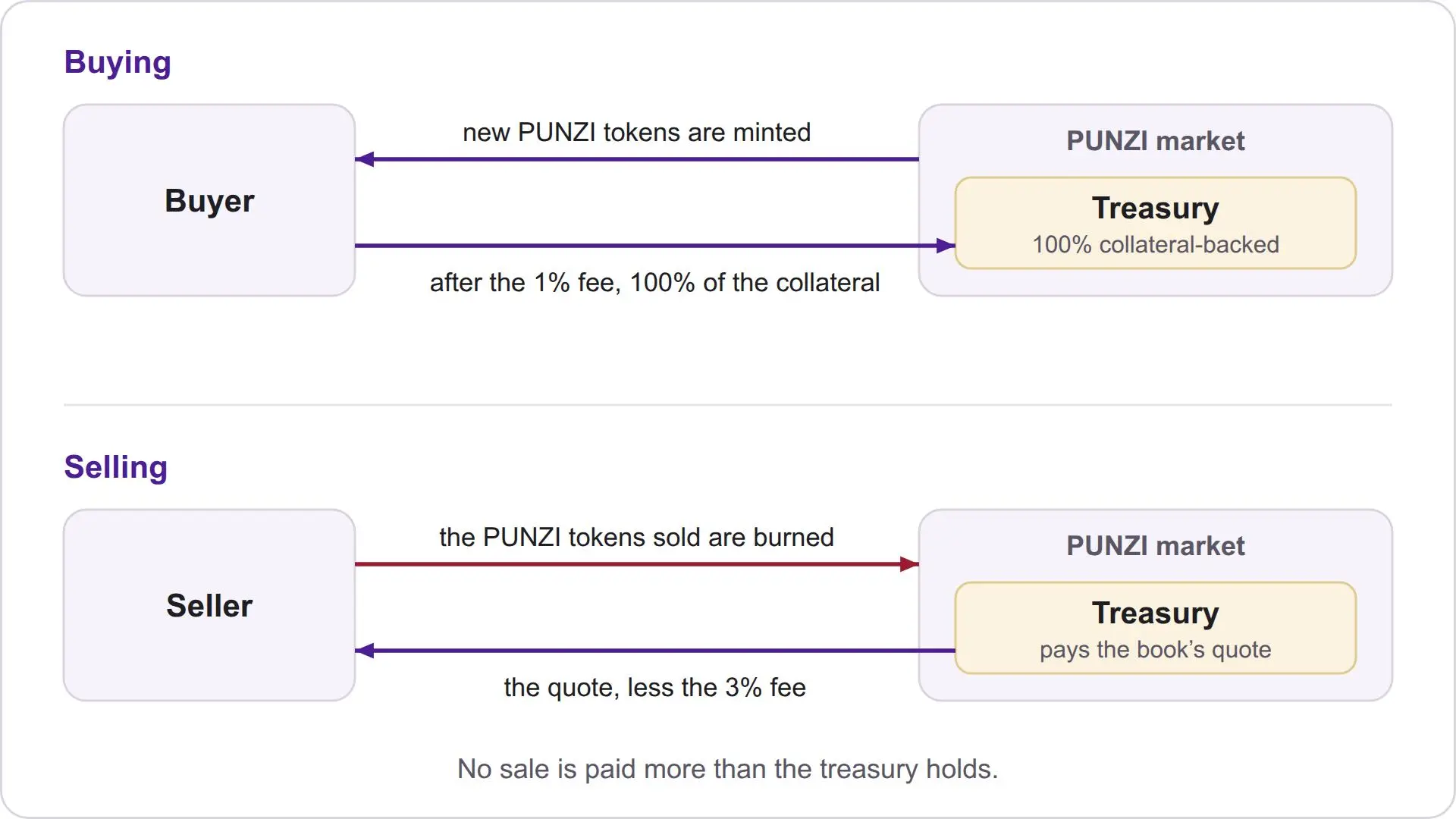
Figure 1. Where the collateral goes. On a buy, after the 1% fee, 100% of the collateral goes into the treasury and new tokens are minted. On a sale, the tokens are burned and the treasury pays the quote, less the 3% fee.
Buying
A buyer sends the market its collateral: the chain’s native token, or the specific ERC-20 token that market accepts. A 1% buy fee is taken separately and 100% of the collateral that goes to buy PUNZI tokens goes into the market’s treasury. The supply curve then decides how many new PUNZI tokens the payment buys, starting from the market’s lifetime position (the total number of tokens it has ever minted). That position moves forward with every purchase and never moves back, so each buyer starts where the last one finished, with the price always increasing.
Selling
A seller sends PUNZI tokens back to the market. The market’s standing buyback book prices them along the same supply curve, discounted by a spread and shaped by the market’s support curve. A 3% fee is deducted, the seller receives the rest in the collateral token, and the tokens sold are burned.
The Buyback Book
The book is a single window of tokens hanging below a tip (similar to standing buys, with a depth of market, for those familiar with trading). In a normal market, the tip of the buyback book (price support, if you will) stands at the most recent purchase price less a 3% spread, and the window (‘depth of market’) is as deep as the treasury can cover at that price. A sale is filled from the top down. After a sale, the tip drops to the lowest lossy sale price and climbs back. The time period of this recovery differs: over 30 minutes after a small sale, 90 minutes after a medium one (from 0.01% of supply to 0.3%) and 9 hours after a large one (from 0.3% and up). A medium or large sale during a 9-hour recovery restarts the full 9 hours, while a small sale keeps the end of a recovery already running (or takes its own 30 minutes, if those end later). Purchases advance the curve, so the position the tip recovers to never moves back; sales pull the tip down for as long as its recovery takes. The book is first come, first served.
Medium and Large Sales
Small sales leave the spread alone. A medium sale, from 0.01% of supply, widens it for the sellers who follow, and it heals back to 3% over 90 minutes. A large sale, from 0.3%+ of supply, widens it further and opens Storm Mode, a 9-hour recovery that nothing can cut short. Each sale is priced before the widening it causes, so it is the sellers who follow who meet the wider spread. Figure 2 shows what that does to the buyback price over time.
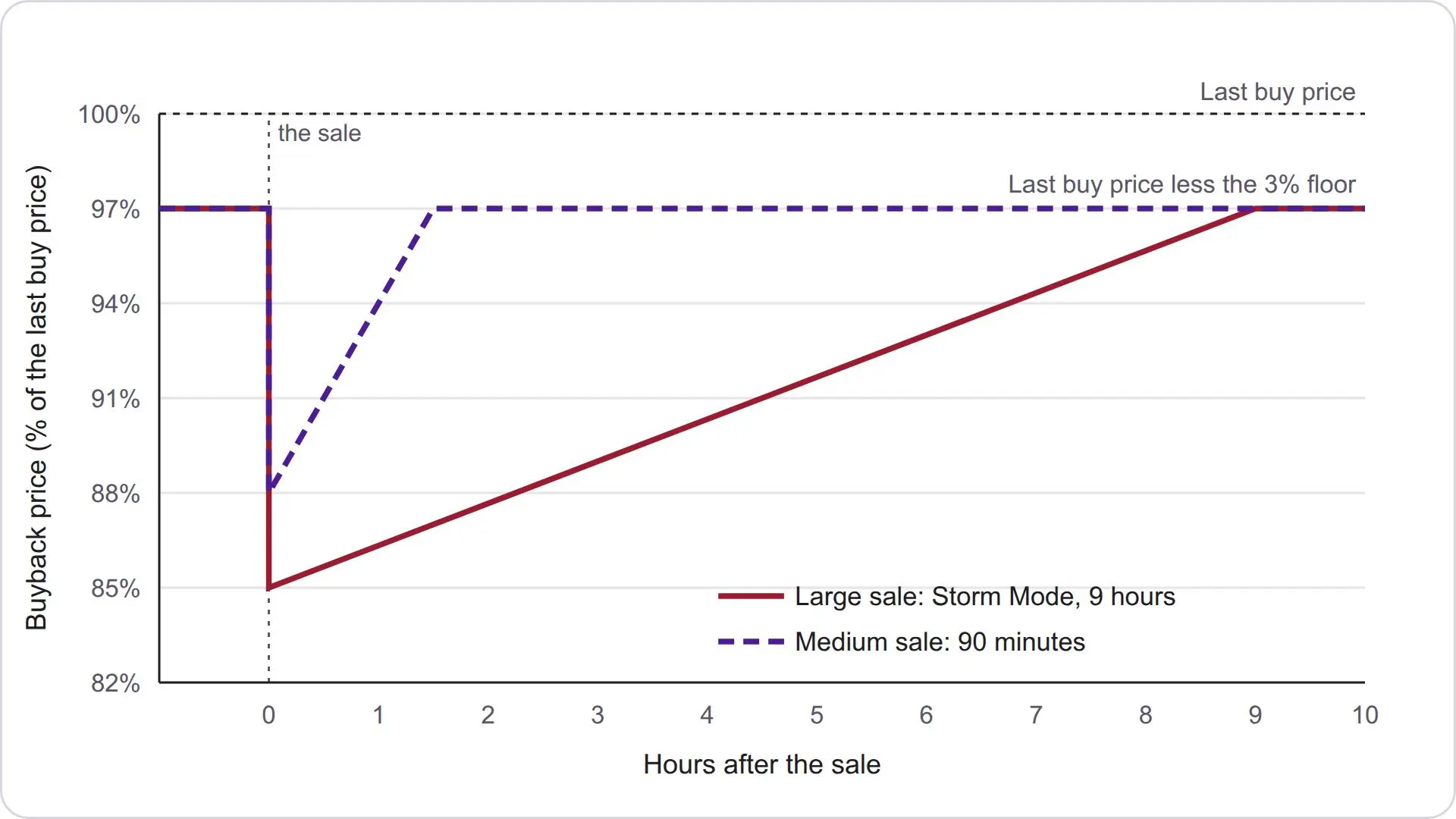
Figure 2. The buyback price at the top of the book after a medium and a large sale, from the spread alone, as a share of the last buy price, for a market whose base spread is 12%. A medium sale drops it to 88% for the sellers who follow, and it climbs back to 97% over 90 minutes; a large sale drops it to 85% and opens a 9-hour Storm. The tip drops with the sale too and recovers on the same clock.
Where the Money Goes
The contract moves collateral out in only two ways: payouts to sellers, and the two fixed fees. There is no withdrawal function, no pause and no upgrade, and the treasury is a public balance that anyone can read at any time. Some collateral tokens can be frozen or changed by their own issuers, which is a separate risk outside the PUNZI contracts (Section 16).
3. A Worked Example
The numbers below were computed with the contract code and deployed parameters of PUNZI-ETH, whose supply and support curves are both Root Exponential. The sequence is an illustration, not a forecast. It follows one participant, Alex, who is neither the first buyer nor the last. ETH amounts are rounded to three decimal places. Figure 3 places the steps on the market’s price curve.
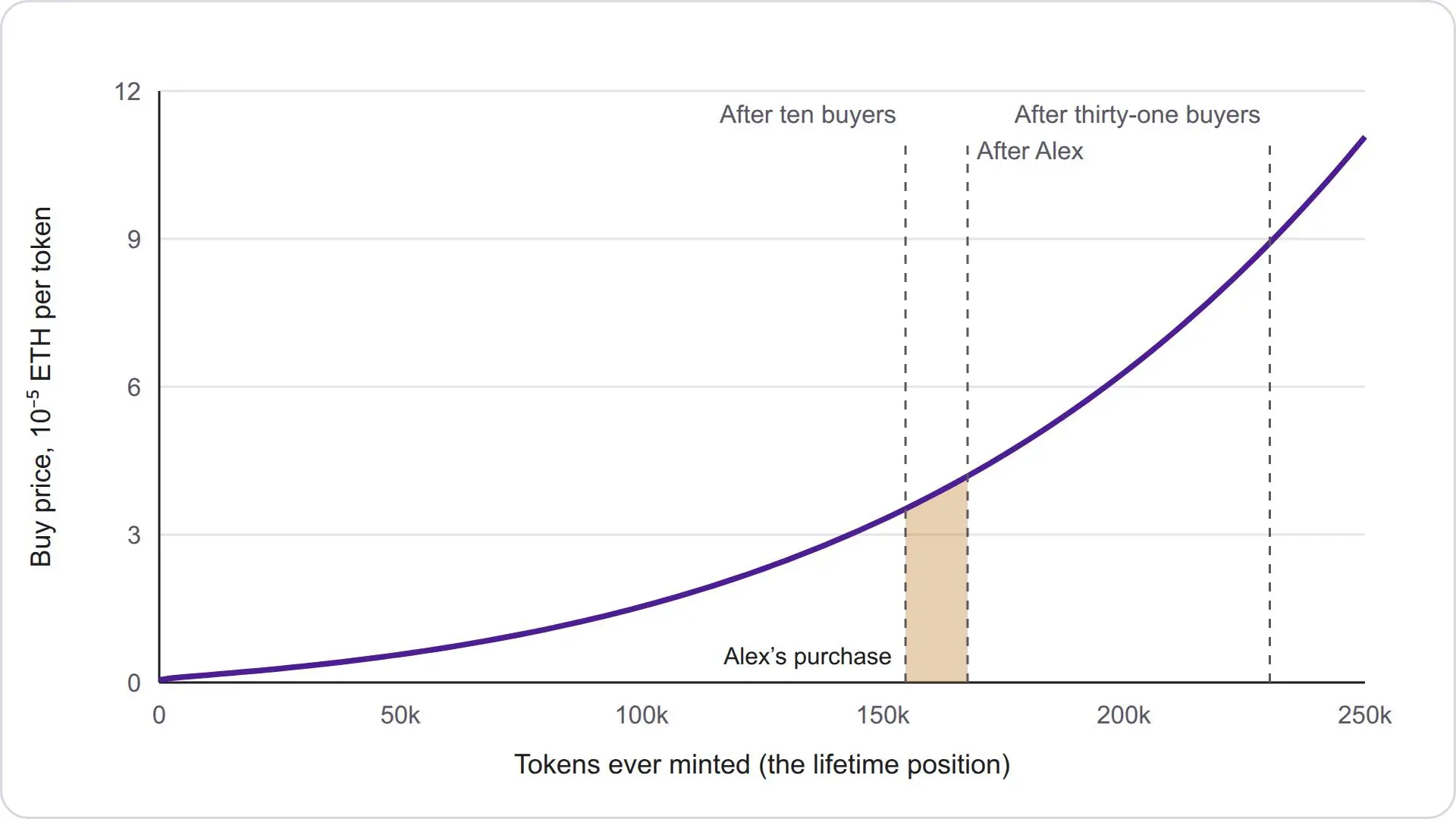
Figure 3. The buy price on PUNZI-ETH, read from the contract at each point, against the number of tokens ever minted. The dashed lines mark the positions in the worked example, and the shaded area under the curve is Alex’s purchase.
Step | What happens | Result (after fees)
1 | Ten buyers pay 0.2 ETH each, an hour apart. | The treasury holds 1.980 ETH.
2 | Alex pays 0.5 ETH. | He receives 12,865 tokens. Selling them straight back would pay him 0.466 ETH (the buy fee, the spread, and the sell fee cost about 7% on a direct round trip).
3 | Over the next twenty hours, twenty more buyers pay 0.2 ETH each. | The treasury holds 6.435 ETH, and Alex’s tokens are now quoted at 1.005 ETH.
4 | The market’s first buyer, holding a quarter of all tokens, sells out. | Storm Mode opens. Alex’s quote falls to 0.463 ETH, is 0.485 ETH 30 minutes later, and comes back to 1.005 ETH once the Storm has passed.
5 | Once the Storm has passed, Alex sells half his tokens, and the rest 30 minutes later. | He receives 0.521 ETH and then 0.456 ETH: about 0.98 ETH in all for his 0.5 ETH.
Result
Alex gained because twenty buyers arrived after him: every purchase moved the curve up, and the treasury grew with them. Had no one bought after him, selling would have paid him less than he spent, as step 2 shows. The large sale in step 4 lowered his quote only for a while: the quote climbed back over the Storm’s 9 hours and was fully back once the Storm had passed, because the treasury could cover the book. The first half Alex sold in step 5 was a large sale too, so the rest, sold 30 minutes later, met a book still recovering from it.
The order of arrival and departure decides each outcome. Nothing in the contract reserves anything for anyone, and nothing promises that later buyers will come. Every step is visible on-chain as it happens.
4. The PUNZI WARS Competition
The 64 markets are ranked across seven categories in the PUNZI WARS interface. In each category, the markets are placed in order from the highest value to the lowest. First place earns 64 points, second place 63, and so on down to 1 point for sixty-fourth place. Markets with equal values share the higher place and its points, and the next market’s place counts every market above it; for example, when two markets tie for first, both earn 64 points and the next earns 62. Only a value above zero earns points, so a market at zero earns none in that category, and a market whose contract state cannot be read is left out of the rankings. The maximum aggregate score is 448 (64 × 7). A category crown requires a unique positive leader; a tie does not create a sole category winner. Equal overall scores use stable deployment-ID order for display.
# | Category | Crown | Metric
1 | Market Cap | The Heavyweight | Marginal buy spot × circulating supply × USD rate
2 | TVL | The Vault | Treasury value in USD
3 | Velocity | The Engine | (Net buy volume + nominal net sell volume) / treasury
4 | Diversification | The Nation | Lifetime unique internal buyer addresses
5 | Growth | The Rocket | cumulativeK / maturityScale
6 | Burn Rate | The Burner | (cumulativeK − totalSupply) / cumulativeK
7 | Retention | The Fortress | Treasury / cumulative net buy volume
Contract state supplies the raw metrics. Market Cap and TVL additionally use frontend collateral USD prices; the trading contracts do not read those feeds. The interface aggregates available sources and may use cached or fallback prices. While visible it polls contract state every 30 seconds and USD prices every 60 seconds. Market Cap uses marginal buy spot times circulating supply, not aggregate redeemable value. Velocity uses lifetime net buy volume plus nominal net seller payout volume divided by current treasury; it has no time denominator. Diversification counts buyer addresses, not people or current holders. Growth is raw lifetime maturity and can exceed 100%; Burn Rate is the burned share of lifetime minted tokens. Retention divides treasury by net buy volume and can exceed 100% after donations or rebases. A ratio whose denominator is zero, such as Velocity while a treasury is empty or Retention before a market’s first buy, is counted as 0. The highest aggregate score determines the displayed “Reigning PUNZI.”
Part II: Technical Specification
5. System Overview
PUNZI WARS is 64 markets and the competition between them. Each market is a PUNZI token with a collateral-specific symbol, such as PUNZI-ETH or PUNZI-LINK, deployed from one of two contract templates: PUNZI.sol for a chain’s native gas token and PUNZI_ERC20.sol for an ERC-20 collateral.
Each contract is a complete market on its own. Its supply curve prices newly minted tokens. Its support curve shapes the discount applied when the contract buys tokens back through a sell book built from that same supply curve. The contract accepts one collateral token, either the chain’s native gas token (ETH, AVAX, BNB, and others) or a specific ERC-20 token (LINK, USDC, UNI, and others), and in return mints PUNZI tokens against it, and holds it in the treasury from which sellers are paid.
Core Mechanics
BUY User sends collateral to the contract. On native buys the received amount is msg.value; on ERC-20 buys the credited receipt is the lesser of the requested amount and the positive balance increase actually observed: the contract credits only what arrived, so a token that charges a fee on transfer cannot overstate the treasury. The 1% buy fee is taken separately, and then 100% of what enters the system backs the treasury. The supply curve determines the minted tokens, subject to the buy minimum and minTokensOut. Through the app you receive exactly the tokens you were quoted. If another purchase lands first, or your collateral token delivers slightly less than you sent, you receive what the amount that arrives buys, never fewer than your minimum. If any tiny fractioned or rounded remainder is left, it stays in the treasury. The cumulative counter k increases by the tokens minted.
SELL User submits PUNZI tokens to the contract. Sell pricing combines the book valuation, the support-pairing factor, and the current spread. The payout is never more than the treasury holds (Sections 7 and 8). A 3% fee is deducted. The submitted PUNZI tokens are permanently burned (destroyed, removed from totalSupply). The net payout is sent to the seller in the collateral token. There is no minimum or maximum sale size: a holder can sell any amount, up to their whole balance, in one transaction. The counter k does not decrease.
Buys have a small minimum, set for each market in its collateral token to prevent spam (about $3.00 to $3.50 at the prices around deployment), and no per-purchase maximum. Sells have no minimum and no maximum.
The One-Way Escalator
The cumulative supply counter k only increases. Selling burns circulating tokens without reducing this lifetime purchase position. The next buy is therefore evaluated from the position already reached, not a position reset or changed by sales. In exact arithmetic, an additional token costs the same or more on every curve, with flat prices occurring only within a STEP tier.
Self-Contained Design
Trading logic is on-chain and does not require a frontend, external server, price oracle, indexer, or background keeper. Buy pricing is computed inside each contract. Sell pricing uses an immutable, ownerless companion deployed per chain and pinned at construction. An unsuccessful or invalid companion response invokes the token’s internal fallback window. Anyone can call the public trading functions and interact with every market directly via their respective chains. The frontend (the dApp) provides an easy and convenient user interface that enables interacting with the contracts, reads contract state, and provides market information, including external USD prices for display.
Standard ERC-20 Tokens
PUNZI tokens are standard ERC-20 tokens with no transfer tax. They can be freely transferred between wallets, traded on any decentralised exchange, or listed on any marketplace. The 1% buy fee and 3% sell fee apply only when interacting with the PUNZI contract’s internal market. Peer-to-peer transfers and DEX trades carry no protocol-imposed transfer fees. This means a full secondary market can form independently of the bonding curve. Where a shorter name is needed for listing, PUNZI should be abbreviated PZI (thus PUNZI-ETH would be PZI-ETH, and so forth).
Lazy Execution
All system logic (support calculations, ratchet updates, Storm Mode transitions, fees) executes inside user transactions. The contracts require no background keeper or scheduled transactions; each user transaction still consumes chain gas. There are no protocol cron jobs or required keeper bots.
6. The 8 Supply Curves
The supply curve determines the price of newly minted tokens at lifetime position k. The eight cards specify ideal real-valued formulas. The implementation represents mathematical quantities in 18-decimal fixed-point units, using PRBMath UD60x18 alongside ordinary integer operations and custom bounded routines. Collateral transfers and fee rounding use the collateral’s native integer units.
The cost to buy n tokens starting from position k is the definite integral of the price function:
Total buy cost
Cost(k, n) = ∫kk+n P(x) dx
The contracts use closed-form cost calculations where suitable. For sufficiently small steps, Power Law, Sigmoid, Hyperbolic, and Dual Power use bounded two-point Gaussian quadrature; STEP uses a closed-form tier sum, while other small-step branches use truncated cancellation-resistant series. The inverse uses bounded bracket expansion and binary search, aiming to return an affordable token amount at one token-wei search resolution.
The ideal formulas have no fixed maximum price within their mathematical domains: the Hyperbolic price diverges as its finite supply ceiling is approached, and the other families grow as supply extends. SIGMOID’s logistic term tends towards L, but its linear tail keeps the ideal price rising above that scale. The tail coefficient τ = 3% is distinct from both the sell fee and spread floor. STEP has flat shelves followed by upward jumps.
Each instance’s coefficients are immutable constructor arguments, readable through curveParam1(), curveParam2(), and curveParam3(). Instance-specific calibrations express the curves in collateral units, whose price scales differ widely across the 64 markets. The cards describe parameter roles rather than universal numeric ranges. Constructor values fix each instance’s coefficients, minimum purchase, and maturity scale; these values do not track later collateral-price changes.
Numerical Conventions
Ideal integrals describe the economic model; fixed-point calculations, rounding, finite approximation branches, and bounded searches determine transaction results. Collateral amounts are ultimately rounded to the collateral’s native integer units.
Linear Exponential
P(k) = m · k · eb·k
Integral: ∫ = (m/b²) · [(b·x − 1)·eb·x] evaluated from k to k+n
A term rising directly with supply multiplied by an exponential one. Starts at zero and steepens continuously, with no flat opening stretch. Overflow-guarded at the exp() exponent threshold, and evaluated by a truncated, cancellation-resistant series for small steps.
Parameters: m = scale coefficient · b = exponential rate. Floorless: P(0) = 0, so the curve starts from nothing rather than a genesis price.
Power Law
P(k) = m · kⁿ
Integral: ∫ = m/(n+1) · [(k+q)ⁿ⁺¹ − kⁿ⁺¹], q = tokens bought
Starts at zero, then accelerates superlinearly. The exponent n is calibrated per token; the higher it is, the more sharply the price bends upward.
Parameters: m = scale coefficient · n = exponent. Floorless: P(0) = 0 exactly; the curve starts from nothing rather than a genesis price, and the first fraction of a token is priced on the same power law as everything after it.
Sigmoid
P(k) = L / (1 + e−c·(k − S₀)) + τ·L·max(0, k − S₀)/S₀, τ = 3%
Integral: ∫ = (L/c) · [softplus(c·(k+n − S₀)) − softplus(c·(k − S₀))] + (τ·L/(2S₀)) · [max(0, k+n − S₀)² − max(0, k − S₀)²]
In the ideal model, the logistic rise levels off towards L while a linear tail hinged at the midpoint continues above it. L is a scale the curve climbs through, not a ceiling.
Parameters: L = the logistic term’s scale · c = steepness · S₀ = midpoint supply (the hinge)
Step
P(k) = base · mult⌊k/tier⌋
Integral: Piecewise sum: ∑ (tokens in tier) · (price at tier)
Price is constant within each tier and jumps at tier boundaries. Like a staircase, flat, jump, flat, jump. Provides clear, transparent price levels. Cost equals the sum across the tiers a purchase spans, evaluated in closed form (no per-tier loop).
Parameters: base = genesis price · mult = per-tier multiplier (> 1) · tier = tokens per step
Exponential
P(k) = a · eb·k
Integral: ∫ = (a/b) · [eb·(k+n) − eb·k]
Compounding growth. Price doubles repeatedly. Early positions are extremely cheap; late positions are extremely expensive. Overflow-guarded at exponent threshold 130.
Parameters: a = genesis price · b = exponential growth rate
Hyperbolic
P(k) = a / (1 − k/Kmax)3
Integral: ∫ = (a·Kmax/2) · [(1 − x/Kmax)−2] evaluated from k to k+n
Defined against a maximum supply. As supply approaches that ceiling the denominator shrinks towards zero and the price climbs without bound, so the ceiling bounds the curve rather than being a level it settles at. Guarded against division by zero at the ceiling and evaluated by quadrature where the closed form cancels.
Parameters: a = scale coefficient · Kmax = the supply ceiling the curve is defined against
Dual Power
P(k) = m · (k1.5 + B · k3.5)
Integral: ∫ = m · [(2/5)·x2.5 + (2B/9)·x4.5] evaluated from k to k+n
Two powers of supply added together. The gentler term dominates early; as supply grows the much steeper term overtakes it, so the curve changes character partway along instead of holding one shape throughout.
Parameters: m = scale coefficient · B = weight of the steeper term. Floorless: P(0) = 0.
Root Exponential
P(k) = a · eb·√k
Integral: ∫ = (2a/b²) · [(b·√x − 1)·eb·√x] evaluated from k to k+n
Exponential growth driven by the square root of supply rather than supply itself. Its logarithmic price grows with the square root of supply, so its relative growth rate declines; the absolute price increase need not decelerate. The square-root argument is bounded, and small steps use a truncated numerical series.
Parameters: a = genesis coefficient · b = exponential rate in the square root of supply
Arithmetic Safety
Solidity 0.8.38 checks arithmetic by default, but the implementation also contains custom guards, unchecked operations, and bounded numerical helpers. Most exponential branches use a 130e18 argument bound and the softplus helpers a 133e18 bound, both below PRBMath’s exponential input limit of about 133.08e18; other guards address powers, square roots, products, sums, and the Hyperbolic supply ceiling. Certain guarded calculations return type(uint256).max as a saturation sentinel. STEP’s closed-form tier cost avoids a per-tier loop, but numerical routines and searches still have bounded loops.
7. The 8 Support Curves
The support curve is the sell side: the contract’s standing book of buyback bids, funded by the treasury, which holds 100% of the collateral from every purchase into the market. It is not an independent price schedule: the book uses the same supply curve as the buy side, mirrored, and the market’s support curve adjusts what it pays through the support-pairing factor. It is one window of tokens hanging below a tip that recovers to the lifetime purchase position, at most as deep as the treasury covers; the ordinary gross sell quote discounts the integrated curve cost of the part of a sale inside that window by the spread and support-pairing factor, subject to the cap of collateral held in the treasury.
The top of the book is the marginal support price. The following is a circulating-supply mirror reference, not the live top bid:
Supply mirror reference: supplyMirrorReference = P(H) × (1 − getSupportSpread(m))
P is the supply-curve price and H = S is circulating supply in this reference. Raw maturity is m = cumulativeK / maturityScale, where maturityScale is immutable. Shape and base-spread schedules use the bounded mapping m̂ = 2(1 − 2−m). Ideally it equals 1 at raw maturity 1 and tends towards 2; integer evaluation rounds and eventually reaches its finite cap, so schedules can plateau. The Section 9 ratchet sets the live effective spread and normally heals to a 3% floor, distinct from the 3% sell fee. Before any burns, H = k; after burns, H < k, and the live tip recovers to the lifetime position k. The actual quote is therefore not simply P(H) times a discount. STEP prices can remain flat within a STEP tier, and treasury coverage limits how deep the recovered tip stands.
The book is one window. A tip at position t, at or below lifetime position k, carries a depth d: the book is the supply-curve window from t − d to t, priced with the same cost function as buys. The companion fixes the tip’s position first, at k once recovered, and then searches in a bounded number of steps for the deepest window the treasury covers there: the window’s value must be covered net of the 3% spread floor, and only depths that pass are kept. A treasury that cannot cover the whole window gives a shallower window. Individual computed gross sell quotes are separately capped at the treasury. A sell consumes the window from the tip down. Only outstanding tokens can be submitted for sale.
What a sale does to the tip. On the normal solver path, every sale, whatever its size, leaves the tip’s stored position at its pre-sale position minus the tokens sold (or zero), and burns the tokens it sold. If that solver call fails or gives an invalid answer, the internal fallback window instead sets the stored position and depth to remaining supply. The tip then recovers on a clock set by the sale, 30 minutes after a small sale, 90 minutes after a medium one and 9 hours after a large one, all the way back to the last buy price less the spread (3% once the spread has healed). The treasury decides how deep the recovered tip stands, never how high: when it cannot cover a full-depth window there, the tip keeps its price and carries less depth. Each sale sets a new clock, starting from wherever the tip stands at that moment. A medium or large sale gives the tip the spread’s own recovery (90 minutes, or 9 hours after a large sale or during a 9-hour recovery), and a small sale keeps the end of a recovery already running, or takes its own 30 minutes if those end later. A later sale can lengthen a recovery already running but never shorten it, and buys do not touch these clocks at all.
The tip’s price recovers on that clock, and its depth moves to what the treasury covers at that price; burned supply does not recover. A burned token is gone. Recovery can nevertheless reprice remaining tokens at higher curve positions, including positions previously traversed by sales; it does not recreate burned supply. The treasury can grow from paid buys, donations, or positive collateral rebases, and can also shrink through sales or external collateral behaviour beyond the contract’s control (see Issuer and upstream-token risk, Section 16). There is no protocol emission or promised subsidy. Buy-ins advance k and add collateral, but a buy within a STEP tier need not raise the spot price at that moment. After medium and large sales the spread recovers alongside the tip, on the same 90-minute or 9-hour clocks (Section 9).
The Mirror Maths
Let C(x) denote cumulative ideal buy cost to position x, S circulating supply and T live treasury in normalised collateral units. For a valid ordinary book with tip position t and depth d, a sale of 0 < q ≤ S is priced on u = min(q, d)/S, the share of supply the book prices, and the reversed cost is:
Sell payout (gross, before the 3% fee)
B(q) = C(t) − C(t − q), if q ≤ d
B(q) = C(t) − C(t − d), if q > d
V_gross(q) = min(T, (1 − spread) × B(q) × ψ(u))
A_gross(q) = floor(V_gross(q) / collateralScale)
A_net(q) = A_gross(q) − floor(3% × A_gross(q))
Support personality
ψ(u) = min(1, G_X(u) / G_Y(u))
A sale consumes the window from the tip down. The internal fallback window instead evaluates C(S) − C(S − q) with u = q/S, since it prices the whole sale. The support factor uses normalised cumulative shapes G, with X the support family and Y the supply family. Both are evaluated at the same saturated maturity; identical families give ψ = 1 when the denominator is nonzero, and a zero denominator uses the implementation’s ψ = 1 fallback. The ideal infinitesimal ratio tends to 1. The factor never exceeds 1, and the gross quote never exceeds T. When cost evaluation yields a saturation sentinel, the quote uses min(T, T × u × ψ) without an additional spread multiplication. V_gross is represented as an 18-decimal fixed-point integer; A_gross and A_net are native collateral-unit integers after conversion through collateralScale = 1018 − collateralDecimals. The displayed net formula assumes ordinary collateral transfers; an ERC-20 seller’s receipt can be reduced by the collateral token’s own transfer behaviour (see Issuer and upstream-token risk, Section 16).
In an idealised pure-mirror round trip, a matching reversed cost interval, no binding depth or payout cap, a 3% effective spread, and a support-pairing factor ψ of 1 (so the support curve adds no further discount), the retained fraction is approximately 0.99 × 0.97 × 0.97 = 0.931491 of the initial purchase payment. The loss is about 6.85%, often rounded to 7%, before gas and integer rounding. Later inflows and earlier exits change the state faced by subsequent sellers. Round trips are not the purpose of the game: at roughly 7% a lap, a round trip is an expensive way to end up where you started, just only lighter.
The 8 Support Shapes
The support family supplies a normalised depth weight g, with cumulative G(u) = ∫₀ᵘ g, used in ψ. Seven personalities depend on maturity or the supply’s progress; Power Law is ageless. Own-supply parameters are drawn only for POWER, STEP, and HYPER support shapes. POWER uses the deployed exponent clamped to 1.9 to 3.1; STEP uses the deployed multiplier and tier layout with a bounded effective tier count; HYPER uses nearness to its supply ceiling capped at 0.995. Foreign pairings use those families’ fixed rules. The other five families use their fixed maturity laws even when supply and support match. The constants below define these support shapes in the contracts.
Linear Exponential ages with m̂
g(u, m̂) = (1 − u) · e−S_L·m̂·u, S_L ≈ 4.23
Newborn, it is the linear ramp 1 − u; age multiplies in an exponential taper, compressing deep fills harder as the book matures.
Power Law ageless
g(u) = (1 − u)ν; own ν with a Power Law supply (clamped to 1.9 to 3.1), else ν = N̂ = 2.5
Weight concentrated near the top of the book at every age; deeper fills compress away from the mirror quickly. The only personality that never ages.
Sigmoid ages with m̂
normalised logistic in u, inflection riding the maturity clock: C_S ≈ 9.79, Θ_S ≈ 1.05, with the same τ tail the supply form carries
Holds near the mirror, then drops away. A young book falls from near the top with no plateau; past design life a flat shelf forms whose cliff edge sits deeper into the book as the deployment ages.
Step ages with own draw or m̂
mult-ratio shelves; own multiplier and tier layout with a Step supply, else mult̂ = 1.2 and T = T_S·m̂, T_S ≈ 36; effective T capped at 350
A literal shelf pyramid: flat weight tiers with sharp drops between them, the shelf count and width riding the deployment’s own tiers or its age.
Exponential ages with m̂
g(u, m̂) = e−S_E·m̂·u, S_E ≈ 7.95
The tightest near-top compression as the clock runs: young books fill almost evenly, aged books pay well below the mirror on deep sales.
Hyperbolic ages with own draw or m̂
g(u, ρ) = ((1 − ρ)/(1 − ρ + ρ·u))³; own ρ = nearness-to-cap, capped at 0.995, with a Hyperbolic supply, else ρ = R_H·m̂/2, R_H ≈ 0.932
Paired with a Hyperbolic supply curve, the shape is set by how close the market’s lifetime position has come to that curve’s supply ceiling. Paired with any other supply curve, it is set by the market’s maturity alone, and in both cases the further along the market is, the faster the depth weight falls towards the bottom of the book.
Dual Power ages with m̂²
g(u, m̂) = ((1 − u)¹⋅⁵ + w·(1 − u)³⋅⁵)/(1 + w), w = W_D·m̂², W_D ≈ 11.6
Two tapers blended by age squared: young books lean on the gentle term, aged books on the steep one; gentle young, harsh aged.
Root Exponential ages with √m̂
g(u, m̂) = e−S_R·√m̂·(1 − √(1 − u)), S_R ≈ 7.90
Weight declines with depth, with a steeper logarithmic decline towards the bottom of the book; age strengthens the taper on a square-root clock.
The family is fixed by the immutable supportCurve constructor argument. These analytic shapes avoid iteration over individual tokens or STEP tiers, but the numerical helpers and support-book searches can contain bounded loops. The family has two roles -- its depth shape scales the mirror by the share of supply the book prices for the sale, while its base-spread schedule determines spread snap targets. Time recovery in Section 9 then sets the live spread.
The 8 Spread Formulas
A normally healed priced book uses the 3% spread floor. After a medium sale the spread widens and recovers over 90 minutes (longer if a Storm recovery is running); after a large sale it widens further and Storm Mode opens, with a 9-hour recovery. The base spread is the snap input for those sales, not the ordinary rested spread. Each family’s base spread starts at 6% (8% for SIGMOID and STEP) and widens towards a cap of 26% to 30% as saturated maturity rises. Fixed-point rounding can leave successive values unchanged, and finite saturation can put a schedule at its cap. A medium sale targets the floor plus 75% of the base, a large sale targets the floor plus the full base, both widen-only. A young deployment’s knock is shallow; an older one targets a wider knock.
The seven smooth arcs use the normal form cap − span·(N(2) − N(m̂))/N(2): in ideal arithmetic the starting value is cap minus span and the cap is reached at saturated maturity 2. STEP uses nine discrete 2-point shelves and a continuous tail towards 28%. These ideal schedules are implemented with finite rounding and bounds.
Linear Exponential 6% − 30%
N(m̂) = m̂·e(S_L/2)·m̂
The compounding ager: widens gently at first, then the exponential factor accelerates the arc through mid-life.
Power Law 6% − 28%
N(m̂) = m̂N̂, N̂ = 2.5
Polynomial ageing: slow to leave 6%, steady through mid-life, levelling towards 28%.
Sigmoid 8% − 26%
normalised logistic with inflection Θ_S ≈ 1.05
The mid-life surge: flat-ish young, a concentrated widening around its own inflection, then a long approach to 26%.
Step 8% − 28%
spread = 8% + 2% per shelf (9 shelves) + a continuous tail
The quantised ager: discrete 2% shelves land on the maturity lattice while a continuous tail rises with maturity throughout; past the last shelf only the tail moves, until finite rounding or saturation leaves the value unchanged.
Exponential 6% − 30%
N(m̂) = e(S_E/2)·m̂ − 1
The steepest ager: still close to 6% at design life, with most of the widening arriving well beyond it.
Hyperbolic 6% − 30%
N(m̂) = ln(1/(1 − ρ)²), ρ = R_H·m̂/2
Ageing by nearness-to-asymptote: the arc steepens as ρ approaches its ceiling R_H ≈ 0.932.
Dual Power 6% − 30%
N(m̂) = m̂¹⋅⁵ + W_D·m̂³⋅⁵
Gentle young, harsh aged: the steep term takes over the arc exactly as it takes over the personality.
Root Exponential 6% − 28%
N(m̂) = eS_R·√(m̂/2) − 1
The square-root clock: front-loaded relative to Exponential, clearing half its span sooner, with eventual levelling from the bounded maturity mapping and finite arithmetic.
Exit Order and the Retained Spread
The book is consumed in order. A sale consumes the book’s depth from the tip down, burns supply, and updates the support-book position for the next trade. Later quotes depend on that state, elapsed recovery, the effective spread, and treasury changes. Identical amounts can therefore receive different payouts at different times. Recovery can move remaining tokens back to higher pricing positions; it does not restore burned tokens or add collateral. The book is not a ledger of each holder’s original purchase price. It works as an automated depth of market, providing buyback support enforced by code, funded by the treasury, and limited to it.
The spread is retained, not collected. On the ordinary priced path, the spread discounts an integrated sell quote; it is separate from the 3% sell fee. The saturation-sentinel path instead uses the treasury pro-rata formula without an extra spread discount. A healed ordinary book uses the 3% floor. Retained value remains in the treasury for outstanding or subsequently minted tokens. PUNZI WARS provides no administrative withdrawal path. Future sells can release residual collateral, subject to the same pricing rules.
What remains at the bottom. Selling all circulating supply can leave residual collateral. At zero supply no holder has tokens to redeem and there is no direct administrative withdrawal. A later paid buy can mint new tokens, whose later sale is priced against the live treasury. The residual depends on the entire exit path, support factor, treasury clamps, collateral behaviour, and sentinel handling.
A market can be revived. A market whose treasury has been emptied is not closed. Any buy still mints new tokens, priced from the market’s lifetime position, and after the 1% buy fee, 100% of the collateral goes into its treasury.
8. Treasury & Solvency
Every PUNZI contract holds a treasury, a pool of collateral tokens locked inside the contract itself. The treasury is the sole source of sell payouts and the foundation of the support system.
Treasury Inflows and Outflows
• Inflow: on every buy the 1% fee is taken separately before funds enter the system (carved from the amount you send, not added on top), and 100% of what enters to buy PUNZI tokens backs the treasury. Send 1 ETH: the fee is 0.01 ETH and 0.99 ETH is used to buy PUNZI-ETH, and that 0.99 ETH goes entirely into the treasury. An ERC-20 buy first credits the lesser of requested collateral and observed positive receipt. Donations and rebases can also change the live reserve.
• Outflow: a gross sale quote is split into the seller’s net payout and the 3% fee.
• No other access: PUNZI WARS provides no administrative withdrawal, emergency drain, or upgrade path. The contract moves collateral only when users buy or sell. External collateral behaviour can separately alter or restrict balances.
Solvency by Construction
Every sell-pricing path takes the minimum of the computed gross amount and the live treasury T. The bound is not an afterthought applied to a separate price; it is a term of every formula that pays collateral out, the solver’s book and the fallback window alike. A sale of any size receives at most what the treasury holds: its gross quote equals the treasury when the cap binds, and the seller receives that quote less the 3% sell fee, subject to collateral-token transfer behaviour. For every sale, in every state:
Solvency invariant
totalPayout ≤ treasury
(holds by construction, every transaction)
When circulating supply is positive, T/S measures collateral backing per outstanding token. It is not a fixed redemption entitlement or an individual price cap: the treasury limits each aggregate sale quote at execution time. Quotes are sequential, not simultaneous promises to all holders. Section 4’s Retention is a different measure, T / cumulative net buy volume; donations or rebases can put it above 100%. “100% treasury backed” means net credited purchase collateral stays in the pool, not that every token can redeem its purchase price, spot price, or one unit of collateral.
Burns and Remaining Backing
A successful sale pays the seller its quote and permanently burns the submitted PUNZI tokens. For a partial sale of q tokens from supply S, with treasury T and actual treasury depletion D, remaining collateral backing is (T − D)/(S − q). Assuming no other balance change, this exceeds T/S precisely when D/q < T/S. D includes the 3% sell fee, not just the seller’s receipt. Sales (and therefore burns) can thus improve or reduce backing per surviving token. External collateral prices separately determine the fiat value of that backing.
Burns change the allocation of existing reserves, not the amount of wealth entering the system. For an ordinary asset, treasury accounting is as follows: prior treasury plus credited buy receipts, less buy fees, less seller payouts, less sell fees, plus external balance changes. Without new inflows or asset gains, aggregate participant receipts cannot exceed collateral contributed less fees. Whether the backing per remaining token increases depends on how much of the treasury departs the system per token burned.
9. Storm Mode & Support Recovery
The ratchet and Storm Mode are two interacting mechanisms that govern how the support spread evolves over time. The ratchet is the recovery clock that tightens the spread towards a 3% floor after a medium or large sale widens it, and then holds it there. Storm Mode is a purely time-based penalty window opened by large sells, during which that recovery runs on a 9-hour clock and the tip’s recovery after a sale waits for that clock rather than taking 30 or 90 minutes. Buys write no spread state of their own. Unlike how a medium or large sale widens it, the spread sits at the 3% floor and stays there through any amount of buying and small selling.
Sell-Size Classification
Before pricing, every sell() call classifies the trade into one of three tiers by its size relative to the circulating supply at that moment, totalSupply() as it stands before the sale’s own tokens are burned, measured in parts-per-million via three public constants: TIER_DENOMINATOR = 1_000_000, RATCHET_TRIGGER_PPM = 100 (0.01% of supply), and STORM_TRIGGER_PPM = 3_000 (0.3% of supply). The tier the trade lands in determines which protocol-state writes it performs.
• Tier 1, small (< 0.01% of supply): burn the tokens and pay the seller the book’s price less the sell fee. The spread and Storm Mode are left completely untouched. On the normal solver path the tip drops from its current position by the tokens sold and that position is stored; the fallback instead stores remaining supply. The tip recovers over 30 minutes, or by the end of a recovery already running if that ends later, and the burned tokens are gone forever (Section 7).
• Tier 2, medium (0.01% to under 0.3% of supply): widen-only snap of the spread to the 3% floor plus 75% of the curve’s base spread (12% total where the base is 12%), recovering to the 3% floor over 90 minutes, unless a longer Storm recovery is already running. The tip recovers on the same clock.
• Tier 3, large (≥ 0.3% of supply): widen-only snap of the spread to the 3% floor plus the full base spread (15% total where the base is 12%) and activation of Storm Mode, a 9-hour recovery window for the spread and the tip that nothing clears early.
(These numbers assume an illustrative 12% base. Bases start at 6% to 8% on a young deployment and widen towards their 26% to 30% family caps with maturity, per Section 7, so the same tier snap grows wider as a deployment matures.)
The tier comparison is exact integer arithmetic on the circulating supply before the sale’s own burn: a sell qualifies for tier N when amount × TIER_DENOMINATOR ≥ totalSupply × THRESHOLD_PPM, where THRESHOLD_PPM stands for RATCHET_TRIGGER_PPM for tier 2 and STORM_TRIGGER_PPM for tier 3. Boundaries are inclusive at ≥. The classification runs once per sell() call, so the threshold scales automatically as supply grows or shrinks over the contract’s lifetime. Buys are not tier-classified and perform no spread-state writes of any kind.
Both thresholds and the scaling denominator are hardcoded. A tier-1 sale does not itself widen the spread or restart a spread/Storm clock, but still incurs the prevailing spread, sell fee, book impact, and gas. If earlier trades widened the spread, a small seller faces what remains of that wider spread too, until its recovery window ends.
Ratchet Mechanism (Spread Recovery)
The ratchet runs as a pure view-function computation on every price query, with no discrete ticks, no periodic transaction, and no recovery-state write between sales. Its computation still consumes gas when invoked by an on-chain trade. It reads three pieces of state, written together by the last medium or large sale (before the first one they hold their deployment values, and the base spread at the current maturity stands in for the snap level): lastSnapSpread (the spread level that sell snapped to), lastRatchetTime (when the snap happened), and spreadRecoveryDuration (the recovery clock that sell stored with it, 90 minutes for a medium sell, 9 hours for a large one or for any snap landing while a Storm recovery is still healing).
• Medium-sale recovery: snap level to 3% floor over 90 minutes, then the spread stays at the floor.
• Storm recovery (large sells): snap level to 3% floor over 9 hours.
• Formula: effectiveSpread = snap − (snap − 3%) × min(1, elapsed / duration) where elapsed = now − lastRatchetTime and duration is the stored spreadRecoveryDuration (5400s or 32400s).
The Widen-Only Snap Rule
Only tier-2 and tier-3 sells write spread state, and the write happens after the sell price is fixed: a seller is paid at the spread that had recovered up to the moment of their trade, and their own snap widens the spread only for the sellers who come after them. The snap is widen-only, max(current effective spread, tier target): a sell can never tighten the spread, and a medium sell landing mid-recovery cannot hand the next trader a discount. Tier-1 small sells and all buys leave the spread’s recovery untouched, so the spread tightens to 3%, and stays tight, straight through ordinary market activity.
Storm Mode Lifecycle
Storm Mode is purely a function of time and one timestamp:
• lastStormTriggerTime, updated only on tier-3 sells (≥ 0.3% of supply), never on tier-1 or tier-2 sells, and never on buys.
• stormMode() is a derived view: true exactly when lastStormTriggerTime ≠ 0 and now < lastStormTriggerTime + 32400 (the zero sentinel means no tier-3 sell has ever happened). There is no stored flag to clear and no code path that ends a Storm early.
• lastRatchetTime / lastSnapSpread / spreadRecoveryDuration, updated together on every tier-2 or tier-3 sell, untouched by tier-1 sells and by buys.
Activation: A tier-3 sell records lastStormTriggerTime and snaps the spread to the 3% floor plus the full base. StormModeActivated is emitted exactly once per fresh storm (a tier-3 sell during an already-active window restarts the 9 hours without re-emitting).
During Storm: recovery runs on the 9-hour clock. Buys leave the spread and Storm clocks unchanged; they still change purchase supply, treasury, and the committed support-book state. Tier-1 sells never touch the spread (their tip drop still lands, and it can never shorten the storm’s recovery). A tier-2 sell re-snaps (widen-only) and keeps the 9-hour clock, which restarts for the spread and the tip (a sale may lengthen a recovery, never shorten it), so a follow-up sell cannot shortcut the penalty. A new tier-3 sell re-snaps to the floor-plus-base target and restarts the full 9 hours.
End: the window simply expires 9 hours after the last tier-3 sell; for an undisturbed Storm, that is exactly when the spread completes its recovery to the 3% floor (a tier-2 sell landing mid-Storm re-snaps the spread onto the same 9-hour clock from its own timestamp, so the spread can finish healing later, but nothing makes the Storm end sooner). No trade is required, no cooldown exists, and no buy, calm period, or small sell can end it sooner.
What Protects the Treasury vs. What Shapes Seller Cost
Two separate mechanisms do two separate jobs, and it is worth being precise about which does which. The treasury is protected directly by the payout formula: every sell’s payout formula caps the payout at the live treasury, so the arithmetic guarantees that no sell, of any size, can ever pay out more than the treasury holds. If that cap binds, the gross quote equals the treasury, and the seller receives it less the 3% sell fee, subject to collateral-token transfer behaviour. That guarantee applies to every sell, of every size, always, regardless of how the spread is set. Banks meet a rush for the exit with a closed door and a reassuring statement; here the door stays open, and using it in a hurry simply costs more for a while. The solvency guarantee, meanwhile, holds throughout.
10. Fee Mechanics
Buy Fee: 1%
Carved from the purchase amount, not added on top. If a participant sends 1 ETH, a 0.01 ETH fee is deducted and 0.99 ETH goes to buy PUNZI-ETH and then enters the treasury backing the minted (PUNZI-ETH) tokens.
fee = floor(creditedReceipt × 100 / 10,000)
Sell Fee: 3%
Deducted from the sell payout. If the support curve calculates a 1 ETH gross payout for the sale of PUNZI-ETH, a 0.03 ETH fee is deducted and the seller receives 0.97 ETH.
fee = floor(grossPayout × 300 / 10,000)
The fixed constants BUY_FEE_BPS = 100 and SELL_FEE_BPS = 300 use a denominator of 10,000. Fees round down in the collateral’s native smallest unit. Both variants reject a buy with a zero rounded fee. A token’s own transfer charges can additionally reduce credited buys or seller receipts; gas and external venue fees are separate.
PUNZI WARS imposes these fees only through its internal buy and sell functions, and that internal market is the only place where PUNZI tokens are created (on buys) and burned (on sells). PUNZI token transfers between wallets and on external venues have no PUNZI transfer fees or tax. External venues, networks, and collateral tokens may impose their own costs.
The asymmetric fees and spread create a cost to a direct buy-sell cycle. In the simplified matched-interval example in Section 7, the combined fee and 3% spread loss is about 6.85%, not the exact sum of three percentages. This friction should help discourage rapid churn.
11. Game Theory
Participant Incentives
The system creates a transparent incentive landscape where participant outcomes depend on the state of the contract at entry and exit:
• Buyers may benefit from subsequent buys (which raise k, although STEP prices can stay flat within a tier) and from token burns (which can improve per-token backing).
• Sellers receive the integrated support-book payout, subject to the live book and treasury cap, less the sell fee. Their exit burns tokens; the effect on remaining holders depends on the payout and resulting treasury state.
• Holders face fewer outstanding tokens after burns. Between medium and large sales the spread recovers towards a 3% floor on every deployment. The purchase price of a PUNZI token never goes down, a property most assets can only aspire to; what a holder can later sell for is a different number, set by the book.
The Ponzi Dynamic, But Different (Transparent & Honest)
PUNZI WARS openly acknowledges the structural dynamic: earlier participants can benefit from later ones. That dependence is explicit. The question is whether visible rules and retained reserves change its consequences. The following features define the experiment:
1. One way: up. The buy price is read from the market’s lifetime position on its supply curve. Every purchase moves that position forward and nothing can move it back, so the price is bound by the curve’s formula: as participation grows, it can only climb. Each buyer starts where the last one finished, and no later buy is cheaper than an earlier one. On STEP, the price holds flat within a tier and then steps up.
2. Support linked to the price. The sell book is priced from the same supply curve, so the contract’s mathematics ties the support to the buy price. Once any recovery after a sale has run, the top of the book stands 3% under the current buy price, and as purchases lift that price, the top of the book rises with it. How deep the book runs below that top depends on what the treasury can cover.
3. Burns reduce supply. Each successful sell destroys the submitted PUNZI tokens. This changes circulating supply and claims on remaining reserves.
4. 100% treasury backing. Every unit of collateral that reaches the treasury stays there to back the minted tokens, and tokens are minted only against what the treasury actually receives. There is no siphoning of the reserve, no team allocation, no hidden withdrawal.
5. Mathematically solvent. The sell-payout formula takes the minimum with the live treasury balance, so every payout is bounded by the treasury and the contract can never pay out more collateral than it holds; the system stays mathematically solvent at all times, by construction.
6. Immutable. The rules are fixed in the contracts, and no one, the developers included, can change them.
7. Secondary markets. Standard ERC-20 tokens can be traded on DEXes independently of the bonding curve, enabling price discovery outside the internal market.
Structural Differentiation
The 64-market matrix creates a comparative experiment using shared architectural rules and different formula pairings. PUNZI WARS does not target a peg nor provide external stabilisation. In the ownerless deployed configuration, no project administrator can alter deployed pricing rules or withdraw treasury funds.
Exchange Listings
Because PUNZI tokens are standard ERC-20 tokens, they can be listed on any kind of exchange: decentralised, centralised or hybrid. Listings are welcome. External liquidity enables price discovery beyond the internal market.
12. The 64 Deployment Matrix
The matrix is an 8×8 grid: eight supply families times eight support families, with every pairing occurring exactly once. Each is assigned a distinct collateral identity, creating 64 markets with separate treasuries. Figure 4 shows the full grid.
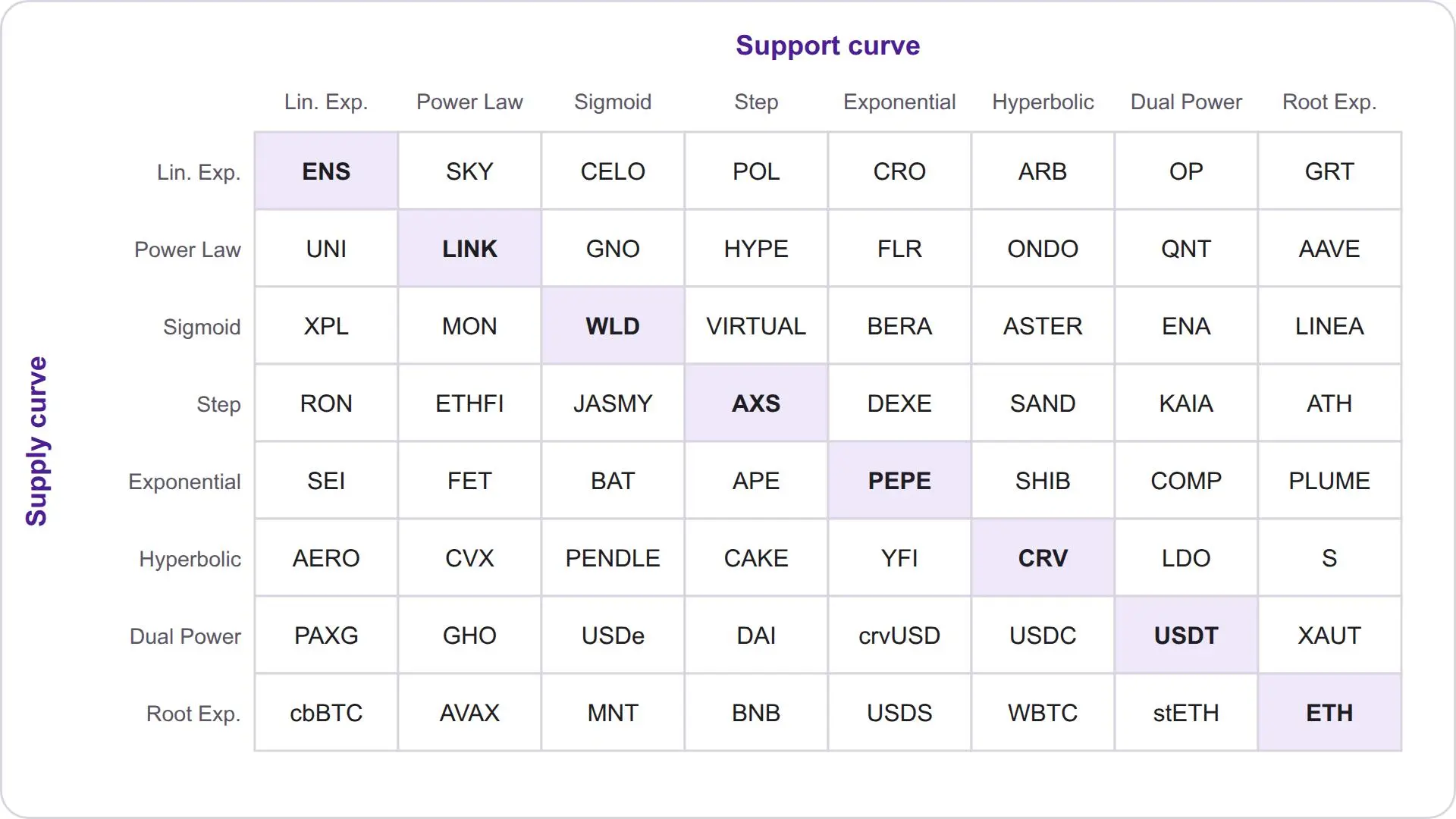
Figure 4. The 64 markets. Each row is a supply curve and each column a support curve; every pairing occurs exactly once, labelled by its collateral. The shaded diagonal marks the eight markets whose two curves are the same family.
Token Supply
The token contracts start with zero supply and provide no pre-mine, team allocation, vesting reserve, or privileged mint. Tokens are minted by paid internal buys against credited collateral. The deployer receives no automatic token allocation and can participate only through the same public market or ordinary transfers as anyone else. Constructor deployment by itself does not mint tokens.
Collateral Model
Each market accepts a single, fixed collateral token. Some markets accept a chain’s native or chain-identity token (ETH, AVAX, BNB, POL, S, ARB, KAIA, FLR, MON, BERA, GNO, MNT, HYPE, CRO, SEI, OP, LINEA, CELO, XPL, PLUME, RON); others accept a specific ERC-20 token (LINK, UNI, AAVE, USDC, USDT, DAI, PEPE, SHIB, and others). The display grouping and contract-template split are different axes: 17 native-gas deployments use PUNZI.sol, while the remaining 47 use PUNZI_ERC20.sol, comprising 4 chain-identity tokens that are not their chain’s gas token (ARB, OP, GNO and LINEA) and 43 third-party ERC-20 identities. The supply and support curves are selected from eight formulas each. Burn behaviour, fee logic, and the renounced-ownership model follow shared rules across all 64 deployments, while collateral handling differs between the native and ERC-20 contract variants.
Each reserve consists of its designated collateral, not a diversified portfolio. Internal pricing has no USD feed. Each contract reads its live collateral balance: native pools use address(this).balance and ERC-20 pools use the collateral token’s balanceOf. Treasury backing is therefore measured in units of that collateral, whose external value can change.
PUNZI-stETH note: The contract reads the live stETH balance, so a positive rebase can increase its reserve and a negative rebase can reduce it without a PUNZI trade. This is inherited collateral behaviour, not a PUNZI yield mechanism or forecast. A buy credits the lesser of the requested amount and the observed positive balance increase, allowing transfer rounding or charges to reduce the credited receipt. Rebase changes can affect treasury-based metrics, including TVL and Retention, without new participation.
13. Security Model
Core Protections
• Reentrancy guard: OpenZeppelin ReentrancyGuard protects all buy and sell entry points. ERC-20 buys collect collateral before updating trade state; outbound collateral transfers occur after the trade-state updates.
• Arithmetic bounds: default checked Solidity arithmetic is supplemented by guarded and unchecked helpers. Saturation and exponential bounds limit some operations. See Section 6’s numerical conventions.
• Solvency guarantee: every sale is priced and capped in one calculation, so no sale can ever pay out more than the treasury holds. The treasury cannot be overdrawn, on any path.
• Slippage protection: minTokensOut checks tokens minted. Native minValueOut checks net seller payout; the ERC-20 variant checks the seller’s observed collateral balance increase, so transfer charges can cause a revert.
• No trading price oracle: internal buys and sells use on-chain curve and book calculations. External USD feeds serve frontend comparisons only. The token has an internal fallback for unsuccessful or invalid companion responses.
• Minimum purchase: an immutable collateral-denominated minimum limits dust-sized buys. Its constructor-set amount is expressed in collateral units and does not track later USD prices.
• Safe transfers: the ERC-20 variant uses OpenZeppelin SafeERC20 for the buyer’s payment and the seller’s payout. This handles the usual optional-return conventions.
Ownership Model
The four ownable contracts, the two token templates and their two factories, inherit OpenZeppelin Ownable, and ownership is renounced at deployment: instance ownership first, then factory ownership. On token instances the only working owner-gated action is renounceOwnership(); transferOwnership() always reverts. Public trading has no owner-only path. The companion is ownerless. The PUNZI WARS contracts contain no pause, upgrade, or treasury-withdrawal function. In the fully deployed configuration, instance and factory owners are address(0), the zero address, which no one controls: the contracts have no owner.
Unsolicited Native Transfers
The native template accepts unsolicited transfers through receive() external payable. They increase the live native treasury without minting tokens, changing k, or creating a personal repayment claim. ERC-20 pools can likewise receive direct collateral transfers outside buy(). Such balance changes can affect sell quotes and rankings. Supply starts at zero; a donation is not a token purchase. Internal buys use the ordinary collateral-transfer path rather than crediting an unsolicited transfer to its sender.
Decimal Normalisation
Collateral decimals are fixed through the constructor; supported normalisation uses collateralScale = 1018 − collateralDecimals. Inputs enter a common 18-decimal mathematical space and outputs are converted back to native collateral units. Common units do not mean identical precision: a six-decimal collateral loses fractions smaller than one native unit when results are converted back, while an 18-decimal collateral can represent smaller amounts.
14. Contract Architecture
Two Contract Variants
Feature | PUNZI.sol (Native) | PUNZI_ERC20.sol (ERC-20)
Collateral | Chain native token | Specific ERC-20 token
Deposits | msg.value | safeTransferFrom
Payouts | call{value} | safeTransfer
Treasury tracking | address(this).balance | token.balanceOf(this)
Approval needed | No | Yes (ERC-20 approve)
Both variants share the same curve-mathematics framework, fee structures, Storm Mode behaviour, and core trading-state model. They differ in how collateral is configured, deposited, held, and transferred. The decimal normalisation pattern (collateralScale) is identical in both.
Immutable Constructor Parameters
name: Token name (“PUNZI” on all deployments).
symbol: Collateral-specific symbol (PUNZI-ETH, PUNZI-LINK, etc.).
supplyCurve: Enum (0-7) selecting the supply curve formula.
supportCurve: Enum (0-7) selecting the support shape and base-spread family.
minPurchase: Minimum collateral per buy transaction.
collateralDecimals: Collateral token precision used for normalisation; distinct from PUNZI token decimals.
curveParam1/2/3: Three immutable supply-curve parameters, exposed as separate getters.
maturityScale: Per-deployment maturity denominator: the lifetime supply position divided by this constant is the maturity m every spread schedule ages on.
phSolver: Address of that chain’s support-book solver: the immutable, ownerless companion contract every sale prices through (with an internal fallback if a call to it fails or gives an invalid answer).
collateralToken: ERC-20 deployments only: the collateral token’s contract address (native deployments hold the chain’s own coin instead).
State Variables
cumulativeK: Monotonically increasing supply position (never decreases).
totalSupply: Current circulating token supply (decreases on burns).
stormMode: Derived view: true while lastStormTriggerTime ≠ 0 and now < lastStormTriggerTime + 9h (no stored flag; the zero sentinel means no tier-3 sell has ever happened).
lastRatchetTime: Timestamp of the last spread snap (tier-2/tier-3 sells only; buys never write it); the deployment time until the first snap.
lastSnapSpread: Spread level the last tier-2/tier-3 snap set (0 until the first snap; until then the base spread at the current maturity stands in); recovery lerps it down to the 3% floor.
lastStormTriggerTime: Timestamp of the last tier-3 sell, start of the 9-hour Storm recovery window (no cooldown exists; the window simply expires).
spreadRecoveryDuration: Recovery clock stored with the last spread snap (90 min for a medium sell, 9 h for a large one; slow-only: a snap never shortens a recovery already in flight); 90 min from deployment until the first snap.
phBook(): The support book’s stored anchor, readable on chain: the tip’s stored position, its stored depth, the timestamp the current recovery runs from, and that recovery’s length in seconds. The live tip and its depth are computed from these with cumulativeK, circulating supply and the treasury. A buy can commit an updated tip, but does not reset the recovery timestamp or change its length. The tip recovers from that timestamp over that length; every sale restarts the timestamp and sets the length (Section 7).
the tip: The top of the sell-side book, anchored towards the lifetime purchase position; the book is the window of its depth below it. On the normal solver path, a sale leaves its stored position at the pre-sale position minus the tokens sold (or zero); if the solver call fails or gives an invalid answer, the internal fallback resets it to remaining supply. It recovers to the lifetime purchase position; the companion’s treasury-coverage search sets its depth there.
the depth: How many tokens the book covers below the tip. Its target is the deepest window, no deeper than supply or the tip’s position, that the treasury pays at the 3% spread floor; after a sale the depth moves towards a higher target over the tip’s recovery and drops at once to a lower one. A sale consumes it from the tip down.
totalVolumeIn: Cumulative net credited buy collateral after the PUNZI buy fee, in native collateral units.
totalVolumeOut: Cumulative nominal net seller payouts after the PUNZI sell fee; is not reduced by any transfer charge the collateral token itself deducts from the seller’s receipt.
uniqueBuyerCount: Lifetime distinct addresses that executed internal buys; not unique people or current holders.
Events
Buy and sell events record the participant’s wallet address, collateral amount, token amount, price field, and protocol fee. Native Buy records msg.value; ERC-20 Buy records the credited gross receipt, which can be below the requested amount. These event amounts differ from totalVolumeIn, which records net buy collateral. Native Sell records the nominal net seller payout; ERC-20 Sell records the observed positive increase in the seller’s collateral balance after transfer. The Sell events’ effective price fields use those respective amounts. Both variants accumulate nominal net seller payouts in totalVolumeOut, so ERC-20 event receipts can differ from that counter. StormModeActivated is emitted for a fresh Storm; a restart updates lastStormTriggerTime without another activation event. Expiry is automatic and has no deactivation event. Read the live Storm window from its timestamp and the support book from phBook(), rather than reconstructing either solely from event counts.
Closing
15. Conclusion
The Securities Exchange Company needed 160 million postal reply coupons, and there were about 27,000. The distance between what an arrangement says it holds and what it actually holds is where growth-dependent finance has traditionally kept its surprises -- and its crises.
PUNZI WARS leaves no room for that distance. Each of its 64 treasuries is simply a balance on a public blockchain, readable by anyone at any time, and no sale can be paid more than that balance. The price position on each curve only moves forward, every sale burns the tokens sold, and the fees are fixed in code at 1% and 3%. Nothing in the contracts lets anyone change the rules, pause a market, or reach into a treasury, including the people who wrote the code.
What remains open is the part no contract can settle in advance: who buys, who sells, in what order, and on which of 64 markets. That is the game, and the leaderboard keeps the score. The market rules are written and cannot be rewritten. The rest runs on its own: immutable code on public blockchains, with no owner, no operator and no one in charge but the people who buy and sell. Let the PUNZI WARS begin!
___________________________________________________________________________
This completes The PUNZI Papers, a series of essays explaining the reason for our project, PUNZI WARS, and the potential we think it points to.
Advisory: PUNZI WARS is a game and an on-chain research experiment. It is not an investment. Participate at your own risk.
Visit us: https://punzi.xyz Follow us: Lens (Hey) · NOSTR (Primal)
PUNZI WARS Whitepaper • November 2026 • Copyright © 2026 Charu Punjani