
Zen blog post in Russian
https://dzen.ru/a/ah7BSpi8qgQFr9ER
The budget of Russia: 50 trillion rubles and what Russia could get instead of a war economy
The main economic issue of modern Russia and budget expenditures: missed development, which we prefer not to notice, mathematical analysis of the opportunity cost of 50 trillion missed future, which has changed the Russian economy.
A short introduction
Here is a financial and mathematical analysis of missed opportunities, compiled on the basis of open data on the execution of the Russian federal budget and macroeconomic indicators by 2026. This material does not pursue political or propaganda goals, does not aim to discredit government institutions or decisions, but is a dry analysis and modeling of an alternative scenario for the development of human capital. This is an attempt to assess the effectiveness of allocating the country's colossal resources solely in terms of long-term economic and demographic effects.
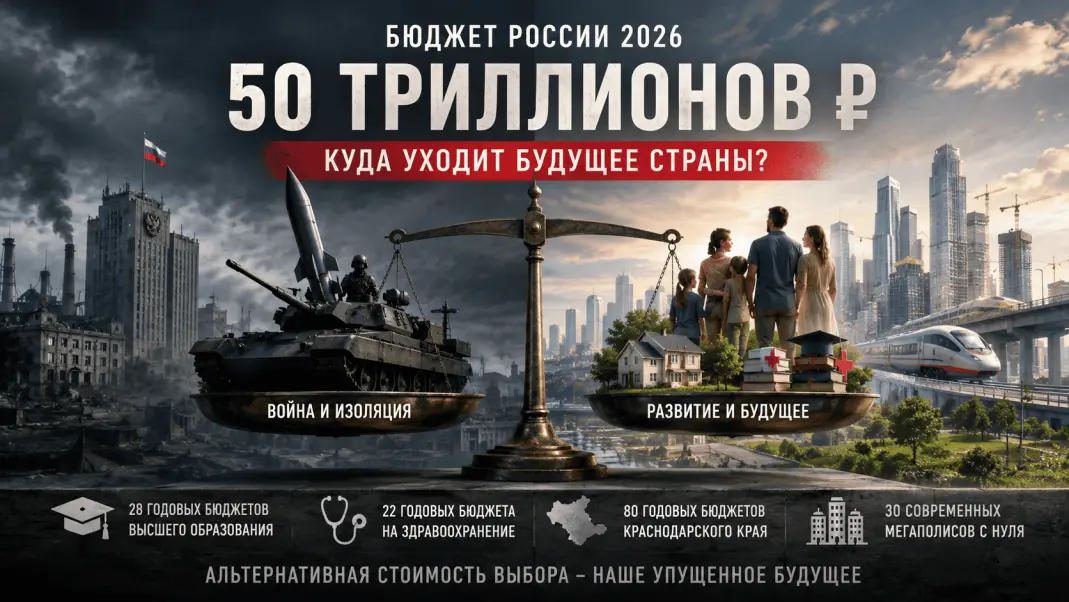
The Anatomy of a Missed Future: The Price We Didn't Notice
It's a strange feeling when you think about the fact that we live in one of the richest countries in the world. This is not an irony or an exaggeration. Our state has enormous resources, but when the figures of budget expenditures exceed the twelve-zero mark, human perception turns off. Billions and trillions turn into abstract white noise, an element of dry graphics. Meanwhile, according to the most conservative economic estimates, the country's direct and indirect costs for the defense sector and related expenses have already exceeded the astronomical milestone of 50 trillion rubles since February 2022.
To clear these reports of emotions and realize the true scale of the numbers, let's translate this gigantic mass of money into understandable macroeconomic comparisons. Fifty trillion rubles is almost 28 of the annual budgets of the entire higher education system in Russia. Or 22 annual budgets for the entire national health service. For regional comparison: This is almost 80% of the annual budgets of such a large and economically developed region as the Krasnodar Territory. For this money, three dozen modern megacities with all infrastructure, roads and scientific clusters could be built from scratch inside the country.
Within the framework of economic theory, there is a basic concept — alternative cost. To understand it in practice, let's conduct a simple thought experiment. Imagine that the government would set out to solve the long-standing demographic crisis and attract human capital to the country in an exclusively peaceful, creative and financially attractive way. Let's say we invite five million people — those who are close to our language, culture and historical heritage, but who find themselves divided by borders.
If the country paid 5 million rubles directly to each of these five million new citizens, including infants and the elderly, and purposefully invested another 5 million per person in their social development — the construction of high-quality housing, free education, medical certificates and the creation of new jobs. For a particular displaced family of three, this would mean 15 million rubles in cash and another 15 million in investments in their integration. With such a model, people from all over the near abroad would voluntarily and massively make a choice in favor of development within Russia.
What would the country itself get within the framework of this mathematical model? Five million new, loyal and motivated residents is a demographic breakthrough that can compensate for the natural decline of the population for decades to come. And most importantly, all the same 50 trillion rubles would not have burned irretrievably, but would have been poured directly into the domestic circulatory system. This would trigger explosive demand for housing, construction materials, machinery, domestic services, and farm products. Each such investment has a multiplier effect, when one ruble invested by the state generates two or three rubles in related sectors of the civil economy. At the same time, Russia would maintain full-fledged scientific, technological and trade ties with the world, avoiding the outflow of hundreds of thousands of young specialists and scientists, whose shortage the economy is acutely aware of right now.
But the real economic model turned out to be skewed towards the military-industrial complex. In current budget plans, expenditures on "National Defense" have reached historic highs, exceeding 12.9 trillion rubles, and together with items on "National Security", the military component absorbs a huge part of the entire state treasury. At the same time, a huge part of military spending — more than 80 percent — is completely classified, which excludes civilian control over the effectiveness of spending.
The disparity looks critical: 2.5 times more money is spent on the entire defense sector than on the entire social policy of the country (including pensions, benefits and support for large families). And the cost of a power machine is almost 7 times higher than the annual financing of the healthcare system and almost 7.5 times higher than the cost of education. Since 2021, these expenses have almost quadrupled, turning into a colossal burden, which results in record inflation for citizens, the tight credit policy of the Central Bank and an increase in the tax burden.
The current defense sector structurally repeats the late Soviet model. He actively consumes scarce resources, metal, electronics and personnel, creating jobs, but at the exit he produces a product that does not participate in further economic turnover. Tanks and shells do not add to the well-being of the civilian sector in the long run, missiles do not cure diseases, and military equipment does not build schools. This is an irrevocable withdrawal of capital from real life.
We don't just pay for this choice by increasing prices in stores. The most difficult, existential question is which model of the state we leave to future generations. A country where the economy is subordinated to isolation, and a huge part of the budget is hidden from its own society? Or a modern developed nation of creation, where people strive for life, security and prosperity?
Dry figures stubbornly prove the scientific truth: the long-term viability and true strength of any state is measured not by the radius of destruction of its weapons, but by the quality of life, health and the multiplication of its human capital. Any imperial concepts pale before the simple mathematics of missed opportunities, for the correction of which society will have to pay with time and well-being for many more generations.
Afterword
The calculation clearly demonstrates that economic resources are always finite, and their concentration on unproductive expenditures inevitably bleeds civil institutions. Historical experience shows that skewing the budget towards defense sufficiency to the detriment of human development creates only a temporary illusion of stability, but in the long run it deprives the state of the main foundation — a stable internal market and a healthy, confident society. Everyone will have to draw their own conclusions from these figures.
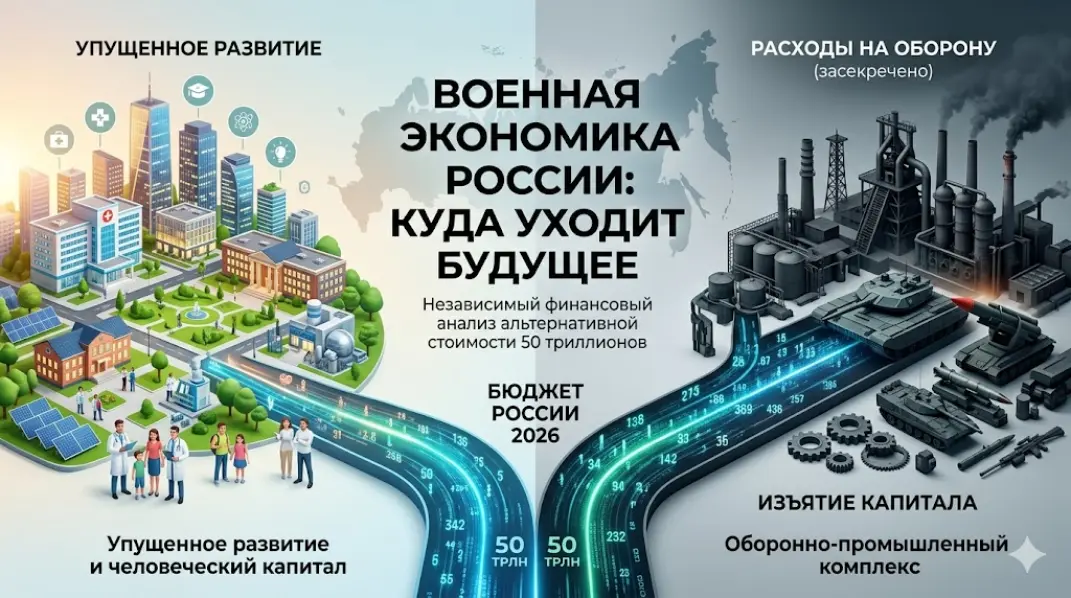
I write and shoot. Join me
Author's video content
https://www.youtube.com/c/ViolettaWennman
Political trash
https://www.youtube.com/@Ship-Shard
I invite you to the telegram channel
https://t.me/shipshard
Highly Social on Zen
https://dzen.ru/shipshard
For goodies
https://dzen.ru/shipshard?donate=true
My hobbies are history, philosophy, psychology, music, economics, politics, and sociology. I write about this and much more. Professional model. She has performed at international music festivals (vocals, dancing, imitation of vocalists). I am studying at the Academy of Arts - the film and art industry, I am a producer and the owner of a video studio.
I am glad to see all of you in my blogs.

You won't lose me here. https://t.me/shipshard






