
Zen blog post in Russian
https://dzen.ru/a/ac1vltpd8zlTLaVe
Strengths and weaknesses of American education and Russian education. Key differences in philosophy and factual examples of these differences. At the end of the publication, we will summarize the results of Russian and American education.
OK, let's talk about American education and compare it with Russian education. Naturally, I will reason from my bell tower and draw on my experience.
There is certainly a strong education in Russia, but as we know, everything is learned in comparison, of course. I really like facts, it's a precise and relentless thing. Let's look at the top 5 countries for secondary education:
1. South Korea has the highest school results in the world.
2. Japan has strong mathematics and science.
3. Finland is the benchmark of the school system.
4. Sweden has a high literacy rate.
5. Germany - strong STEM training.
But where is Russia? 17th-20th place (PISA and World Top 20 Education Ranking)
But where is the USA? 25th place, weaker than Europe and Asia.
Now the top 5 countries in higher education:
1. The USA is dominated by Harvard, MIT, UCLA, etc.
2.Great Britain - Oxford, Cambridge
3.Switzerland - ETH Zurich
4.Canada - strong universities + accessibility
5.Germany - free higher education, strong engineering
But where is Russia? The best Russian university is Moscow State University, about 200-300 places, St. Petersburg State University is lower. There is not a single Russian university in the top 100.
With the level of higher education by country, it is clear what is happening with the average. In what ways is Russian secondary education stronger than American secondary education? Mathematics in Russian secondary schools is stronger, and physics and chemistry are also at a good level. This is the main point. Russian children start studying algebra and geometry earlier, there are more hours of mathematics, the program is more complicated, the requirements are higher, and the Olympiad culture is strong. Also, the depth of the program in Russia is stronger: more subjects, more hours, higher pace, higher knowledge requirements, more homework. And here I am with my own inventions, but is it necessary? Do I need advanced math in school? The beginning of analysis, integrals, derivatives? Maybe someone needs it, but many people don't need it. It's a lot of hours of crying, homework, deuces, stress, wasting time on things you don't need. As a result, in Russia, everyone comes out of school smart, but they are generally not able to understand what to do in real workplaces and there is trouble with critical thinking. Education is good, but divorced from reality.
Let's get on with the facts. USA - 91-95% of adults have a High School diploma, which means they have graduated from grades 11-12. In Russia, 60% graduate from 11th grade, because they leave after 9th grade.
In the USA, 50% of adults have higher education, it is one of the most educated countries in the world. In Russia, 30% of adults have higher education, which is the average level in the world, which is also not bad. What are the strengths of Russian education? This is an academic base, especially mathematics, physics, chemistry. A lot of theory, a lot of cramming, heavy loads, deeper immersion in these sciences. High performance in Olympiads in these subjects. That's it, I think the pros are over and whether it can be considered a plus. You can, of course, but I want to talk about the practical application of education. We don't need education just for the sake of the process. And then there are only disadvantages, in my subjective opinion, please note, THIS IS MY SUBJECTIVE OPINION!
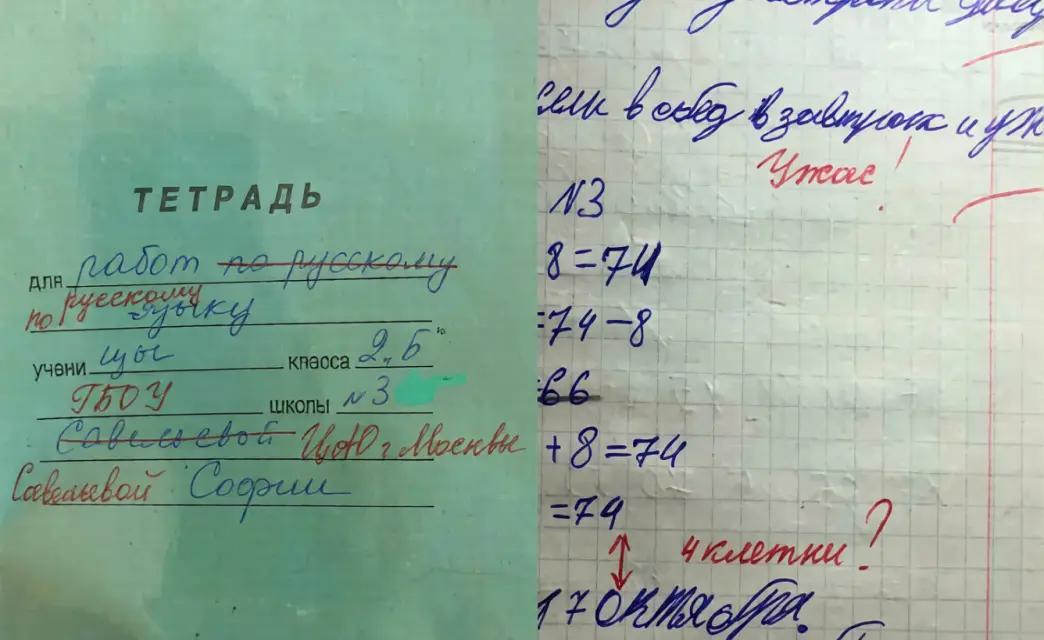
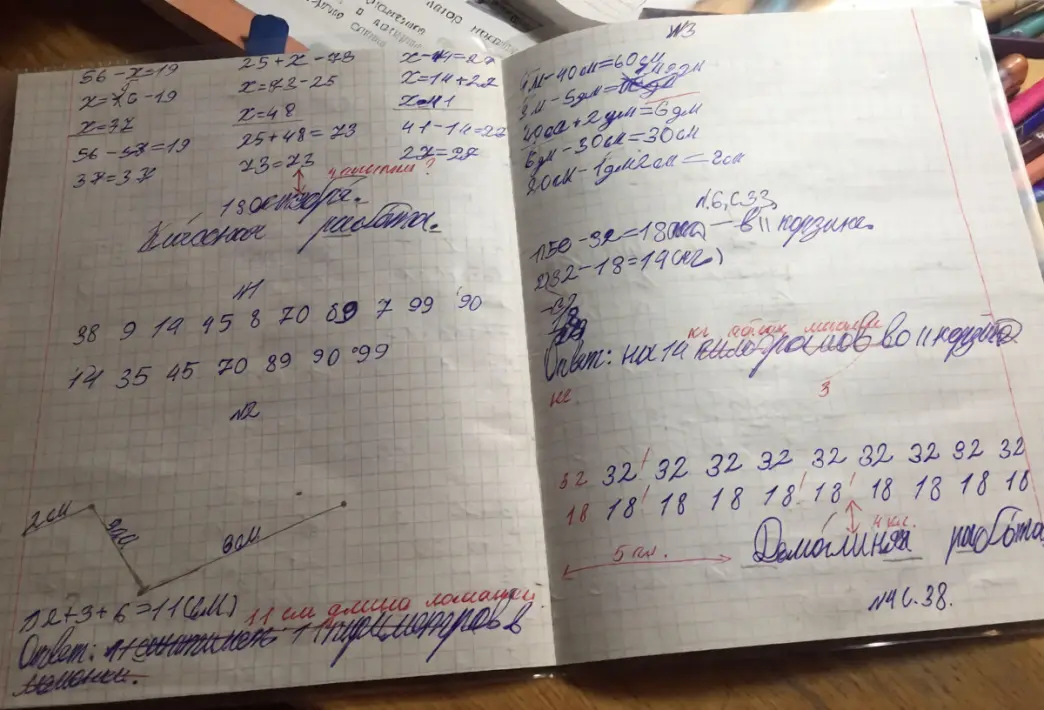
Overwork and cramming, a lot of theory and little practice, children get tired, many people don't need it all, little critical thinking, project work, teamwork, analytics. In the Russian Federation, you are already being invested and hammered into your head what is right and what is wrong. That's the trap, the Russian school seems to be strong, because there is a lot of theory, a high workload, a lot of math, a lot of homework, a lot of requirements, up to how many cells you need to step back to write "homework" and if not, then everything will be covered with a red teacher's pen, stress, pressure, fear of mistakes, outdated methods, authoritarian teachers. Oh my God! I wrote this and I even felt sick, I really hate it all in Russian school. So, let's move on to American education, as it was supposed to be about it. The United States is a country with one of the highest levels of higher education among major economies. The USA is the world leader in universities. There are about 40-45 American universities out of the top 100 in the world. And how many Russian ones? Zero?!
The philosophy of education in the USA and the Russian Federation is radically different. Russia has an academic workload, a lot of theory, and a unified curriculum. USA - flexibility, choice, individual trajectories. Maybe it seems to someone that if there are no 6 lessons, a lot of homework, strict requirements for completing assignments on the page, strict discipline, many hours of math and chemistry lessons, then this means a weak education?! I do not think so. In the USA, there is a humanistic model of education aimed at personal development. Basic principles: learning should be interesting, the teacher should be a partner, and the student should be a personality. Making a mistake is part of the learning process, and that's okay. Different levels for different kids. The main goal is the ability to think. A lot of practice, a lot of group work that requires collaboration, a lot of presentations, a lot of freedom of choice, many levels of difficulty. What does this lead to in reality? A weak student does not drop out, a strong student receives a high level, which is available in specialized lyceums in Russia.
In the United States, there is no single program for everyone, as in Russia, there are levels of difficulty, and the child learns at the level he is capable of. Regular is the basic level, Honors is the advanced level, Advanced Placement is the university level, Magnet programs are a specialized school within a school. All children start learning at a basic level, then the teacher sees opportunities and potential, children take tests, parents and students themselves can have priorities and desires, and students can move through the levels of difficulty on all these components. A child can be an Honor in Math and a Regular in English. This is completely normal. You can go to the highest level and, if it is difficult, you can go back down. The school is open in the summer, during the summer you can catch up with what you missed, raise the level. Summer school at the request of students and parents.
Subjects are formed differently, the whole education system is arranged differently. In Elementary schools, i.e. in elementary school, up to 5th grade there are such subjects:
- English Language = reading + writing + grammar + literature.
- Math = all mathematics in one subject.
- Science = natural sciences, biology, etc. (all together).
- Social Studies = history + geography + culture + economics.
- PE = physical education.
- Art / Music = art.
There's a lot of care at the Elementary, they're still kids there, kids, and they're considered toddlers.
Then there is the Middle School (secondary school with grades 6-8), which is the transition from children to adults. Mathematics is one subject, but everything is included there, both geometry and algebra.
In the 6th grade, the following subjects are taught: fractions, percentages, negative numbers, proportions, basic algebra (expressions, equations), areas, volumes, graphs and coordinates.
In 7th grade: linear equations, systems of equations (simple), proportional relations, probability, statistics, geometry: angles, triangles, circles.
In 8th grade: linear functions, quadratic functions (introduction), systems of equations, Pythagorean theorem, transformations of shapes, etc. With Middle School, the division into difficulty levels begins and everyone learns at a comfortable level for themselves.
The subject of Science is divided differently: Grade 6 - Earth Science (natural sciences, geography, astronomy), they study: the structure of the Earth, volcanoes, earthquakes, rocks, minerals, atmosphere, climate, oceans, weather, Solar system, planetary motion, Moon, tides, etc.,
Grade 7 - Life Science (Biology), they study: cells, DNA, heredity, bacteria, viruses, plants, animals, ecosystems, food chains, evolution, human anatomy, basic,
Grade 8 - Physical Science (physics+chemistry), they study: atoms, molecules, the periodic table, chemical reactions, acids/bases, energy in reactions, motion, speed, acceleration, forces, energy, simple mechanisms, light, sound, and more.
English is one subject, but it is internally divided into 4 components: Reading, Writing, Grammar, and Speaking & Listening. They read: novels for teenagers, popular science texts, articles, poetry, historical documents. They write: essays, argumentative texts, literature analysis, research papers. They often have contests for writing fantasy, detective stories, or horror stories. Prizes and gifts are given for the first places. In general, teachers are often rewarded with treats, gifts, badges, intra-school money with which to buy all sorts of nonsense, coupons for a free lunch at a local fast food outlet.
Another subject is Social Studies. This is an analogue of history + geography + social studies, but all together.
6th grade - Ancient Civilizations (Egypt, Greece, Rome, China, India),
7th Grade - World History (Middle Ages, Renaissance, Islam, Africa, Asia),
8th grade - US History (American history from colonization to the Civil War). Geography is included there: maps, climate, regions of the world, migrations, resources.
There are also Electives (elective subjects), for example: theater, music, choir, orchestra, art, robotics, programming, foreign language design, journalism, cooking, etc.
My daughter has an interesting Computer Science subject. It's practical digital literacy + programming basics + Internet security + project work. They study Internet security there (how to avoid scammers, how to recognize fake sites, how to prevent an account from being stolen, how passwords work, what two-factor authentication is, how to behave on social networks), how to make online purchases (how to compare prices, how to check the seller, what is a refund, what are subscriptions, how not to get into hidden payments), learn how to work with a computer (Google Docs, Slides, Sheets, creating presentations, working with files, cloud services, email), programming basics (Scratch, Blockly, Python (basic), algorithms and logic. They also play Minecraft there. Schools use Minecraft Education Edition, which is not just a game, but an educational platform. They build architectural objects there: houses, bridges, cities, farms, parks. They do engineering projects: Redstone mechanisms, automatic doors, elevators, traps, logic circuits. They create scientific models: a cell model, a volcano model, and a model of the ecosystem's solar system. They hold competitions: who will build the most stable bridge, who will create an automated farm, who will make the best "smart home", who will solve the problem faster with the help of command blocks. Training missions: programming agents (robots), performing tasks through code, solving logical problems. I want to draw your attention, I'm talking about a low-rated school right now.
In High School, subjects are finally divided in the same way as in Russia, chemistry and physics are separate, but not all of the subjects are required. There is a block of required subjects, and you choose the rest yourself. But you need to take into account, if you are going to university later, which subjects are required for this university. But even if you don't have enough of them for some compulsory subjects, you can always get them at another educational institution, such as a college. There is also PE (physical education), 2 times a week and Music where they sing and play musical instruments in an orchestra. In our school with three out of 10 points, there is a music class with musical instruments for each student: drums, trumpets, violins, cellos, keyboards, all kinds of xylophones, bells, timpani, microphones. A chromebook (laptop in Russian) is provided for each student, as well as all school stationery: pens, pencils, notebooks, in short, EVERYTHING, you don't need to buy anything. Everything is free at school!!! Including food.
So, let's summarize.
American secondary education does not place much emphasis on the depth of knowledge in mathematics, physics and chemistry. It exists in Russian education. American education does not imply homework, there is practically no homework, students manage to do everything in school. In Russia, there is a lot of homework, even in elementary school, all the free time after school and clubs, the child does homework, around which the whole family is nervous. In the United States, children are not engaged in penmanship and homework, there are requirements for the text, but this applies to high school, to writing an essay, for example. In Russia, there are very strict requirements, 3 cells here, four there. A lot of tears, stress, fear of making a mistake. But Americans at middle school still write like a chicken with a paw. But they type on the keyboard like the gods. In America, there is more freedom of choice in subjects and level of education, in Russia there is a single strict standard. There are pros and cons to this. You know what they are. Personally, I prefer freedom, I and my child regulate what we need. In Russia, everyone is stretched to the same standard, weak students are not allowed, the strong are bored, there is no room for choice. In America, the teacher is a partner, as an older friend, in Russia the teacher is a very authoritarian figure. In the USA, the difference between schools may be like between different countries, schools with a good rating, like elite schools with the level of Singapore, and schools with a bad rating, the level of Mexico. Therefore, in the USA, people with children choose housing near good schools. They look at ratings. But at the same time, in a weak school there is still a place for strong students, thanks to the levels and the Magnet system. Schools with good ratings are not paid, they are also free. It's just that if the school isn't right for you, you need to apply there. If they don't accept you, then you just stupidly rent an apartment in the area of the school you want to go to, it's not a problem, they have to take you. A low-rated school is not a dump, it's the same as a high-rated one, they just do worse on tests, with lower scores. Whether the education system in the United States is better or worse, I believe it is better because it is more flexible. All children are enrolled in normal basic secondary education. And here they do not draw beautiful results and do not hide emergencies, SMS messages are sent to parents about all events, even if something happened near the school. In short, this is such an extensive topic, you can't tell in one post.…
On the topic of education in the USA:
An ordinary school in the USA with a low rating
https://www.publish0x.com/professional-videoproduction/an-ordinary-school-in-the-usa-with-a-low-rating-xyqnvlq
A school in the USA and a competent investment by the state in its tomorrow
https://www.publish0x.com/professional-videoproduction/a-school-in-the-usa-and-a-competent-investment-by-the-state-xkeljmw
Music lessons in a typical American school
https://www.publish0x.com/professional-videoproduction/music-lessons-in-a-typical-american-school-xnjeyzk
Lockdown in an American school
https://www.publish0x.com/professional-videoproduction/lockdown-in-an-american-school-xjdzzpe
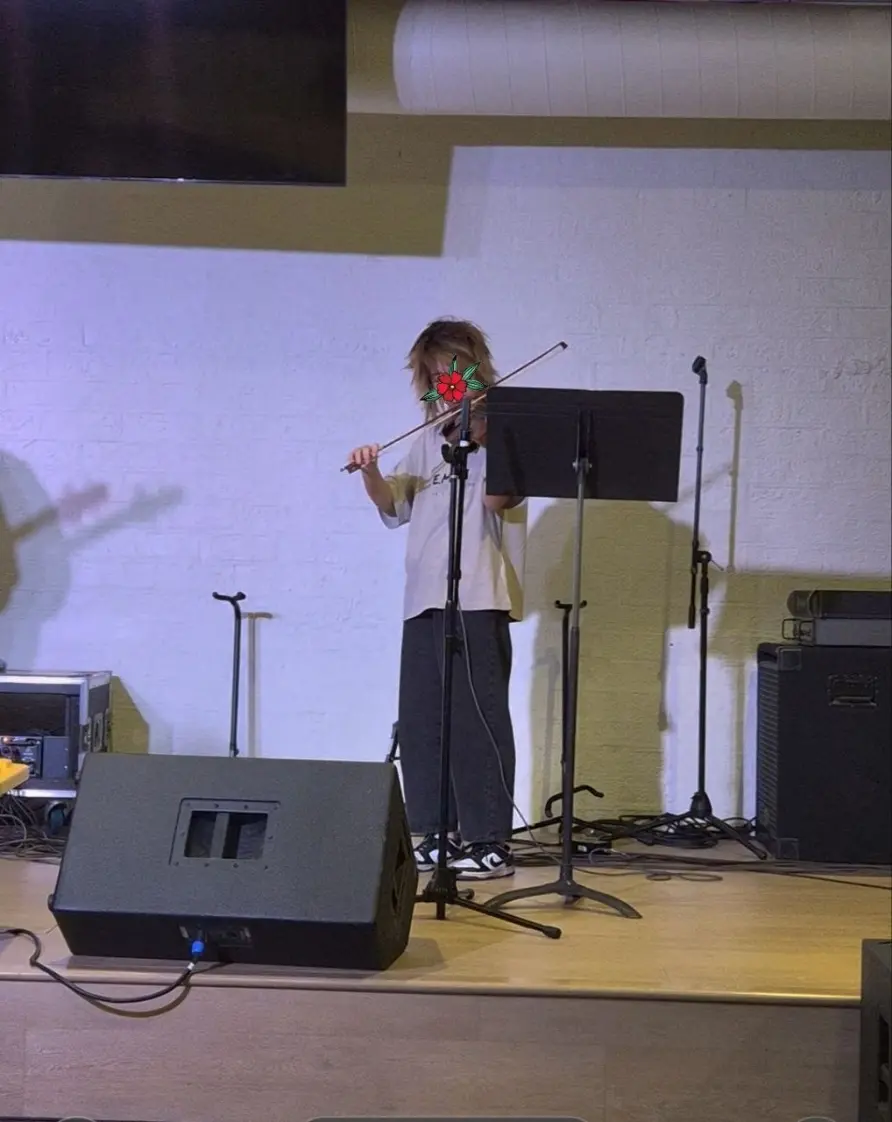
My junior Senichka was accepted into a cool High School (starting next school year). Here, each child has a school assigned to their residential address, but if you want to get to another one, you need to apply online in advance and if there are places there, you can be accepted. After Elementary School, we applied to a cool Middle music school (grades 5-8), but we never got an answer, we had to study at the designated address, and she only got 3 out of 10 points. Each school has its own rating, which consists of 3 main parameters: test results in mathematics and English, the gap between strong and weak students, and how the student's level of knowledge has increased after studying at this school. The rating is also influenced by school resources, parent reviews, and more. What I like about American schools is that in a weak school, you can still be a strong student while the teachers deal with the weak. Three times a year, there are internal school tests, the results of which determine the level of knowledge of students. Do you remember how in American movies there are often scenes where adults meet and say: do you remember how you and I were in math class together? So, according to the test results, my baby can be with some students in mathematics and with others in English. If you are a strong student, you will study in a stronger class, with a stronger composition. Three times a year you have a chance to go from weak to strong. If the subject is not given to you, you can study in this particular subject, in a class with an easy level, and in those subjects that are important to you, you can achieve the best grades. But that's not all. There is also the Magnet system, it is a school within a school, it is for the strongest students. If you are in Magnet, you can apply to enroll in another school with Magnet. You need to submit an online application there, and if you have high scores, then you will most likely be accepted. When I got to a weak school, I immediately applied to the Magnet program and my baby is now studying at Magnet. Now I missed the time to apply to High School again (because everything is different and it's hard to know the nuances in time) (this is from 9th to 12th grade) and had to apply for a late submission (even there is one for people like me), but remembering past experience, I thought that we would be ignored because I was late. But they TOOK us! The remarkable thing about that school is that my angel can play the violin there, form a band, and play in an orchestra. Graduates of this school easily become students of our good universities. In short, I'm happy as a rabbit. For information, the high school that went to our address also scored 3 out of 10. This is weak, and I would like to study at a good school before university.
How are things going with your kids now?
God has given man freedom of choice. And no other person has the right to take it away from you. I remain free and wish you all the same, to be free!
Anna Kim
https://vk.com/id2223883
So, the afterword from the author of the Ship Shard blog is summarized, structured and supplemented with facts.
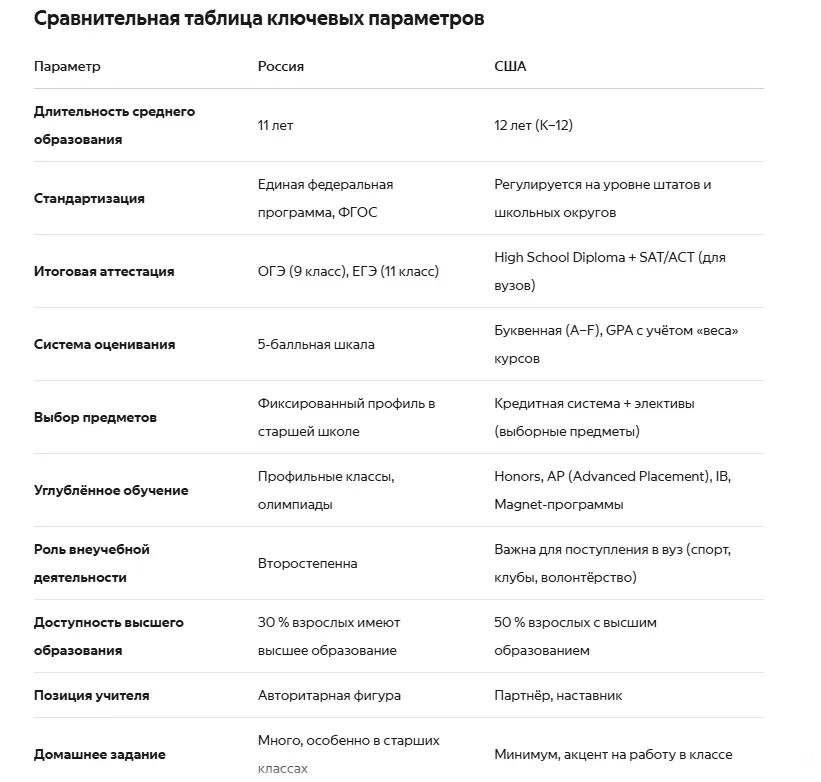
Comparative table of key parameters of education in the USA and Russia:
The strengths of Russian education:
- Fundamentality. Deep training in mathematics, physics, and chemistry is confirmed by the high results of international Olympiads.
- Uniform standards. They guarantee a basic level of knowledge throughout the country.
- Early study of exact sciences. Algebra and geometry start earlier than in the USA.
- Discipline and structure. Clear requirements for the design, schedule, and completion of tasks.
- Preparation for exams. The OGE and USE system trains stress tolerance and test-taking skills.
Weaknesses of Russian education:
- Overload. A large amount of homework, a high academic load, especially in high school.
- Little practice. Theory prevails over applied skills.
- Authoritarian teaching style. The teacher is an authority, not a partner; the fear of mistakes suppresses initiative.
- Standardization. The unified program does not take into account individual abilities: the strong are bored, the weak are difficult.
- Weak development of soft skills. Critical thinking, teamwork, and presentations are not a priority.
- Isolation from reality. Knowledge is often not applicable in real life or profession.
The strengths of American education:
- Flexibility. Difficulty levels (Regular, Honors, AP) allow everyone to learn at a comfortable pace.
- Individualization. The student chooses electives, builds a trajectory for their interests and goals.
- Development of soft skills. Emphasis on critical thinking, presentations, teamwork, projects.
- Practical orientation. Subjects like Computer Science teach real skills (programming, cybersecurity).
- A humanistic approach. A teacher is a mentor, and mistakes are considered part of learning.
- Availability of resources. Free laptops, office supplies, meals at schools, even those with low ratings.
- Support for the weak and the strong. Magnet programs for the gifted, additional classes for the laggards.
- The rating system of schools. Transparency: parents choose a school based on test results and student growth dynamics.
Weaknesses of American education:
- The gap between schools. The quality depends on the area (real estate tax), which creates inequality.
- Low depth in exact sciences. Mathematics and natural sciences are weaker than in Russia and Asia.
- A formal approach to assessments. GPA can be inflated due to easy courses if you do not choose Honors/AP.
- Less academic rigor. The lack of strict requirements for registration and discipline can reduce responsibility.
- Dependence on motivation. Without personal interest, a student may choose courses that are too easy.
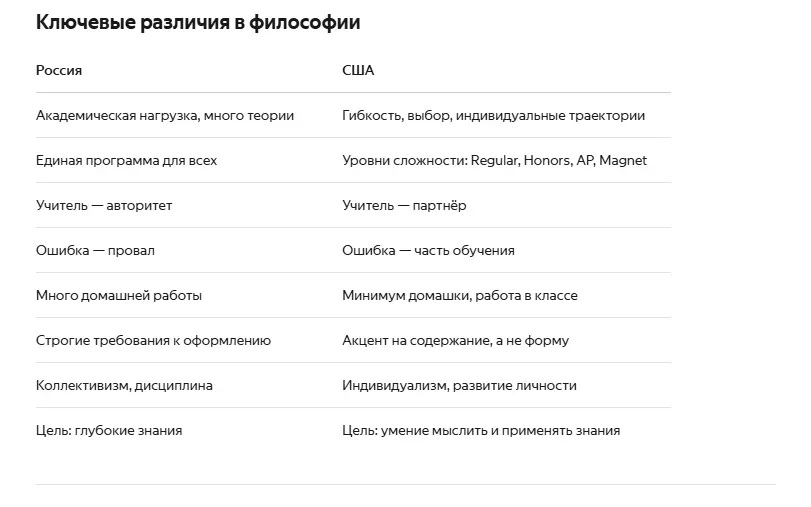
Key differences in philosophy in education between the USA and Russia:
Practical examples of differences:
Mathematics:
- In Russia: the early beginning of algebra / geometry, complex problems, Olympiad tasks.
- In the USA: gradual complication (grade 6 — fractions, grade 8 — fundamentals of algebra), difficulty levels.
Natural sciences:
- In Russia: individual subjects (physics, chemistry, biology) with in-depth theory.
- In the USA: in high school — integrated courses (Science: Earth, Life, Physical), in high school — separation.
Humanitarian subjects:
- In Russia: history, social studies, literature — separately, emphasis on facts and dates.
- In the USA: Social Studies (history + geography + economics), emphasis on analysis and discussion.
Technologies:
- In Russia: computer science as a separate subject, often theoretical.
- In the USA: Computer Science — practical digital literacy, programming, cybersecurity, using Minecraft Education Edition for projects.
Conclusion: which is better?
Russia is suitable for those who:
- plans a career in science, engineering, and precision disciplines;
- appreciates structure and clear rules;
- I am ready for a high academic load for the sake of fundamental knowledge.
The USA is suitable for those who:
- wants flexibility and freedom of choice;
- focused on the development of soft skills and applied skills;
- aspires to enter the world's top universities;
- appreciates an individual approach and partnerships with teachers.
The overall result:
- Russian education is an "academic foundation": deep, rigorous, but sometimes divorced from practice.
- American education is "personal development": flexible, practical, but requires self—motivation.
An ideal system would probably combine the strengths of both: the depth of the Russian exact sciences program and the flexibility/practicality of the American model.
Please support us, like-minded people, join the telegram channel https://t.me/shipshard






