
WORLD WAR I
WWI isn’t talked about nearly as much as it should be, but it was the first international conflict between imperialistic nation states that involved countries from other sides of the planet all being in conflict simultaneously. Improving technology and innovation paved the path for faster communication, faster transportation, deadlier weapons, more powerful governments, and innovative Money Changing methods. These innovations translated into a tremendous travesty for the countries involved including leveling entire cities with artillery shells and bombs, death, family, disease, and poverty.
Although we won’t discuss the battles or military movement of the war, we will discuss the staggering statistics of this conflict that were caused by greedy Money Changers and politicians. Most citizens don’t want to get involved in war, and would rather have peace. However, young men and women were dragged into WW1 by their respective countries while being threatened by jail time, manipulation, or worse.
We will talk briefly about the military movements within Europe to understand the progression of the conflict; The important role European and American Money Changers had in the struggle, including their lending partners, and some of the impressive profits financial families were able to acquire in their cozy mansions while unnecessary, bloody and violent death was occurring to children while being looked at as nothing more than collateral damage to the Money Changers on their path to global financial domination and to set their future generations up for a lifetime of wealth that will never know want because they already have everything. Also, the government power increasing will be a large topic of discussion that was due to regulation, the creation of federal institutions, and social obedience.
Politicians and Money Changer's desire for the expansion of their private wealth, power, and influence across the globe caused European superpowers to form economic and military alliances with each other. This process of creating alliances increased the tension and pressure for armed conflict in the region by having powerful countries fighting to become the ultimate powerhouse of Europe. Each respective super power’s politicians and Money Changers had their own goals, and those who had enemies of enemies became friends. The Triple Alliance consisted of Germany, Austria-Hungary, and Italy which had been formed in 1882. The Triple Entente was formed in 1907 due to the increasing tension of allies against the leaders of the Triple Alliance and consisted of France, Britain, and Russia.
The Conflict
The jolt of energy that sent the engine of war into motion was the assassination of Archduke Franz Ferdinand, who was the heir to the Austro-Hungarian throne and nephew to Emperor Franz Joseph I. The assassin was a man named Gavriol Princip, a young Bosnia-Serb on June 28th, 1914. In response to the death of his heir, Franz Joseph I blamed Serbia and demanded substantial and unrealistic reparations on July 23rd. Serbia denied the ultimatum on July 28th and Austria-Hungary quickly responded by declaring war on Serbia by dropping artillery shells in important Serbian cities hours later.
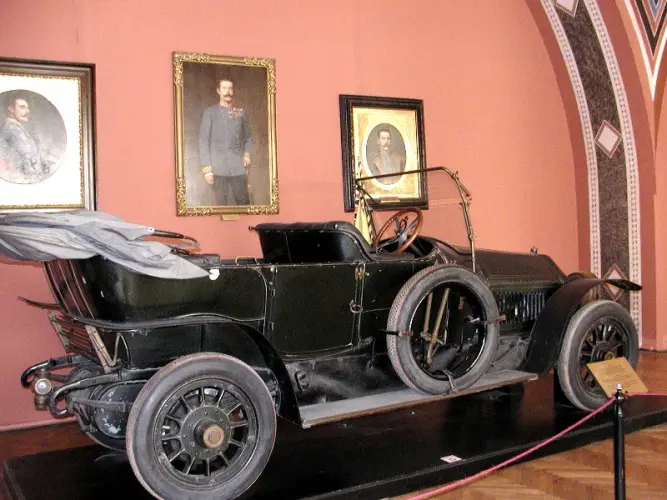
(The 1911 Gräf & Stift 28/32 PS Double Phaeton in which Archduke Franz Ferdinand was riding at the time of his assassination, Museum of Military History, Vienna (2003))
At the time, Serbia was acting as a Russian Satellite State and Tsar Nicholas II quickly came to their ally’s aid. Beginning in 1888 Germany had been run by William II, a descendent of William I, and was the primary decision-maker as the German Emperor. Wilhelm II of Germany had created a pact with Austria-Hungary that they would support each other militarily and he began directing his generals to prepare for battle while declaring war on Russia.
Italy and the United States remained neutral at first, while Great Britain only declared war on Germany after they began attacking neutral Belgium as a route to get to France on August 1st, 1914. The majority of Europe was now in armed conflict and the first World War was on its way. The great powers took up a large percentage of the military, however, their colonies were forced to be involved as well and the casualties were stacking up as more and more battles were taking place on the land and the sea.
By November of 1914, a new alliance called the Central Powers was created that consisted of the Ottoman Empire, Bulgaria, Germany, and Austria-Hungary. In response, France, Great Britain, Japan, Russia, and Serbia formed the Allied Powers with Italy joining in 1915 after the entry of Great Britain.
In the war's early stages, Germany was the second largest industrial force in the world, only behind the United States, and they were faced with enemies on two fronts. To the east, Germany’s main opponent was Russia and to the west their immediate threat was France, so William II had to make a strategic decision on which opponent to face first. Germany’s plan was to first attack France, as the Russian army would take a long time to mobilize. Therefore, Germany sent 6,000,000 troops to begin funneling toward their enemy.
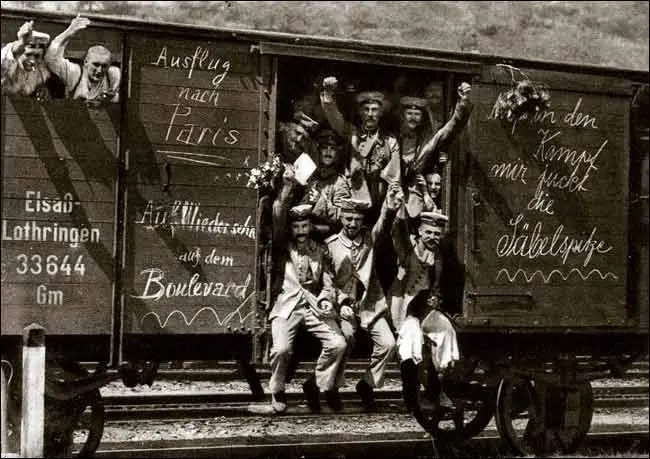
(German soldiers on the way to the front in 1914)
When Germany decided to attack France, their plan was to make their way through neutral Belgium in order to get a viable flank on their enemy. During their invasion of Belgium, German soldiers killed more than 6500 civilians and burned nearly 20000 buildings (Horne & Kramer 2001, ch 1–2, esp. p. 76). Furthermore, British newspapers published stories involving the rape of Belgium, child molestation, and other war crimes that stirred up emotions in citizens of the west, especially in the United States. However, these claims were found to be false and were only used as a way to instigate the United States' involvement in the war and manipulate citizens to believe that the US should enter the war.
Germany then made their way through Belgium and began marching into French territory planning to quickly sweep out France and move its forces to fight the large Russian Army to the East. However, this plan failed. When Germany reached France there were numerous bloody battles that led to stalemates. The result was each side digging into the ground for protection from automatic machine guns and artillery strikes. This was the start of what would be known as trench warfare.
In this type of fighting, military forces would spend a majority of their time in ditches that were dug out by hand and hardly ever gained ground because of the deadly weapons that were being used on each side. New weaponry such as heavy machine guns, artillery, and explosives were being manufactured in mass for each side to use against each other in war. This characteristic of battle created an unprecedented type of conflict those military leaders were not prepared for. On multiple occasions, army officers would send troops running across fields that were being hard-scoped by enemy machine guns and just within range of long-range armaments strikes that mowed people down in mass.
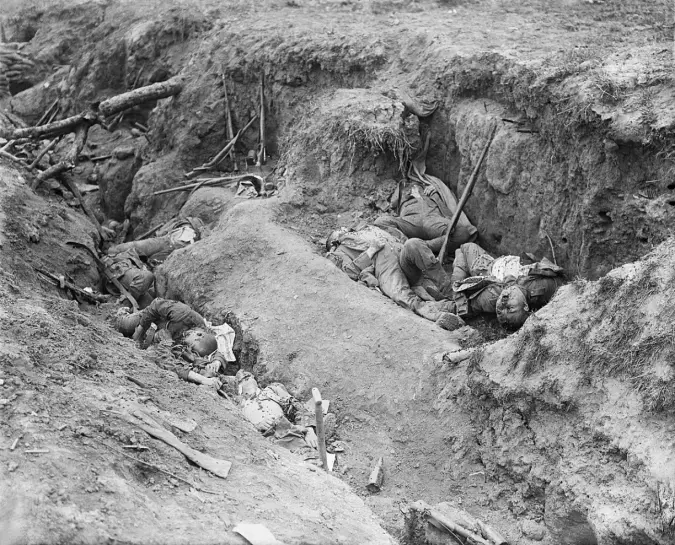
(Dead German soldiers at Somme 1916. John Warwick Brooke)
Attempting to try and gain an edge on their enemy, Germany and France would continue to try and outflank each other during the trench warfare until they reached the English Channel. Once they reached the ocean, trench warfare continued on the western front until about 1917, with soldiers living in some of the worst imaginable conditions.
On the Eastern Front, Russia immediately invaded Austria-Hungary in 1914. Russia was initially successful and was able to capture the important kingdom of Galicia and Eastern Prussia. However, by early 1915 Germany and Austria-Hungary had successfully defeated Russian forces, pushed them out of Galicia, and overtook Warsaw, emptying Russian forces of Poland. Even after Bulgaria’s entry into the war on the side of the Allies, the Central Powers delivered crushing defeats, solidifying their success on the Eastern Front.
(German Soldiers in Kyiv, during Operation Faustschlag)
Fearing the Central Powers' success on the Eastern Front, Great Britain had created a naval blockade in the English Channel and the Mediterranean Sea that served to slow down the delivery of food, energy, and war materials that could be used by the Central Powers. At the time, Great Britain had the largest and most advanced navy in the world, which gave them great success with their blockade. To counter Great Britain’s navy, Germany had created a military submarines called U-boats that were capable of deploying torpedoes underwater and striking without ever being seen. Germany was able to use its self-propelled torpedo technology to deliver the first successful attack against Great Britain’s naval vessels. This important new development would be a crucial part of Germany's military strategy moving forward and in “In the course of events in the Atlantic alone, German U-boats sank almost 5,000 ships with nearly 13 million gross register tonnage, losing 178 boats and about 5,000 men in combat” (Copping, Jasper. 20 December 2013)
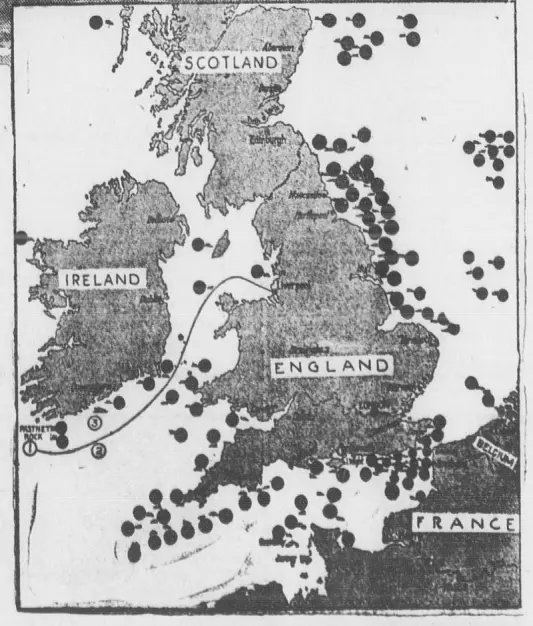
(1915 Map of German U-Boat Operations)
Another important development taking place across the world was the development of the flying machine, otherwise known as an Airplane. This innovation led to World War I seeing the first use of airplanes in combat. Zeppelins and hot air balloons had been used before, but the airplane offered a dynamic and fast weapon that could be used to gain a tremendous advantage on the enemy’s location, as well as deliver fatal blows. The combat in the air started with shooting machine guns out of the plane, but that proved to be ineffective. However, the air forces quickly adopted, and by 1915 machine gun synchronization was possible that allowed fighter pilots to shoot bullets directly through the propellers.
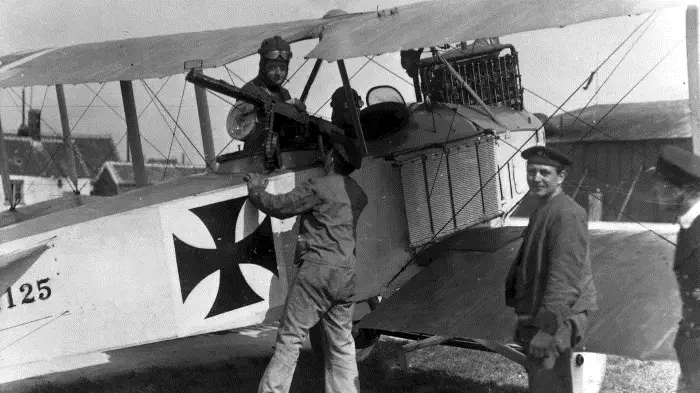
(A reconnaissance aircraft/combat two-seater pictured on a German naval airfield as an aerial gunner checks the machine gun. History.com)
After the Central Powers were having large success against Russia on the Eastern Front, the Russian citizens started a revolution in 1917 empowered and led by Vladimir Lenin that would last until 1923. When the revolution began, the Russians suffered around 5,000,000 causalities or prisoners as a result of the war. The revolution started when the lower and middle classes began occupying important areas in Petrograd (now St. Petersburg) and Tsar Nicholas II ordered troops to fire upon the revolutionaries. After the protests became too overwhelming the troops refused to fire upon the ground and a provisional government called the Petrograd Soviet was set into place. However, the Petrograd still wanted to maintain Russia’s place in the war, which stirred intense controversy among citizens, politicians, and front-line troops who wanted to return home to see their families. Therefore, in 1917 the German government helped Vladimir Lenin lead a new Russian party called the Bolsheviks and called for an end to Russia’s involvement in the Great War. This was popular among Russian citizens and Lenin quickly became an influential politician.
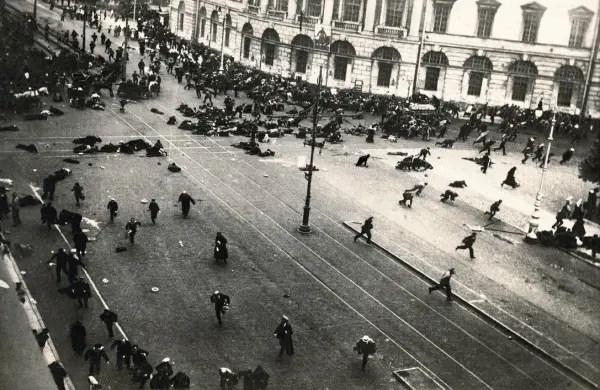
(Petrograd AKA Saint Petersburg, July 4, 1917, around 2 PM. just after troops of the Provisional Government have opened fire with machine guns)
Russia was now out of the war and the only enemy on the Eastern Front the central powers had to worry about was Romania. However, facing Germany and the other strong industrial powers, Romania had no chance and quickly surrendered once they realized they would no longer be receiving help from Russia. The Central Powers had won the War on the Eastern Front.
In the Southern Theatre, Austria-Hungarian was able to gain initial success against Serbia where they dominated the region for a majority of the war. In 1918 French and Serbia were able to effectively push out the Central powers because they had to focus their troops on other fronts.
Also in the Southern Theatre was Italy, who had had previously been friendly to Germany before the war. However, Italy was promised territory and resources from the Allied Powers if they were to join and be victorious and once Great Britain joined the allies, Italy's decision was to follow suit. Once the Italians were in the Great War, they focused their military efforts on fighting off Austria-Hungary although they had an ineffective army. However, Italians were granted some of the lands promised at the end of the war which is why people refer to World War I as the Italians Fourth Revolution, but this failed promise led to discontent with some in the Kingdom of Italy, which created a sense of a ‘mutilated victory’ for Italians. One of those who were dissatisfied with the acquisition of land was a journalist who turned into a politician to capture the nationalist spirit inside Italy, Benito Mussolini.
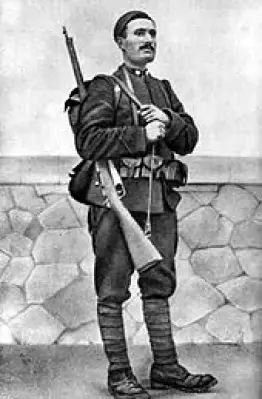
(Mussolini as an Italian soldier, 1917)
Another important development in the Southern Theatre was occurring within the Ottoman Empire. The systematic ethnic cleansing of Christian Armenians was occurring that started in 1915 and was carried out in two phases, with the first phase involving exterminating able-bodied men of all ages and the second stage focusing on the killing, raping and torture of women and children. When all was said and done 1.5 million men, women and children were dead. Death marches, being forced to practice Islam and torture were common for the victims. While Turkey, the successor of the Ottoman Empire, still denies its occurrence to this day.
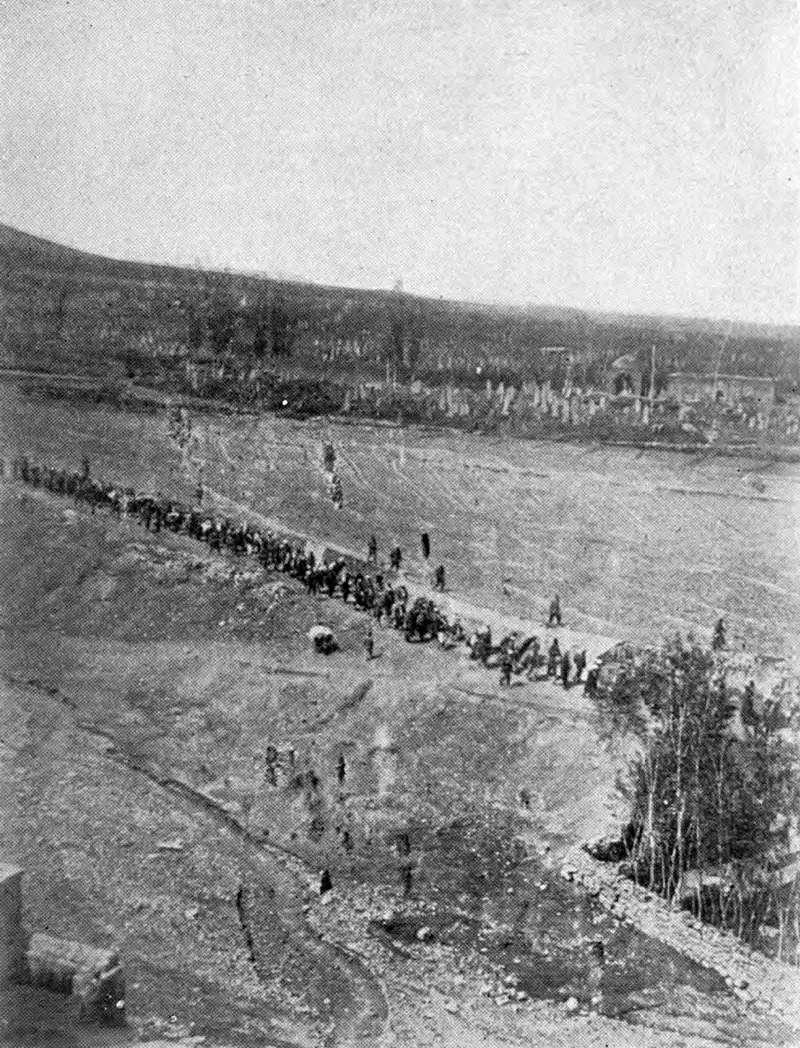
(Christians on the path across the great plains of the Mamuret-ul-Aziz)
Remember that on the Western front France and Germany were basically in a deadlock via trench warfare and Germany was successfully managing Great Britain with U-Boats. However, there was one country that would undeniably shift the momentum of the war that was still remaining neutral and that was the United States. What is questionable is how the United States became involved, after President Woodrow Wilson had sworn to neutrality.
There were two large factors that swayed the United States' decided to get involved in the war, the sinking of the Lusitania and the Zimmerman Telegram.
The Lusitania was a British passenger cruise line that regularly traveled from New York to Britain during the early 20th century. It was almost 1800 ft in length and carried over 2000 passengers on a regular basis from Liverpool to New York City and back. The British company Cunard Line, which eventually was absorbed into the Carnival Corporation, was created from British government subsidies that were intended to compete with the international transportation market that was monopolized by JP Morgan’s International Mercantile Marine Company (IMM). When the Cunard Line created the Lusitania, it was the fastest way to travel across the Atlantic in the world.
However, by the time the first world war broke out, the international waters the Lusitania traveled through were considered a warzone by both British and German authorities. The ship still made its regular trips from New York to Britain carrying passengers and other equipment as well. Some of that equipment included rounds for guns. It was legal and a normal custom at the time to be shipping regular gun ammunition through the passenger cruise lines because of the extra cargo space afforded to them. Then, like now, the ammunition went through inspection and had to be deemed non-explosive to legally store on the passenger cruise line. After the examination, the rounds are placed into large brown boxes to ship across the ocean. However, the amount of wartime cargo that was on the ship coming from a neutral country that was disguising their markings on the side of the ship and flying with no flags to represent their affiliation through a warzone was somewhat uncanny. Post examination of the event realized that the Lusitania was carrying over 340,000lbs of explosive missiles, rounds, ammunition, bombs, and more. This payload broke international maritime laws which explicitly didn’t allow for explosive weaponry to be transported on passenger ships, somehow bypassing the examination that should have taken place. The United States government kept this knowledge secret from the American public, including the countless passengers whose lives were directly put at risk, and left families without seeing their husbands, wife, mothers, fathers, and friends ever again. Let alone the internal eruption that began within the United States. To this day, salvage and research teams take extreme precautions when going through the wreckage because of the dangerous cargo that was being carried along the ship. but wait, there’s more.
The Lusitania made regular trips carrying unordinary amounts and types of cargo to the British until it was sunk. Now that the ship was no longer able to transport these goods, the United States had to hire a company to create and move merchandise. Who did they select? The International Mercantile Marine Company (IMM), a trust created by John Pierre Morgan. Morgan’s strategy involved owning British cruise lines, but he was unable to do so because of laws at the time. However, he was able to evade these rules by forming a trust, that would buy up the cruise lines throughout the world. The main focus of the IMM was monopolizing the international transportation industry. They owned 13 cruise lines through business deals, negotiations, and buyouts. His tactics included creating an interlocking directorate with cruise lines, railroads, and supply chains. An interlocking directorate is where the board of directors of a public or private company is made up of an interconnecting web of people that are on the board of directors of other public or private companies. This allows Morgan’s influence to be heard in multiple industries that he’s involved with. One of the cruise lines that IMM manufactured was the RMS Titanic 1912, which sank on her maiden voyage on April 15th from a collision with an iceberg. After the Titanic sank, which killed more than 1500 of its passengers and crew, the entire cruise line industry experienced a decrease in cash flows and revenues. In addition to a decrease of cash flow, IMM had taken far too much debt than it was able to pay back and ended up defaulting on its bonds in 1914.
As a result, in 1914, the same year the World War started and two years before the U.S entry, IMM was placed into receivership. A receivership is where an institution has custodial rights over the defaulting institutions' tangible and intangible assets, property, merits, and entitlements. The handling of the process was extremely favorable for Morgan’s company and allowed the trust to be saved from their financial problems as World War I started, which once again saved IMM finically by giving them an increase in business from their trips across the Atlantic and supplying of wartime resources to countries across North Africa and Europe. Resources that were concealed and illegal in a time of neutrality were being created and transported so Morgan’s company could earn profit and Woodrow Wilson could show off a booming economy, while still maintaining the illusion of noninvolvement in the world war.
On Friday, May 7th, 1915 in the midst of The Great War, it was hit by a torpedo from a German U-boat and sank in under 20 minutes. During this time, Britain was suffering from a drought in its production of ammunition and was shooting out far more shells than they were able to generate. In order to make up for this deficiency, they began importing from their allies who were already involved in the war. However, the largest empire at the time led by President Woodrow Wilson remained neutral and the World War hadn’t begun yet. Still, the British empire wasn’t getting enough firepower from their current allies, and with the United States lacking in production and President Woodrow Wilson had an upcoming election, he attempted to remain neutral while still profiting from the wartime calls of another country in order to boost the economy. During this time period, it was considered perfectly legal to ship ordinary bullets across the ocean in passenger cuisines. However, multiple survivors from the incident stated that there were two explosions. When the Times newspaper initially reported the event, they claimed that two torpedoes hit the liner, killing nearly 1200 passengers and crew, including 128 American Citizens. This event sparked outrage in the United States and the citizens of a neutral country were beginning to become more and more in favor of joining the war. Newspapers, media outlets, and the government began an outcry for joining the first world war on the basis of the Lusitania being attacked and began a propaganda campaign for recruitment and voluntary joining of the military with the Lusitania as a focal point. It began to sway public opinion which was initially neutral, into being certain the U.S should be joining the war efforts.
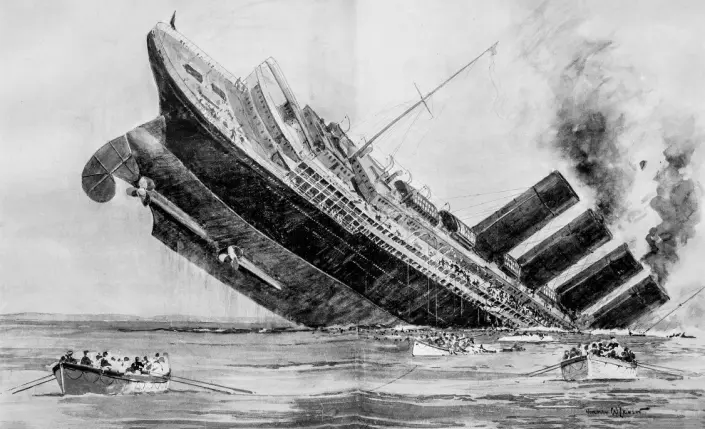
(Illustration of the sinking by Norman Wilkinson)
In conclusion, the British Lusitania was one of the false flag events carried out by the United States and British governments during World War I that included carrying illegal wartime explosives, munitions, and bombs in an undercover, an unmarked and disguised passenger cruise liner that was designed to transport citizens from continent to continent. Instead, Woodrow Wilson and the US government lied and kept secrets from the American and British citizens that directly resulted in their death. Furthermore, the operation after the attack was commissioned by a John Pierpont Morgan, a crook, whose main goal was to exploit those with less wealth in order to increase profits, monopolize the industry and show off profits for his family and shareholders. In addition, the event was used as a focal point of a wartime propaganda campaign that manipulated the public opinion into joining the Great War for two years preceding the United States' entry which officially made the event the World War we know about today. Media outlets across the country are using propaganda like newspapers, flyers, billboards, films, commercial advertising on televisions, and photography to control the minds and hearts of the people. These actions led to the beginning of the government's understanding that American citizens are docile beings, that are okay with being manipulated, abused, stolen from, and sacrificed. The most powerful of these manipulators were none other than our President Woodrow Wilson and Franklin D Roosevelt. Wilson had a speech, which outlined 14 points that the United States would be fighting for throughout the deadly encounter. People believed and subsequently taught, that the United States was fighting for a noble cause.
The second cause with the Zimmerman Telegram. Arther Zimmerman was a German Telegram Messenger who on January 17th sent a telegram to the German embassy in Mexico to propose an alliance if the United States were to enter the Great War. The Telegram was sent on US lines and was intercepted by British code breakers, where it was sent to the presidential office and made public by the government. When the news hit the papers, many people believed that it was a tactic used by the British to get the US involved with the war, because they feared losing to Germany. However, Zimmerman came out later and made a speech regarding the message that was intercepted. In the message, Zimmerman stated
“I declared expressly that, despite the submarine war, we hoped that America would maintain neutrality…. My instructions were to be carried out only after the United States declared war and a state of war supervened. I believe the instructions were absolutely loyal as regards the United States…. President Wilson after our note of January 31, 1917, which avoided all aggressiveness in tone, deemed it proper immediately to break off relations with extraordinary roughness. Our ambassador no longer had the opportunity to explain or elucidate our attitude orally. The United States Government thus declined to negotiate with us. On the other hand, it addressed itself immediately to all the neutral powers to induce them to join the United States and break with us.” (Speech Regarding the Zimmermann Telegram, 29 March 1917)
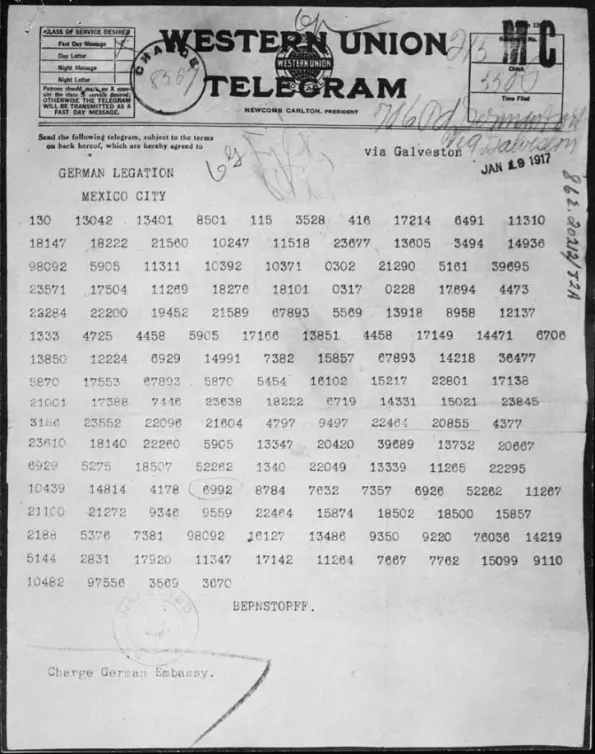
(The Zimmermann Telegram as it was sent from Washington, DC, to Ambassador Heinrich von Eckardt, the German ambassador to Mexico.)
Mexico responded by not supporting Germany as they were in the midst of their own civil war and feared getting involved in armed conflict with the United States. Three days after the speech by Zimmerman, President Woodrow Wilson asked Congress for a ‘war to end all wars the US officially declared war on Germany on April 6th, 1917. In December of that same year, Congress would declare war on the Austrian-Hungarian empire. Throughout the war, the United States mostly stayed uninvolved with the Southern and Eastern Theaters that involved Africa and Eastern Europe.
After only having around 300,000 trained troops, Congress passed the Selective Service Act which drafted more than 4,000,000 citizens to fight a war across the world. Furthermore, the US provided supplies, weapons, food, and weaponry at a rate worth millions of dollars per day. However, the United States didn’t fight in any significant land battles until 1918, which was the last year of the war, and therefore didn’t suffer substantial economic or military causalities.
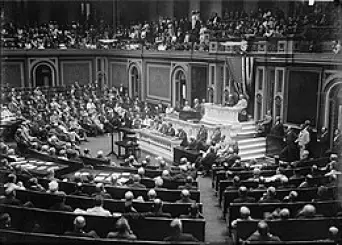
(President Woodrow Wilson before Congress, announcing the break in official relations with Germany on February 3, 1917)
The end of the war came when the Central Powers and their allies began waving the white flag and surrendering to the overwhelming strength of Allied Powers that was now led by the United States. The surrendering started with Bulgaria. Italy was able to push out the Austria-Hungarian influence side of the territory they believed to be theirs and achieved what many historians consider to be their final war for independence. Led to Austria-Hungary surrendering and the end of the Habsburg empire falling under the pressures of losing the Great War.
On November 9th the German Revolution would occur when high-ranking officials in the military disobeyed William IIs commands. He was abdicated and two days later Germany signed the Armistice that brought the fighting in World War I to an end. The result of the German Revolution was the establishment of the Weimer party that led in Germany until 1933, which we will discuss later.
Once Germany surrendered the Allied Powers came up with the Treaty of Versailles which was created to punish Germany for the pain inflicted on different regions of the world.
The treaty of Versailles created a committee in charge of retrieving the money from a newly formed government the Weimar Republic of Germany. The committee demanded Germany, a country that was already in massive debt because of the lost war, to pay back reparations that exceeded 130 billion Goldmark, a German currency that was backed by their supply of Gold. 2370 Goldmark’s equaled 1 kilogram of pure gold, which as of this writing costs about $61,000. However, during the first world war, Germany gave up the gold standard on their currency in order to pay for the mounting debts, which then turned their currency into Papiermarks (Marks). Since the abandonment of the gold standard, the value of the currency became less valuable, this is known as inflation. Germany continued to print Marks to buy the foreign currency that could be used to pay off their debts. However, this practice along with the reparations committee demanding they be paid in gold compounded the issue of inflation in the German economy and led to a phenomenon called Hyperinflation. To put into perspective how tragic the spectacle was, in the ladder part of 1922 a loaf of bread in Germany cost around 160 marks; only a year later, that same loaf of bread would cost around 200,000,000,000 Marks. Around that same time, 1 US dollar could buy around 4,000,000,000,000 Marks.
This intense currency devaluation had terrifying repercussions on the economy and led to hunger, protests, and in severe circumstances death. Toward the height of the rise of hyperinflation the citizens of Germany fell back on bartering goods and services in order to obtain things they needed to live, which is the most basic form of economic activity. Corporations couldn’t pay their workers; the price of foods and drinks would skyrocket from the time you ordered them to the time they came to your table and governments and economists were left to solve the issue.
This horrendous episode of hyperinflation led to the downfall of the Weimar government. Hans Luther, a German economist generated the eventual solution, which created a central bank and new currency called the Reichsmarks which was the currency until Germany split at the end of World War II. German citizens began to welcome the new currency in hopes of eradicating their economy of inflation and suddenly, there was a huge power vacuum that needed to be filled with the slow deterioration of the Weimar republic due to their failing policies, and there began a small under roar from a small political group being led by a young and decorated military veteran that would go down as the most famous public speaker in the world, Adolf Hitler.
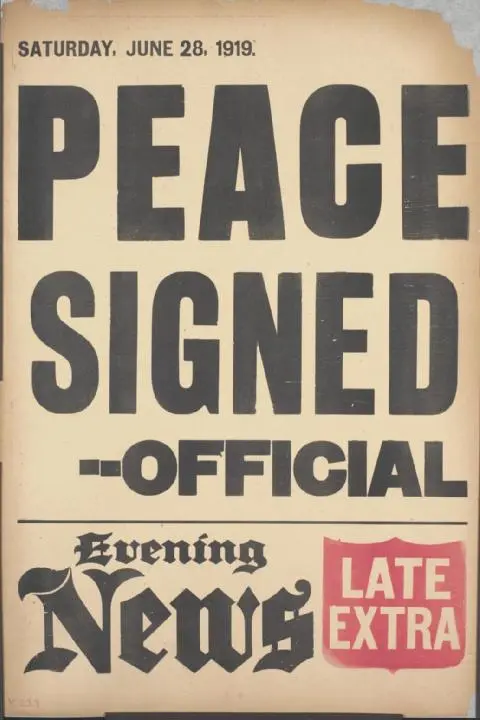
(A British news placard announcing the signing of the peace treaty)






