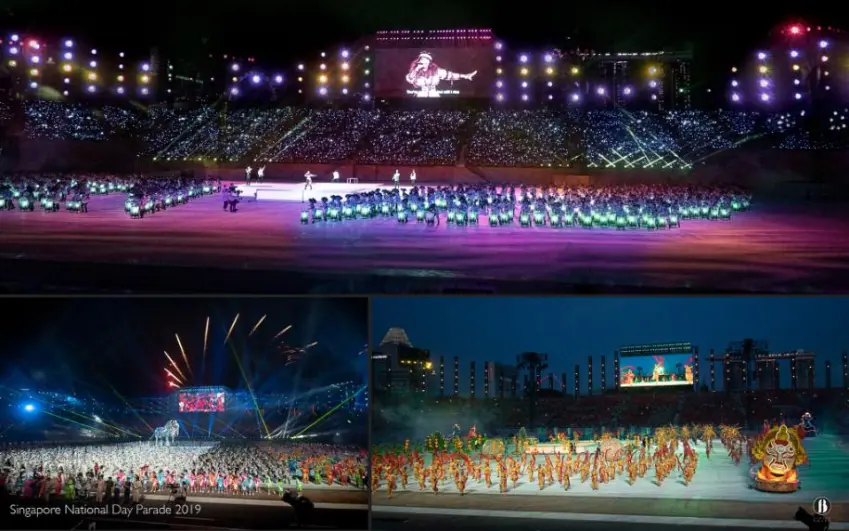
The production design problem that appears most often in my work is not scale. It's not budget, timeline, or technical constraint, though all of those have featured. The problem that recurs across every significant commission in the Studio Bound portfolio — across the NDP and Expo 2020 and the Dragone productions and the Las Vegas environments and the Olympic broadcast sets — is contradiction. The brief that requires two things that appear to be mutually exclusive. The design that has to be permanent and temporary at once, present and invisible at once, fixed and completely free.
For most of my career I treated contradictions as problems to solve — tensions in the brief that good design work would eventually resolve into a single coherent answer. The observation that changed my approach was gradual and then, at some point, impossible to ignore: the productions that resolved their contradictions too early produced work that was correct but not alive. The productions that held their contradictions — that lived inside the tension rather than escaping it — those were the ones that held an audience.
The Electric Motor
In my book on creativity I use a specific image for this: contradictions act like the magnetic poles in an electric motor — opposing forces that, when harnessed skillfully, generate motion. Resolve the tension, equalise the poles, and the motor stops. The contradictions are not the problem. They are the engine.
This is counter-intuitive enough that it requires real evidence to accept. The evidence is in the work. The productions at Studio Bound that have generated the strongest responses — from audiences, from clients, from the broader creative community — are consistently the ones where the design held an apparent impossibility together without forcing it into a single resolution. The design where structure and freedom coexist. The environment where presence and absence produce the same effect. The show where the constraint becomes the creative fuel rather than the limitation to be managed.
Understanding this changes how I read a design brief. The contradictions in the brief are not the parts to worry about. They are the parts to find, name, and then deliberately hold open for as long as possible — because the creative answer almost always lives in the space between them.
Red and White Are the Brief
The Singapore NDP 2019 is the clearest example in my portfolio of constraint producing creative freedom rather than limiting it. Red and white are fixed. They are the palette for the NDP and have been for every NDP. A designer who approaches this as a constraint to overcome — who tries to expand the palette, introduce neutrals, find ways to make the restriction less restrictive — is misreading the brief. The restriction is the brief.
What red and white actually is, in the hands of a designer who understands light, material, scale, and motion, is infinite. The red of a fabric in natural light is not the red of a fabric under saturated theatrical lighting. The red of a structure seen from sixty metres is not the red of a costume seen from three. The palette does not limit the emotional range available — it concentrates it and forces me to find emotional variation through every other available dimension. Constraint is the thing that gives imagination something to push against. The NDP palette, taken seriously, is not a limitation on the work. It is the engine of the work.
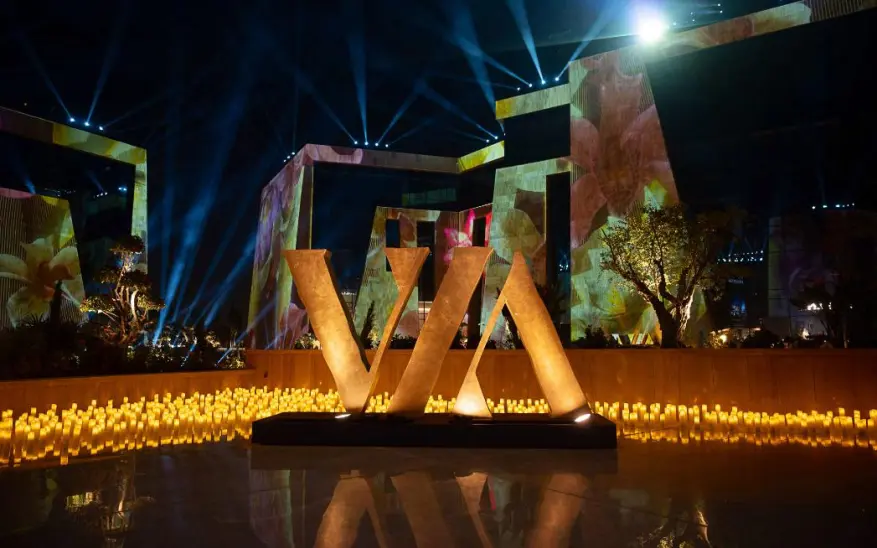
The Show That Has to Be Nothing
Via Riyadh 2023 is the most complete expression in my portfolio of the presence/absence contradiction. The brief was the opening gala for Riyadh Season — a high-profile event with John Legend performing for an audience that included the most significant figures in Saudi Arabia's cultural, political, and business life. The environment had to be significant enough to signal the occasion's ambition. And the moment John walked on stage, it had to disappear.
Those are not two separate requirements. They are the same requirement, stated from two directions. An environment that is visually compelling in the absence of a performer but that competes with the performer when he arrives has failed. An environment that recedes correctly but has no presence before the show begins has also failed. The design that works holds both conditions simultaneously — creates the occasion and then gives it away. That is only possible if you are comfortable working inside the contradiction rather than trying to resolve it toward one side or the other.
Twenty-five years of production design at global scale has produced one consistent observation across every commission I've taken: the best work does not come from the moment when the contradiction is resolved. It comes from the moment I stop trying to resolve it and start asking what it can generate instead.
Further reading: The Best Work Happens When You Stop Having All the Answers | Input, Processing, Output: The Creative Cycle That Actually Works

About Patrick Larsen
Patrick Larsen is an Emmy Award-winning production designer and the founder of Studio Bound, based in Singapore. Over two decades, he has designed environments for global audiences — from the Expo 2020 Dubai ceremonies and Olympic broadcast environments to Las Vegas residencies, Broadway-scale theatrical productions, and permanent installations across Asia and the Middle East. Studio Bound takes projects from concept to build with one fully integrated team of designers, concept artists, technical drafters, and production managers. Visit studiobound.sg or read more at patricklarsen.studio