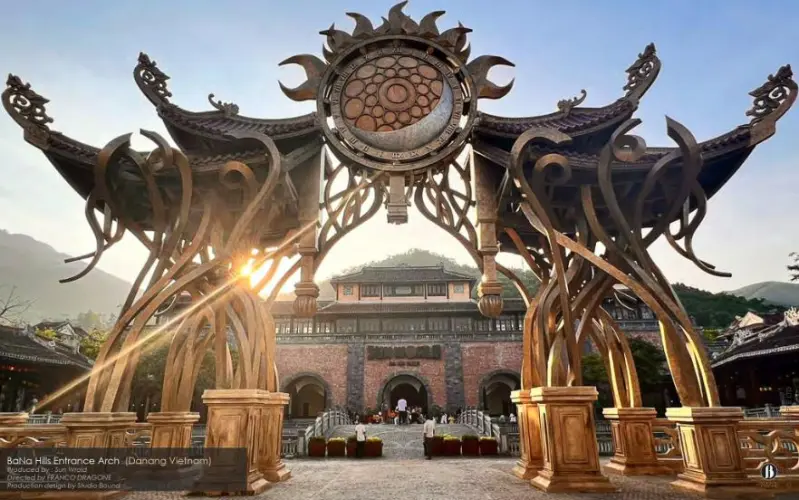
Most of what Studio Bound had designed was of a temporary nature. A National Day Parade exists for one evening. A Las Vegas residency runs for a season. Olympic broadcast environments are built, used for two weeks, and dismantled. Even installations that feel permanent — theatrical venues, attraction environments, themed spaces — are eventually renovated, rebranded, or replaced. The design discipline for temporary work is different from permanent work in ways that are easy to underestimate until you are doing both.
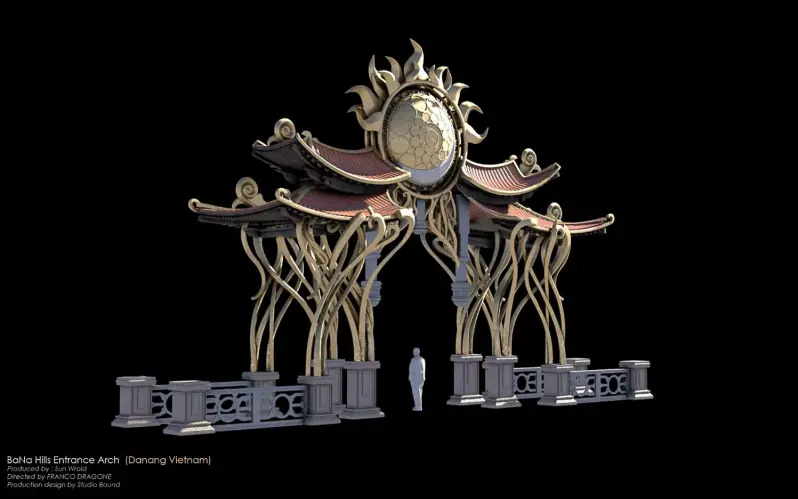
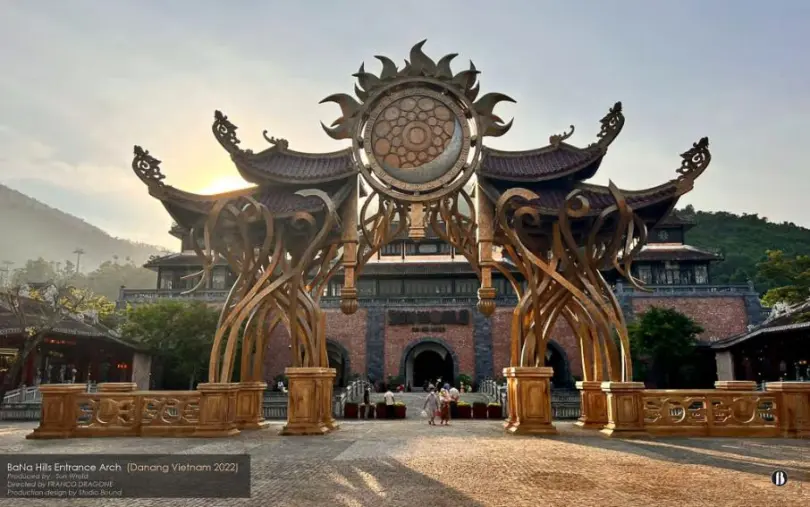
The Ba Na Hills entertainment environments in Da Nang, Vietnam — designed by Patrick Larsen and Studio Bound in collaboration with Sun Group and Dragone — are not temporary. They are architecture. They are built into a mountain resort that Sun Group designed to draw visitors for decades. When Studio Bound completed this commission in 2022, the question was not whether the design was strong enough for opening night. The question was whether it would still be strong enough in 2032.
When the Design Brief Is Forever
Ba Na Hills sits in the mountains outside Da Nang — a resort complex of extraordinary scale and ambition, drawing visitors from across Vietnam and from regional tourism throughout Southeast Asia. The brief Studio Bound received was to design entertainment environments that would become permanent features of the resort: not staging for a show, but physical spaces that would define the Ba Na Hills visitor experience across thousands of visits, across seasons, across years.
That changes every decision. For a temporary installation, a material that looks correct on opening night is a correct material. For a permanent environment in Vietnam's mountain climate — humidity, temperature variation, heavy visitor traffic — the question for every material is not "does it look right?" but "what will it look like in five years? In ten? Will it degrade in a way that communicates quality, or in a way that communicates neglect?" Materials that age gracefully become part of the environment. Materials that age badly become a maintenance problem that signals, to every returning visitor, that something is wrong.
Patrick Larsen's approach to the Ba Na Hills material palette was to treat durability and aesthetics as the same question rather than two separate ones. The most durable materials were the correct materials — not because cost savings were prioritised over quality, but because for permanent work, the material that survives correctly is the material that is doing its aesthetic job over the full life of the installation.
Designing for the Second Visit
The Ba Na Hills resort draws return visitors. Local Vietnamese come regularly. Regional tourists from across Southeast Asia build Ba Na Hills into their return trips to Da Nang. Families visit across years. The resort is not designed for the single experience of a tourist who will never return — it is designed for the community of visitors who will come back, and who will notice if the environment has changed, degraded, or stopped rewarding attention.
This changes the design philosophy fundamentally. A design that exists only for the first-encounter reveal — the dramatic first sight, the big opening moment — exhausts itself on the second visit. The guest who returns already knows what is coming. If the environment has nothing to offer beyond the reveal, the return visit confirms that the first visit was complete, and there is no reason for a third.
Studio Bound designed the Ba Na Hills environments with second-visit depth as a specific design requirement. Details that reward close investigation. Secondary sightlines that are only visible from positions visitors reach after the primary circulation path. Layers that accumulate meaning over multiple visits rather than being fully legible at first encounter. The environment was designed to be richer on the second visit than the first — which means it was designed to bring people back.
The Dragone Standard for Permanence
The Ba Na Hills commission was developed through Studio Bound's collaboration with Dragone — a creative framework with a specific and demanding aesthetic standard. Working with Dragone means working at a level of environmental coherence where every element justifies its presence, where nothing is decorative in isolation, and where the total environment is held to a standard of integrity that has no margin for the merely adequate.
For permanent installation work, this standard has a particular implication. In a live performance, the audience's attention is held by what is happening on stage. The environment supports the performance and is read in relation to it. In a permanent installation, there is no performance most of the time. The environment must justify itself entirely on its own terms — must be worth inhabiting in the absence of any event, for visitors who simply exist within the space with no other focal point.
At Ba Na Hills, the moments between performances happen thousands of times a day, across every visitor who moves through the space. Patrick Larsen and Studio Bound designed to that condition — building environments that are worth being in even when nothing is happening inside them. That is the level of work a permanent landmark demands. Ba Na Hills is that kind of work.
Further reading: Designing for Permanence | The Journey

About Patrick Larsen
Patrick Larsen is an Emmy Award-winning production designer and the founder of Studio Bound, based in Singapore. Over two decades, he has designed environments for global audiences — from the Expo 2020 Dubai ceremonies and Olympic broadcast environments to Las Vegas residencies, Broadway-scale theatrical productions, and permanent installations across Asia and the Middle East. Studio Bound takes projects from concept to build with one fully integrated team of designers, concept artists, technical drafters, and production managers. Visit studiobound.sg or read more at patricklarsen.studio