
INTRO
In a few years, AI has moved from a curiosity to something many students open every day. It can explain a hard topic at midnight, quiz you before a test and polish your writing. It can also tempt you to skip the thinking that school is supposed to build.
So the real question isn't whether to use AI. It's how to use it so that you actually learn and stay on the right side of your school's rules. This guide gives you a practical way to do that.
Two sides of every benefit
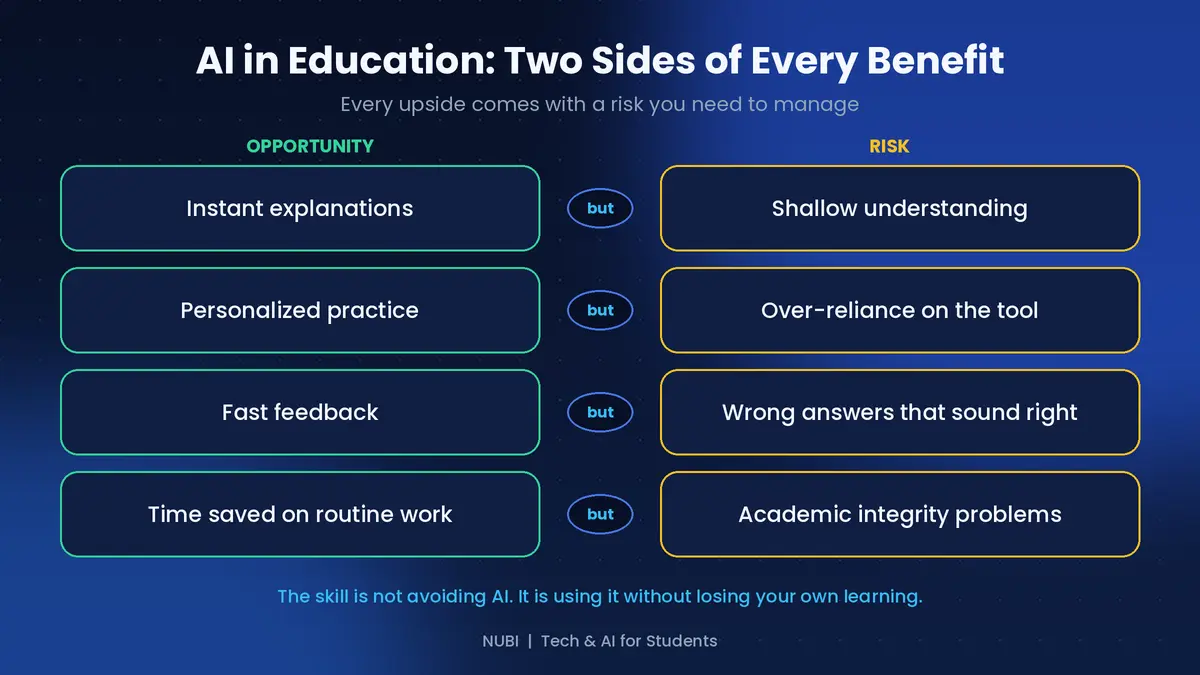
Each advantage of AI comes with a matching risk:
Instant explanations can lead to shallow understanding if you never struggle with a problem yourself.
Personalized practice can turn into over-reliance on the tool.
Fast feedback is useful, but AI sometimes gives wrong answers that sound right.
Time saved on routine work can slide into academic integrity problems if you use it where it isn't allowed.
Knowing both sides is what lets you use the tool well. The goal isn't to avoid AI, it's to use it without losing your own learning.
The traffic light rule
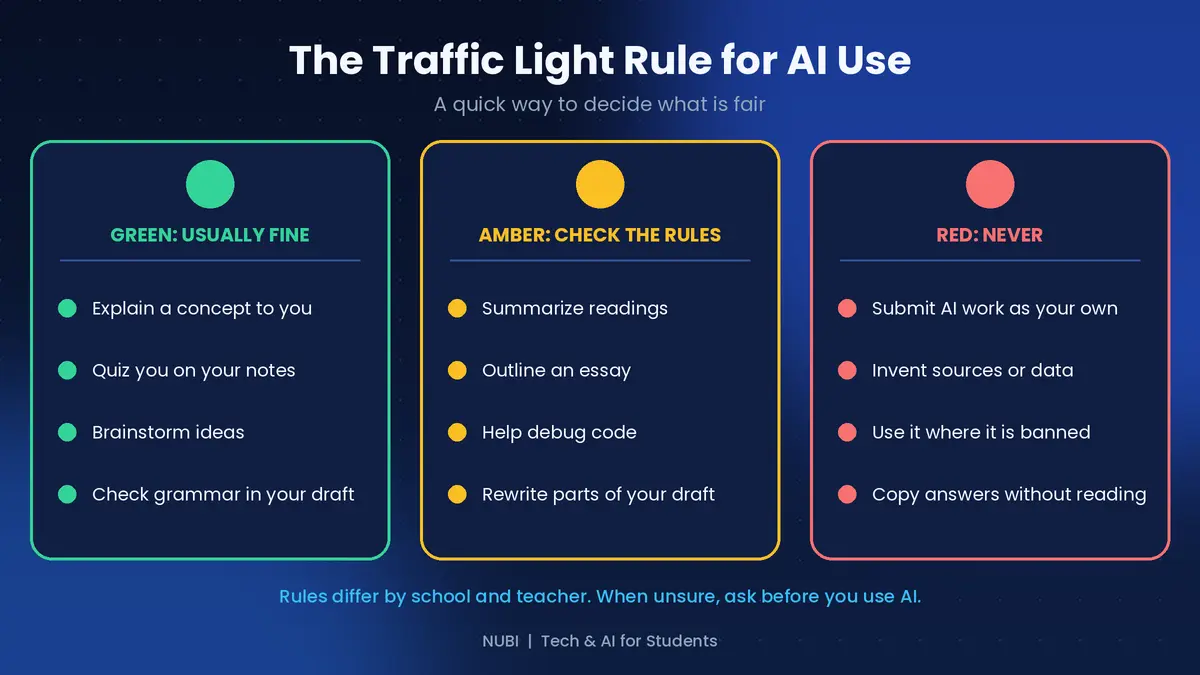
A simple way to decide what's fair:
Green, usually fine: having AI explain a concept, quiz you on your notes, brainstorm ideas or check grammar in your own draft.
Amber, check the rules first: summarizing readings, outlining an essay, helping debug code or rewriting parts of your draft.
Red, never: submitting AI work as your own, inventing sources or data, using AI where it is banned, or copying answers without reading them.
Rules differ between schools, courses and even individual lecturers. When you're unsure, ask before you use AI. A short question now is far better than an integrity case later.
The honest AI workflow
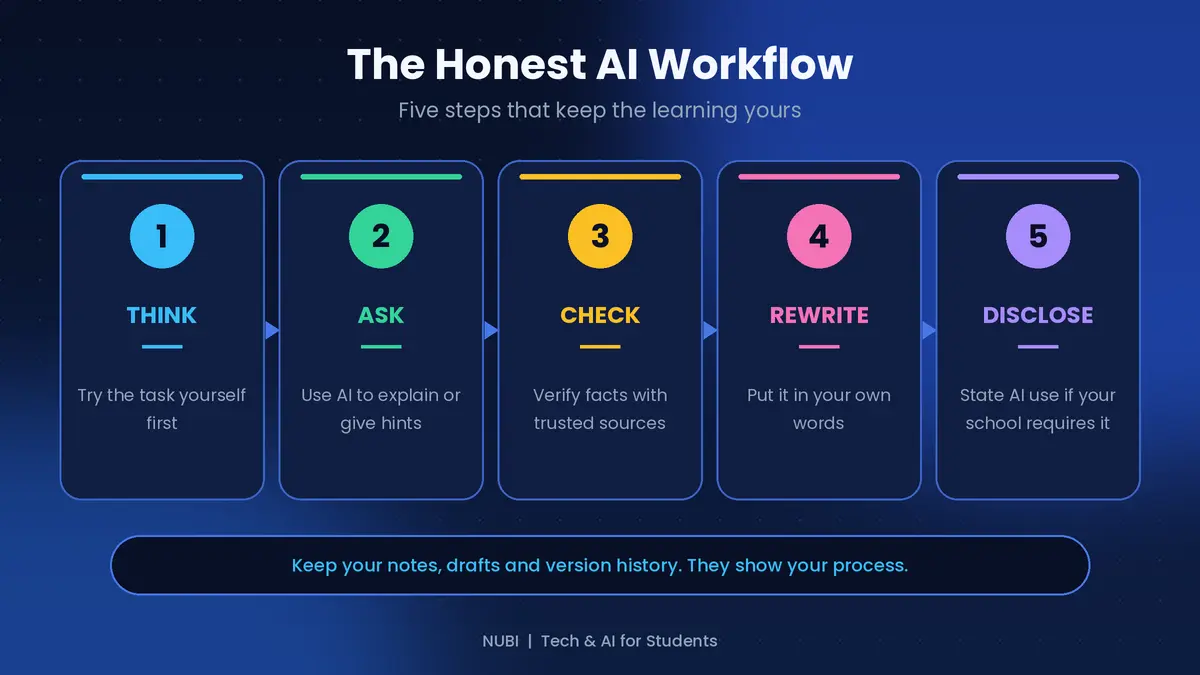
Think. Try the task yourself first, even if you only get part of the way.
Ask. Use AI to explain, give hints or point out what you missed.
Check. Verify facts with trusted sources like your textbook or official documentation.
Rewrite. Put the ideas in your own words, so you understand them.
Disclose. If your school requires you to state AI use, do it plainly.
Also keep your notes, drafts and version history. If anyone ever questions your work, that trail shows your process. This matters because AI detection tools aren't fully reliable and can wrongly flag honest work, so your own record is your best protection.
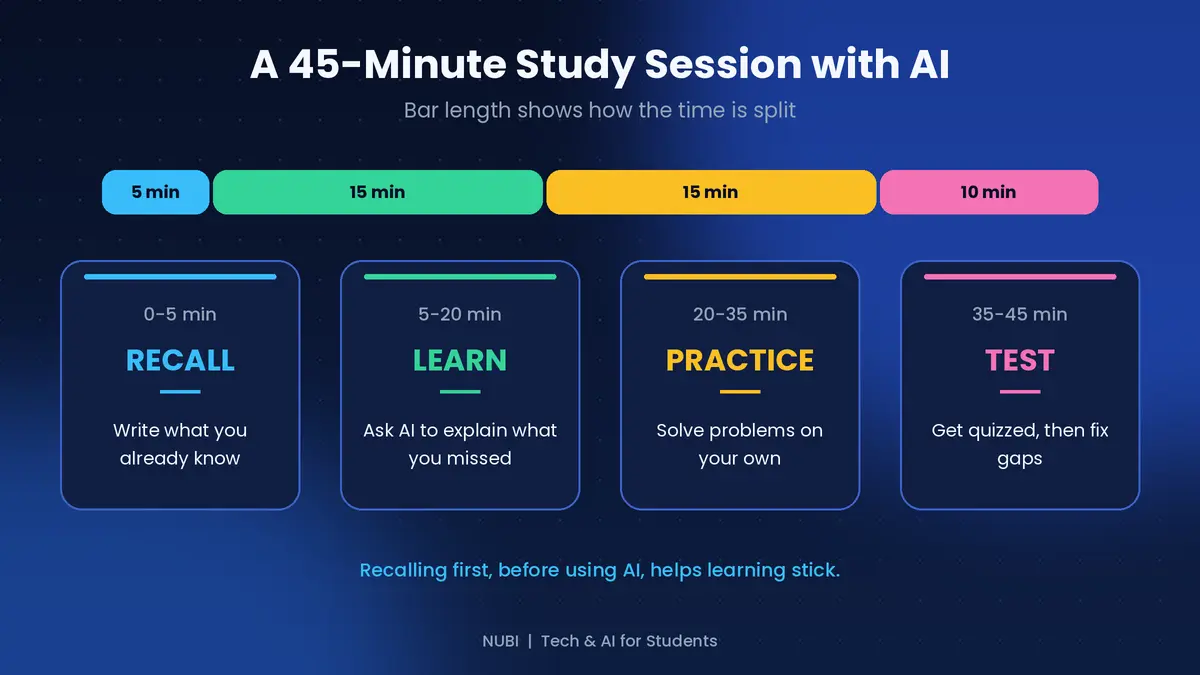
A 45-minute study session with AI
0-5 minutes, Recall: write down what you already know about the topic, with no help.
5-20 minutes, Learn: ask AI to explain what you missed, in simple terms.
20-35 minutes, Practice: solve problems on your own.
35-45 minutes, Test: have the AI quiz you, then fix the gaps.
Recalling first, before you use AI, helps the learning stick, and it shows you exactly where your gaps are.
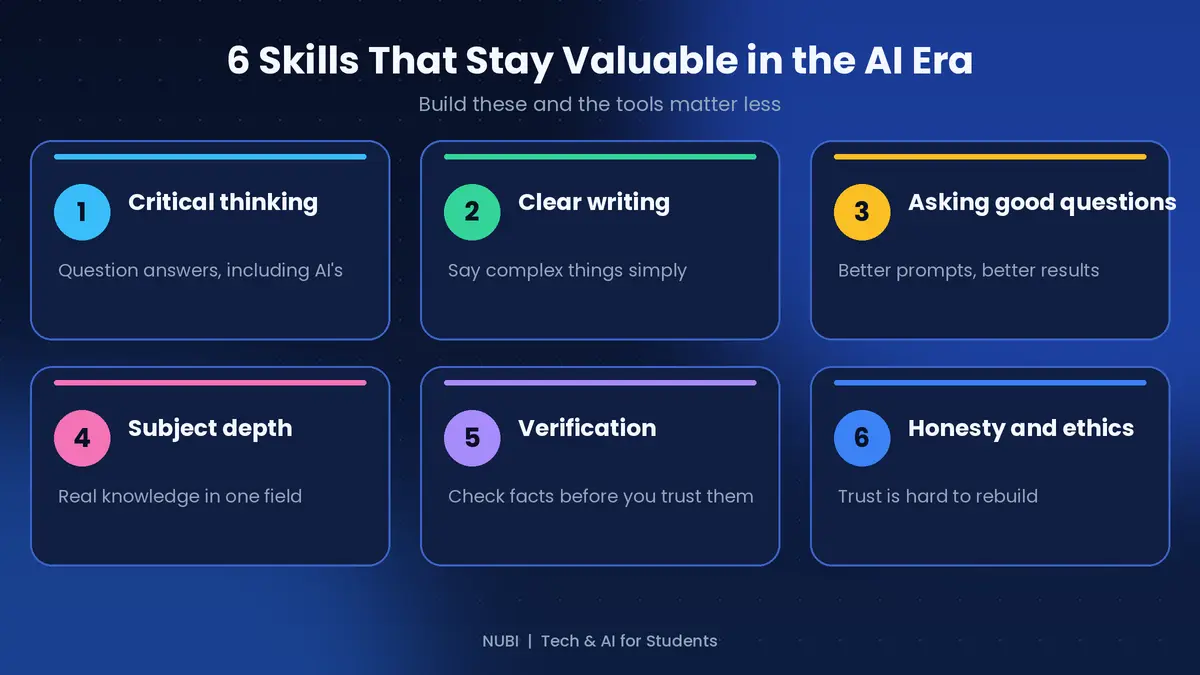
6 skills that stay valuable
Critical thinking: question answers, including the ones AI gives you.
Clear writing: explain complex things simply.
Asking good questions: better prompts get better results.
Subject depth: real knowledge in at least one field.
Verification: check facts before you trust them.
Honesty and ethics: trust is slow to build and quick to lose.
Tools will keep changing, but these skills carry over to every new one.
A note for tech-minded students
If you're drawn to technology, use this moment to learn how AI actually works, not just how to use it. Understanding the basics, such as how models learn from data and why they make mistakes, makes you a more careful user and opens doors to many careers.
Quick recap
AI brings real benefits and real risks
Use the traffic light rule: green, amber, red
Follow the honest workflow: think, ask, check, rewrite, disclose
Start study sessions with recall, before AI
Keep drafts and notes as proof of your process
Build skills that outlast any tool
Final thoughts
AI will be part of education from now on, and the students who do best will be the ones who use it to understand more, not to think less. Be curious, be careful and be honest. How do you use AI in your studies? Tell me in the comments and I'll learn from your answers too.
Support this blog
If this guide helped you, you can tip me. Every bit helps me keep creating free guides for students. Thank you!
Next: crypto wallets explained, and how beginners keep their funds safe. Follow so you don't miss it.






