
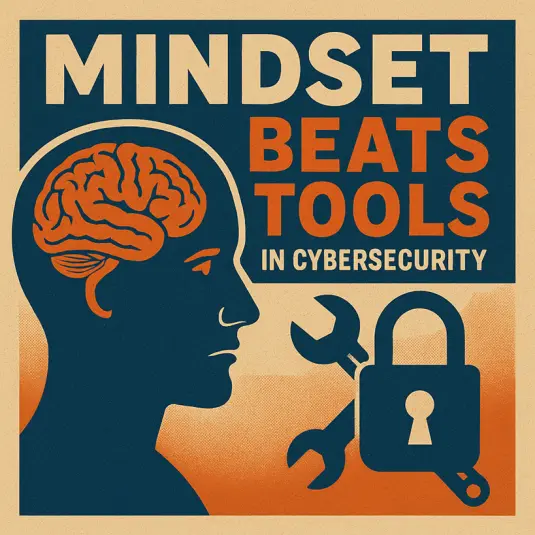
“You can’t automate instincts. And you can’t patch what you don’t understand.”
That’s the hard truth many cybersecurity professionals learn too late.
In a world drowning in dashboards, threat feeds, and flashy tools, we’ve quietly lost sight of something more important: the human operating system. The way we think — under pressure, during chaos, when a breach is unfolding — determines whether we survive… or become the next headline.
After spending years on the frontlines of cyber defense, I came to a realization:
Tools don’t make the defender. Mindset does.
🔐 Why Tools Alone Won’t Save You
Spend five minutes on cybersecurity Twitter, and you’ll find hundreds of posts raving about new EDRs, automated scanners, AI-driven SIEMs.
Here’s the problem: attackers don’t follow playbooks. They improvise. They manipulate assumptions. They bypass shiny tools by exploiting the one thing most defenders overlook — the human behind the screen.
I’ve seen teams with every premium tool fail, simply because they didn’t know what to look for — or how to think like the enemy.
🧩 Enter the Hacker Mindset
The best defenders I’ve worked with don’t just memorize MITRE ATT&CK tactics.
They ask sharper questions:
-
“What would I do if I had just 5 minutes inside this system?”
-
“Which assumption is the weakest link in this setup?”
-
“How can I confuse the attacker before they confuse me?”
These aren’t technical questions. They’re mental models. And mastering them can make a junior analyst outperform a senior engineer.
🔧 Toolkit Thinking vs. Tactical Thinking
Too often, security programs treat people like robots:
"Follow this checklist. Use this tool. Repeat."
But in real breaches, checklists fall apart. Logs go missing. Alerts don’t fire. And when you're staring at a blinking terminal at 2 AM, you won’t be saved by a PDF playbook. You’ll be saved by your ability to:
-
Connect seemingly unrelated data points
-
Trust your gut and investigate further
-
Zoom out, then zoom in — fast
This is what I call tactical thinking. It’s not just about what tools you have — but how you wield them under pressure.
🎯 Shift Happens: From Defending to Hunting
One of the biggest shifts in my career happened when I stopped asking:
“How do I stop attacks?”
…and started asking:
“How do I think like the attacker?”
That mental pivot changed everything. Suddenly, I was no longer reacting. I was predicting. Anticipating. Disrupting.
That’s the difference between average defenders and elite threat hunters.
It’s not a toolset.
It’s a mindset.
🔄 Practical Tools from the Field
I’m not anti-tools. In fact, I’ve spent years building, testing, and customizing them. But I use them differently.
In my work, I created a Toolkit Framework — a real-world system for choosing, combining, and executing tools effectively, based on attacker behavior.
A few key principles from the field:
✅ Use fewer tools, but know them deeply
✅ Every tool needs a backup method — or a manual failover
✅ Build “muscle memory” for triage. Speed matters more than style
✅ Don’t just automate. Understand before you script
🧠 Mindset + Toolkit = Cyber Mastery
The future of cybersecurity won’t be won by the loudest dashboards or the most lines of code. It’ll be won by people who can merge tactical mindset with technical precision.
That’s why I wrote two guides — one that dives into the psychology of elite defenders, and another that gives you the hands-on systems, scripts, and frameworks to act on that insight.
Together, they’re more than just books. They’re a new way of thinking about cybersecurity:
No fluff. No filler. Just real insights from the battlefield.
📚 Ready to Level Up?
If you’ve ever felt like you're stuck in reactive mode — drowning in alerts, juggling tools, and never quite getting ahead of the threat — it’s time to upgrade your mental firmware.
📘 Inside the Hacker Hunter’s Mind — for mindset, strategy, and mental models
🛠️ Inside the Hacker Hunter’s Toolkit — for practical execution and field-tested tools
The greatest threat isn’t the hacker on the other side. It’s the blind spot in your own thinking.
Change your mindset. Sharpen your tools. Defend smarter.
#CyberSecurity #Infosec #ThreatHunting #HackerMindset #BlueTeam #SOC #RedTeam #CTI #AhmedAwad #Nullc0d3




