Cryptocurrencies are experiencing days of sharp decline, with Bitcoin losing the 70,000 USDT mark and dropping 4.12% at the time of writing. Ethereum is faring even worse, shedding 4.83%, as selling pressure spreads across all major tokens. Wall Street, on the other hand, is still holding up despite yesterday's slowdown, with futures remaining in positive territory on a weekly basis.
Bitcoin and Ethereum relive last November’s correction
The current scenario echoes November 2025, when crypto assets tumbled across the board following Bitcoin’s October all-time high (ATH) while Wall Street aimed for new peaks. The bearish trend for Bitcoin and Ethereum on the weekly chart traces back to their respective annual lows from early summer.
BTC ($68,561 | ▼ -6.80%) rebounded from its early July low of 57,802 USDT before accelerating in August—a rally that pushed the price to a September peak of 87,252 USDT. From that high, a downtrend began that is now leading into a sixth consecutive week in the red. Yesterday, the main vector support around the 72,000 USDT area was broken without any bounce. The risk now is a continuation down toward 64,000 USDT, the base from which the August acceleration originally took off.
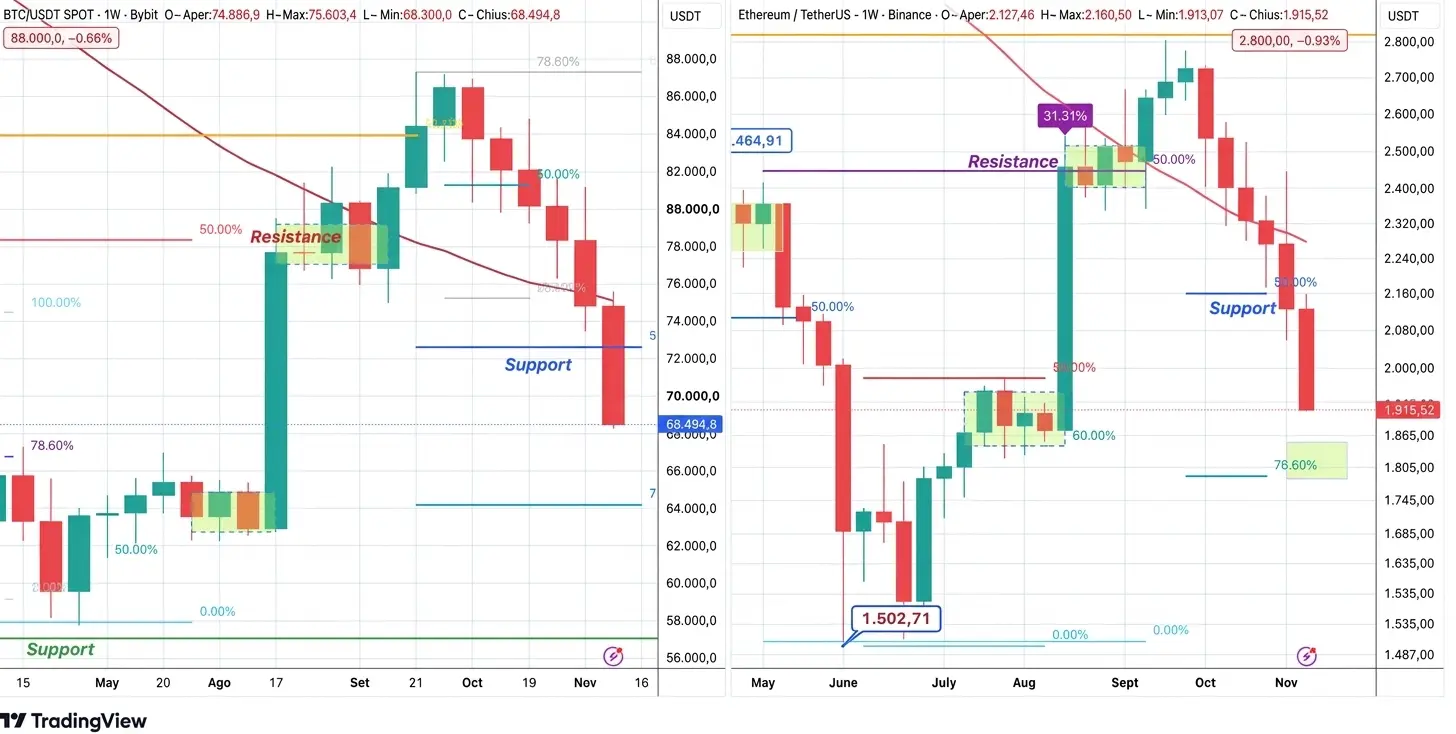
For Ethereum, the same view starts from its early June low of 1,503 USDT. The August acceleration phase is clearly visible, culminating in the September peak at 2,808 USDT and the subsequent start of the downtrend. Last week, ETH broke its main support at 2,160 USDT and has now wiped out all the gains built during the August leg. The risk now is a continuation of the decline toward the 1,800 USDT area.
Crypto assets are all in the red in November except Tron
The November downturn is widespread, and in the performance rankings, Zcash is the worst performer with a -28.54% drop. Hyperliquid follows at -19.89% and Ripple at -19.75%, while Ethereum is down -14.76% and Bitcoin -11.62%. Bitcoin and Ethereum’s November weakness is weighing on their year-to-date balance, with Bitcoin at -21.59% and ETH at -35.72%. Tron is the only token remaining in positive territory, up +2.21% since the start of the month.
Weighing most heavily on the market are spot Bitcoin ETFs, which have recorded six consecutive sessions of outflows totaling $1.49 billion. The Fed factor and the return of rate hike risks are also taking a toll. The FedWatch tool assigns a 100% probability to a rate hike at the December 9 meeting—89% for a 25-basis-point tightening and 11% for a 50-basis-point hike, with rates currently sitting at 3.75–4%. Higher interest rates increase the opportunity cost of holding Bitcoin, which, like gold, pays no yield.
Wall Street holds up, Nvidia loses its CEO
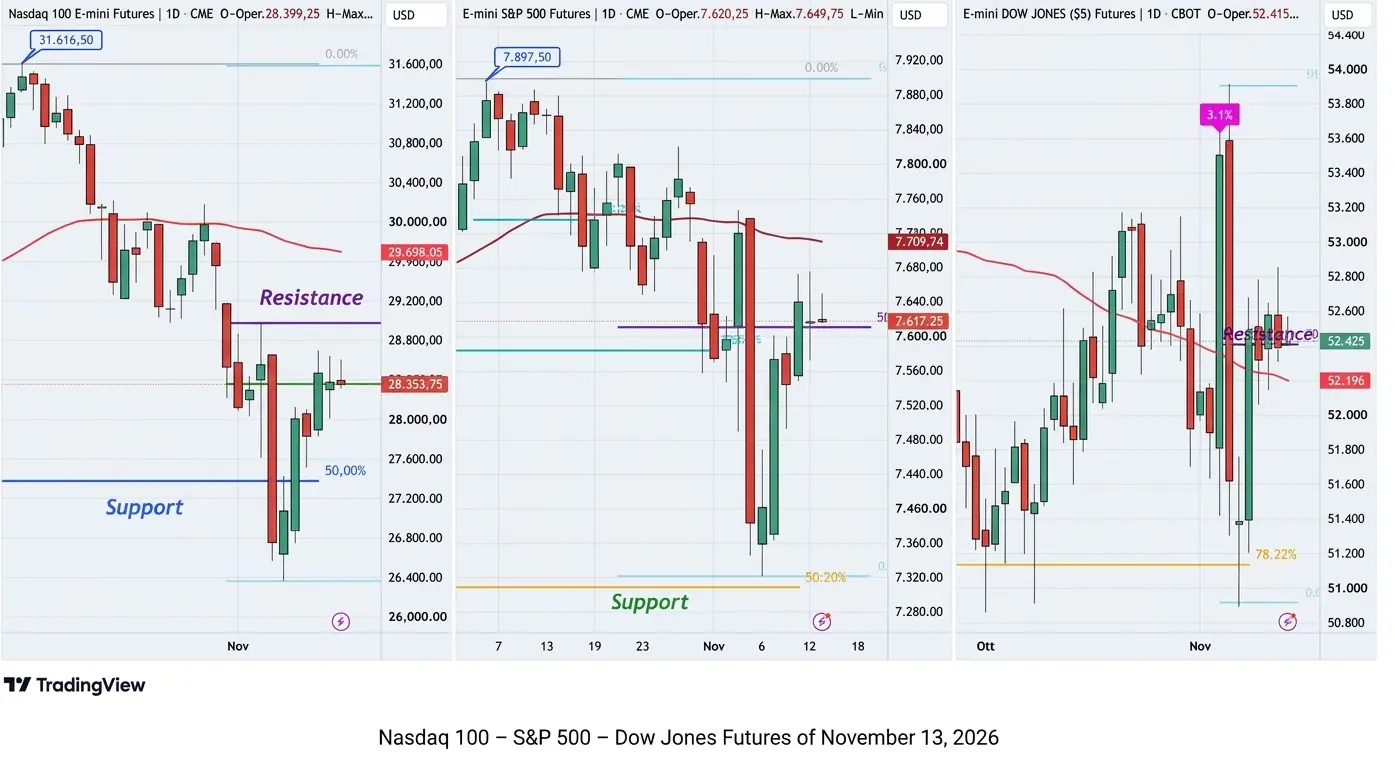
Yesterday's session on Wall Street closed lower, weighed down by the resignation of Nvidia's CEO. Since Monday, Nasdaq 100 futures are up +4.7%, the S&P 500 +2.89%, and the Dow Jones +1.99%. This morning, ahead of the cash market open, the S&P 500 and Dow Jones are trading flat, while the Nasdaq 100 is down -0.1%.
According to a filing with the SEC, the U.S. securities regulator, Jensen Huang has stepped down from his role as CEO of Nvidia and from the board of directors. Chief Financial Officer Colette Kress becomes interim CEO ahead of the November 17 quarterly earnings report. Yesterday, Nvidia dropped -4.34% and is down -18.79% since the beginning of November. Its year-to-date balance for 2026 has slipped into the red, sitting at -10.89%