Dear Friends,
Many of us fear cholesterol. When we undergo a blood test, we check if our LDL levels are high, and some people are even prescribed statin medications. This naturally raises a question: what does this cholesterol actually do inside our blood vessels, and how is it linked to heart attacks?
To understand this, we must first learn about a condition called atherosclerosis.
Our body has blood vessels known as arteries, which carry blood from the heart to all other organs. These vessels need to be flexible to ensure that blood flows smoothly.
However, over time, fatty substances can begin to accumulate on the inner walls of these arteries. 'Bad cholesterol,' known as LDL, plays a major role in this process.
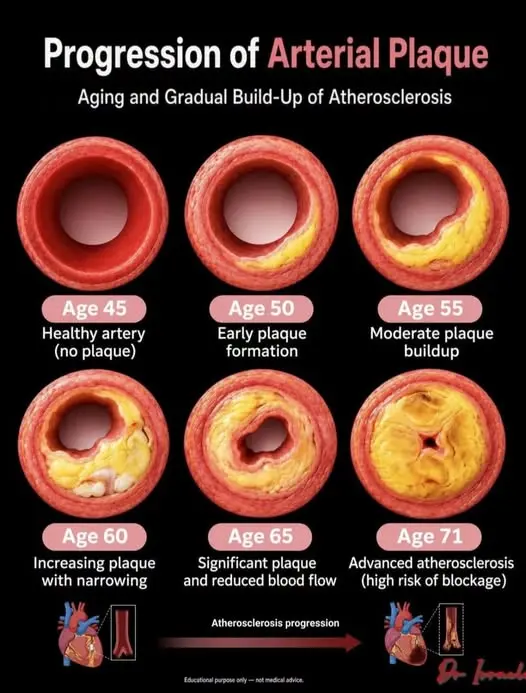
It is not just cholesterol that accumulates; it combines with other fats, calcium, inflammatory cells, and various other substances in the body to form a deposit. This deposit is called 'plaque.'
The process by which plaque gradually builds up on the walls of blood vessels is known as atherosclerosis.
Let me provide a simple analogy to help you understand this.
Think of the water pipes in your home. Initially, there is plenty of space inside for water to flow. But if, over many years, substances begin to accumulate on the inner walls, the space available for water to pass through will gradually decrease.
Plaque forms in our blood vessels in much the same way.
Why does this happen?
Aging is one factor, but it is not the only cause. Factors such as high LDL cholesterol, high blood pressure, diabetes, smoking, physical inactivity, obesity, and a family history of heart attacks at a young age increase the risk of developing atherosclerosis.
It is important to understand that this change does not happen overnight; it is a process that unfolds slowly over many years.
Does everyone develop atherosclerosis as they age?
This is a very important question.
While the risk of developing atherosclerosis does increase with age, there is no fixed timeline—for instance, it is not the case that one’s blood vessels will necessarily be clear at 45, show some cholesterol buildup at 50, have more by 60, and become completely blocked by 70.
One person might have significant plaque buildup by age 40, while another might have very little even at age 70.
This depends on factors such as cholesterol levels, blood pressure, the presence of diabetes, smoking habits, family history, and lifestyle.
Therefore, the progression shown in this illustration should not be assumed to be the inevitable path for everyone as they age.
What is the connection between atherosclerosis and a heart attack?
This is where the significance of the matter lies.
The blood vessels that supply blood to the heart itself are called coronary arteries.
If plaque builds up significantly in these vessels, it narrows the passage for blood flow, which can reduce the supply of oxygen to the heart muscle. This may lead to chest pain during activities like walking or climbing stairs—a condition known as angina.
However, there is another critical factor that can trigger a heart attack.
Sometimes, the outer layer (cap) of the plaque within a blood vessel can rupture. When this happens, blood clots form at that site. Such a clot can suddenly block the blood vessel entirely. This obstructs the blood flow to the heart muscles, leading to a heart attack.
It is a misconception that a heart attack occurs solely due to the gradual narrowing of blood vessels. A major cause of heart attacks is the sudden disruption of existing plaque, which triggers the formation of a blood clot.
So, what is the purpose of statin medications?
Let us now look at the class of drugs known as statins.
Medications such as Atorvastatin and Rosuvastatin belong to the statin category.
These drugs reduce the production of cholesterol in the liver, thereby lowering the levels of LDL cholesterol in the blood.
Furthermore, they help prevent existing plaque in the blood vessels from worsening and keep the plaque stable. This reduces the risk of the plaque rupturing and forming a blood clot.
The primary benefit of this is a reduction in the risk of heart attacks and strokes.
However, it is important to understand that taking a statin does not cause all the cholesterol deposits in the blood vessels to disappear immediately.
The decision regarding who needs statins—and the appropriate dosage—is based not only on LDL cholesterol levels but also on factors such as the presence of existing heart disease or diabetes, age, and other risk factors.
Treatment is not the same for everyone.
So, what can be done to prevent atherosclerosis?
By making certain lifestyle changes, it is possible to delay the onset of this condition and mitigate its impact.
Reducing the intake of unnecessary saturated fats in one's diet...