
Regulatory oversight regarding digital asset movements is expanding across European jurisdictions through new administrative measures.
Under Royal Decree-Law 44/2026,published 11/25/2026, Spain has authorized its financial intelligence unit, Sepblac, to freeze cryptocurrency accounts and suspend pending transactions prior to obtaining judicial authorization.
The Royal Decree-Law primarily addresses consumer credit regulations and partially addresses an EU anti-money laundering directive, now also applies equally to cryptocurrency, traditional bank, and payment accounts. Previously, Sepblac could only suspend transactions when requested by a foreign EU financial intelligence unit; Sepblac can now intervene on its own initiative whenever it identifies indications of money laundering or terrorist financing.
This action reflects a broader trend among European authorities seeking immediate enforcement mechanisms within the cryptocurrency sector.
Key Provisions of Spain's Freeze Authority
Standard procedures typically require court orders or international legal requests before assets are restrained. The new decree allows Sepblac to act unilaterally when money laundering or terrorist financing is suspected.
The key provisions of the decree include:
Account Suspension: Sepblac may suspend digital asset accounts or business operations for up to 5 business days.
Transaction Halts: Specific active transactions may be frozen for up to 10 business days.
Implementation Timeline: The regulations are set to take effect on January 25, 2027, subject to a 30-day ratification window by the Congress of Deputies.
Consequently, asset holds can be executed by custodians or exchanges immediately upon directive from Sepblac, prior to full judicial review.
Global Context and International Regulatory Trends
Spain's actions align with recent policy announcements in other major financial jurisdictions during the same period:
United Kingdom: The Financial Conduct Authority (FCA) is advancing enhanced authorization rules for decentralized finance (DeFi) protocols, citing illicit finance concerns following security breaches such as the $6.3 billion Binance exploit.
Japan: The Financial Services Agency (FSA) published a discussion paper on November 26 outlining potential regulatory frameworks for DeFi interfaces and self-custodial wallet transfers.
Legal and Compliance Implications
From a regulatory enforcement perspective, immediate freezing mechanisms address the rapid cross-chain movement of funds, which can complicate investigative processes.
Conversely, administrative freezing powers without prior judicial oversight introduce significant constitutional and due-process considerations for market participants.
These measures highlight the fundamental operational differences between self-custodial holding solutions and centralized intermediaries subject to administrative orders.
The ongoing evolution of these regulations raises key legal questions regarding the balance between law enforcement efficiency and procedural rights.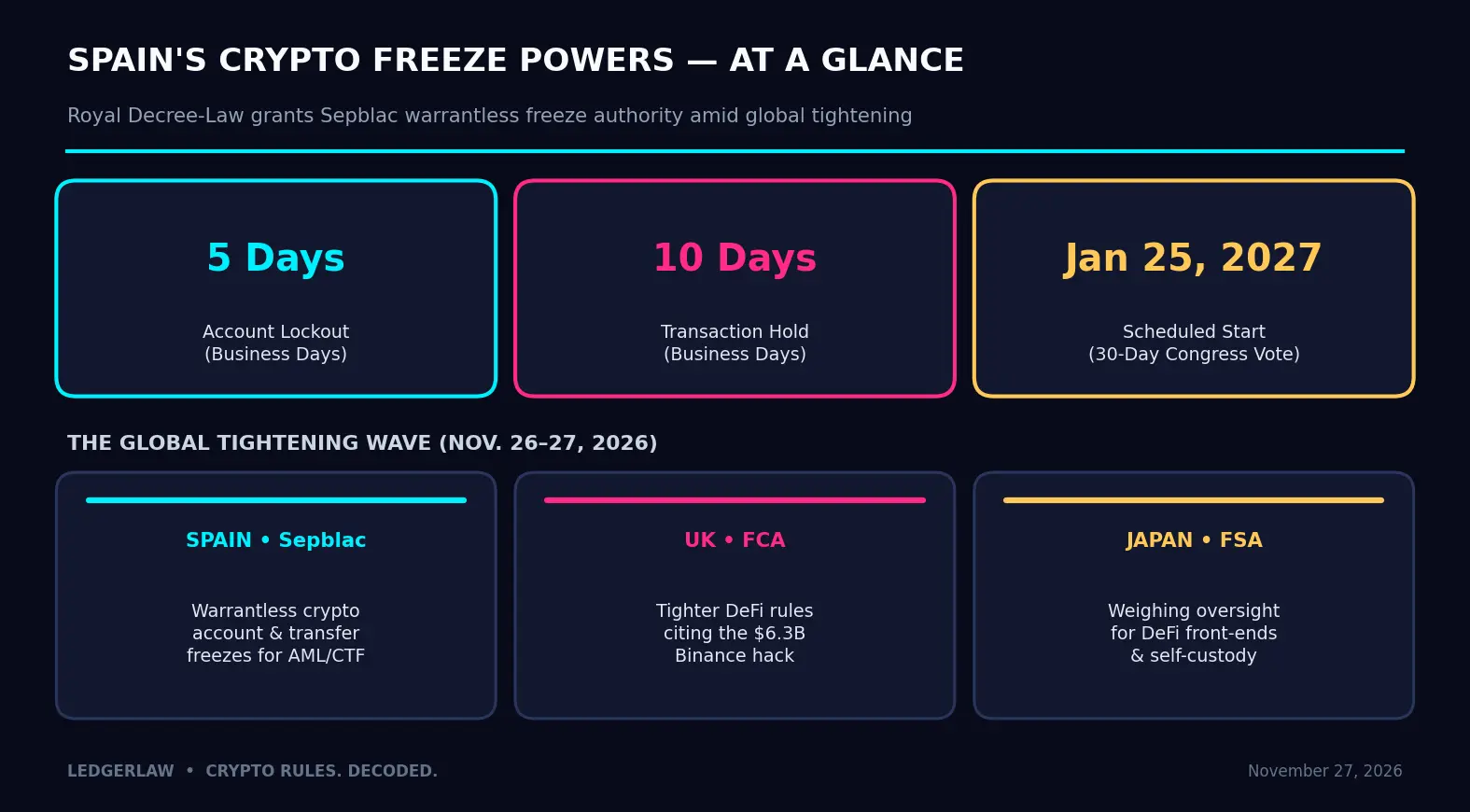
For informational purposes only. Not legal or investment advice.






