
The New Economy Movement or NEM, was once considered one of the strongest alternatives to Ethereum. Its native cryptocurrency, XEM, was once part of the top 10 coins by market cap. However, XEM has been slowly losing its popularity in the past year. Although nowadays XEM is still part of the top 30 cryptocurrencies, it’s not discussed as much as before.
So, is it still worth it to invest in NEM (XEM) in the long term? Before we can decide, let’s take a look at the coin’s technology and other factors to consider. Let’s begin!
NEM - Summary
NEM is one of the blockchain platforms that try to become the default solution for smart contracts and decentralized applications (dApps). Typically, when people mention smart contracts, the first thing that comes to their mind is “Ethereum.”
However, the NEM core team believes Ethereum is too complex for mainstream developers. They believe this is the case because Ethereum utilizes its own programming language for smart contracts, which is called Solidity. NEM, on the other hand, utilizes Java - which is much more common and can potentially attract more mainstream developers.
NEM, just like its competitors, is also a dual-layer blockchain platform. It serves similar purposes like Ethereum, EOS, Tron, or NEO. NEM is used by dApp developers to issue their own crypto tokens, to create DAO (Decentralized Organization) ecosystem, or for automatic accounting.
NEM core team believes blockchain has much larger use cases than just Bitcoin or to transfer money from point A to point B. NEM has a mission to put all kinds of data in the blockchain. The idea is that you don’t need to trust any centralized party. And thus, all data can be automatically verified.
The unique selling point of NEM is not just about its usage of Java. NEM has its own consensus algorithm that is called “Proof of Importance”.
So, in “standard” cryptocurrencies, usually, they have what they call as Proof of Work (PoW), Proof of Stake (PoS), or Delegated Proof of Stake (DPoS). With the PoW system, miners have the task of verifying transactions.
In the PoS system, token stakers are the ones who need to verify transactions. And in the DPoS system, delegates (who get voted in by the token stakers) are the ones who verify transactions. But in the NEM ecosystem, they have Proof of Importance (PoI).
In a PoI system, token owners need to create more transactions. Having more coins is not enough to get the “important” status within the blockchain network. So, basically, you need to have more XEM coins and do more transactions at the same time, if you want to get the top priority.
The more “important” your status is, the more rewards your node will get. The idea of Proof of Importance is to encourage NEM believers to “spend” their XEM coins. As we all know, nowadays, most crypto traders only HODL and speculate with their cryptocurrencies.
NEM core team believes it will be better if they can change this mindset, especially among their coin believers. Despite this effort, however, XEM trading volume is not really that huge. There are many coins with higher trading volume despite lower market cap.
Analyzing NEM Team

Before we know if investing in one coin is worth our money or not, we need to know who’s the team behind the project. Investing in a crypto coin is like investing in the team itself. Why? Because we believe in the project’s future. And the future is somewhat dependent on the team itself.
The creation of the NEM coin began from a Bitcointalk user called UtopianFuture. The original idea was to fork NXT, which was more popular at the time. Nevertheless, this idea was then disregarded. NEM was created from scratch.
In June 2014, the project New Economy Movement officially launched its alpha testing. Several months later, the beta testing was finally launched. And in March 2015, the main net began. Thanks to the popularity of the blockchain, the NEM core team started its own foundation in 2016.
So, who are the key people behind the NEM foundation? According to its official page, at the moment, Alexandra Tinsman acts as the President. Jason Lee is the Vice President, Nate D’Amico is the Chief Technology Officer, Lei Dong is the Chief Finance Officer, and Lewis Farrell is the Chief of Marketing.
All the key people in the NEM foundation do not really have much background in the crypto space prior to joining the foundation. However, that’s understandable, as NEM itself has been around for many years. And crypto space (before the creation of NEM) was still in its very early stage.
There are, however, some legitimate doubts regarding the NEM foundation. In January 2019, it was reported that the NEM foundation was nearly broke. It was reported that the foundation had to layoff around 150 employees.
According to reports and rumors, apparently, the NEM foundation lost a lot of money when they tried to promote NEM-based initial coin offerings (ICOs). The ICOs, however, turned out to be total disasters. Ecobit and ProximaX were among the ICOs that got heavily promoted by the NEM foundation. And now? Nobody even knows anything about them.
Whether the NEM foundation can turn things around or not, we do not know yet. To be fair, the team is still very young. They have learned from their experiences. Hopefully, the team will make the right decisions in the future for the sake of the project itself.
NEM Future And Potential Roadblocks

Predicting the future of NEM is not an easy thing to do. Well, first of all, NEM is trying to become an all-in-one solution for smart contracts and decentralized applications. It does not offer a unique solution, and it is just trying to be the alternative to more popular dApp platforms like EOS or Ethereum.
Despite its unique consensus mechanism (Proof of Importance) and the utilization of Java programming language, it’s still not enough to convince many dApp developers to “migrate” and start developing for NEM.
Its future is most likely dependent on several things. First of all, the NEM foundation needs to make the right move to “lure” developers. And then, there are some external factors, like the development of Ethereum and Bitcoin price.
Potential roadblocks for NEM future are its competitors. Ethereum, EOS, NEO, Tron, and other dApp platforms are more popular than NEM at the moment. And if they can improve their scalability and decentralization, it will be hard for NEM to gain a bigger market share.
Past Hacking Incident That Keep Haunting NEM Project
When we discuss the NEM project, we must learn about its past hacking incident as well. So, at the beginning of last year, a Japanese cryptocurrency exchange called Coincheck was hacked. The hackers managed to steal $400 million worth of NEM tokens (500 million NEM tokens at the time).

The hacking incident was reportedly one of the largest in crypto history; they even made it to the mainstream media websites like TheVerge. Even though the hacking incident was not exactly the fault of NEM blockchain itself, but big crypto traders already started to feel skeptical about the future of this project since the hacking incident took place.
NEM Adoptions
Unfortunately, adoption is not NEM’s biggest strength. There are some exciting names in NEM’s enterprise partners. That being said, most of NEM foundation’s partners are usually less popular companies which operate in the blockchain industry. Some non-blockchain partner companies are interesting, like Sumeru Inc. or dtk.io.
Other blockchain-based partners include Dragonfly Fintech, Tech Bureau Corp, and Atraura Blockchain. Some of the NEM supporters actually criticized the marketing strategies of the foundation. They believe the foundation should have done more, especially with a huge budget that they had in the previous years.
External Factor And XEM Price
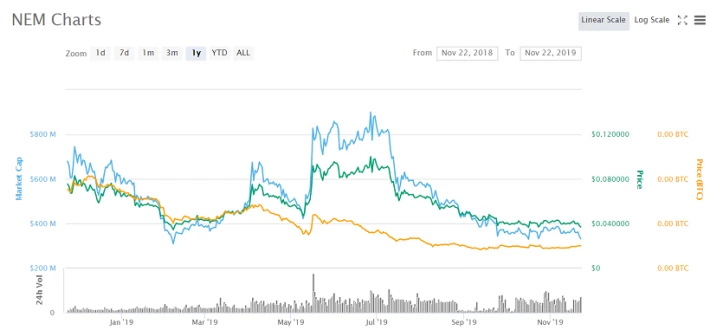
We know about the fundamentals of the NEM blockchain, but how about the external factor? Well, this is one of the most important things. In cryptocurrencies, most altcoin prices are affected by Bitcoin price action. So, whenever Bitcoin goes up, usually, altcoin prices follow. When Bitcoin goes down, altcoin prices go down even more.
XEM price is not an exception. It had its best days when Bitcoin kept going up as well. When Bitcoin went down, XEM price went down as well. It’s not exactly rocket science. Cryptocurrencies are often “seen” as one collective asset.
Generally, 2019 has been a good year for cryptocurrencies (especially Bitcoin). However, recently, Bitcoin has been going down from more than $12000 to less than $8000. Some analysts predict Bitcoin might go up again in 2020 following the mining reward halving event somewhere in the middle of the year.
However, some other analysts believe this wouldn’t be the case due to lack of demand and because everybody already “expected” the same thing. And the upward or downward movement of Bitcoin would (most certainly) affect the price of XEM as well.
So, if you decide to invest in XEM, you need to take Bitcoin price into one of your considerations.
Conclusion
NEM and its native crypto called XEM are very interesting to follow. NEM has a big potential to become the next big thing. However, the hacking incident and the questionable marketing decision of the NEM foundation make it hard for the project to get bigger.
Even though these problems were things of the past, but many crypto traders have started to look elsewhere. Whether NEM can turn things around and can finally compete with the likes of Ethereum or EOS, only time will tell. Investing in XEM coin is still a decent thing to do. But once again, its future is not very bright compared to other altcoins that have the same capabilities and try to solve the same thing.






