(Intelli Gaming: Article) Long have I played with LEGO bricks of all kinds. That was a long time ago. But what stayed is the desire to imagine and build things around me.

In this article, I want to take a good look at that wonderful game. There is much to cover since the company is international and has been around for many years. This is not an info-commercial or a publicity but more just an honest look at a good game. First, the pros and cons:
Pros
- Develops dexterity, attention to detail, memorisation, creativity
- Promotes re-usability, stimulates imagination.
- Helps to understand how things work.
- Covers an extremely wide range of topics, all compatible.
- Modular design.
- Bricks might be old but remain entirely fungible (a 2x4 red brick is the same as a new one). Also very solid, they don't break.
- Completely universal, every human can play easily.
Cons
-
Small pieces may be swallowed by young children, animals, aspirators and / or fall in difficult to access areas.
History
The game sees its origins in Denmark, on August 10th 1932. The founder of the company, Ole Kirk Kristiansen, began his career as a wood worker and made toys in that material for many years. It was not until 1947 with an injection mould that Lego would start to produce the famous bricks the world knows it for.

The name itself is derived from Danish "Leg Godt", meaning "Play Well". The company took time to build its success and I like the perseverance behind their efforts. One key technical aspect is that bricks manage to stick together a bit more than just plastic. The solution was to use acrylonitrile butadiene styrene (ABS).
LEGO has covered all aspects of life with their products ranging from civil transports to space, passing by daily lives and other remarkable objects. Today, the company uses the power of online media and even cinema to attract new ideas as can be seen in their website for that purpose: ideas.lego.com.
Legoland
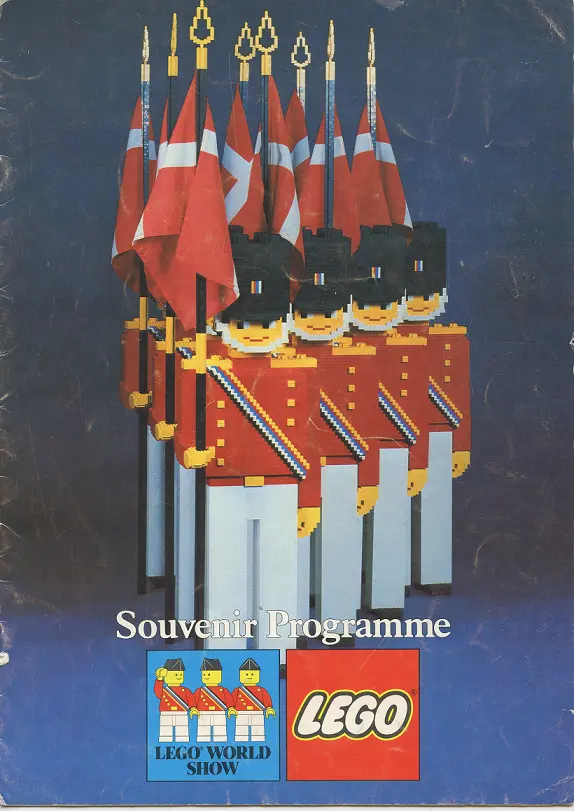
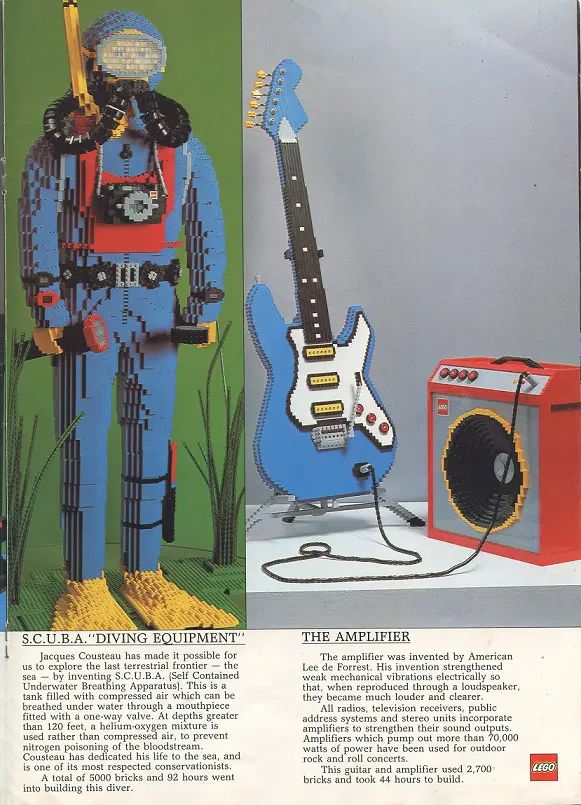
The famous bricks have led to the creation of expositions across the world to promote the game. The name Legoland is synonymous with large life-size recreations, in LEGO bricks, of everyday objects. Here are a few that date back from the late 1980s, a decade during which LEGO expanded worldwide and led to the LEGO World Show:

Why I like it
I love the game because you can create many things. Your projects can be small, following the manual precisely or you can deviate a little bit. Otherwise, you can use whatever bricks you have and mix and match kits together to create even more complex vehicles.
Another use, or another approach which is not that obvious, is that whatever you build with regular rectangular bricks, can be doubled in size, and again, and again...
So you can build a tiny LEGO house of size 4x4 (each wall is 4 units long) and as such, you can also build another house which is 8x8, or 16x16 and each time, you can definition and can add details. As such, the game scales very well with the size you want.
What I really means, with the above paragraph is that you can buy a set with a tiny special "guitar" brick that a little guy can use. Or you could have a kit to build a guitar about 30 cm in length. Or you can build a huge, life-size guitar (as shown above) or even bigger.
Also, the Technic series of LEGO is the perfect gift for the future engineer...
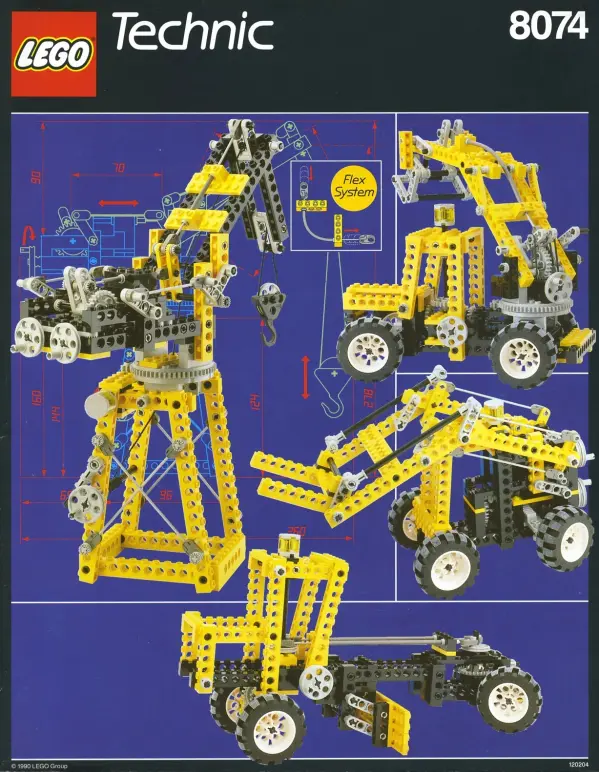
The series was first introduced as the Expert range of toys. Then it was re-branded as "Technical Sets" in 1977 and finally as "Technic" in 1983. From LEGO Technic, you get the basic infrastructure and mechanics. For more specialised systems, such as hydraulics, electrical motors and electrical circuits for lights or remote control are sold in different LEGO packages. Gears, wheels and axles were also very common. But also, you could add any electrical system or other components and attaching those to LEGO bricks quickly allows you to prototype various machines.
Obviously, with today's 3D printing technology getting better and better, the possibilities for builders and innovators of shape and functionality are even more extended.

Coming Up Next
The next article is part II of this short series. In the next article, I will examine the progression of Lego from their humble beginnings to the source of inspiration it has been for me regarding astronomy and the exploration of space. Stay tuned!






