![These 5 media outlets know how to carry listicles well [May 2026 list]. Outset Media Index (OMI) by Outset PR](https://www.publish0x.com/img/1175891.webp?action=resize&ar=1&enc=webp&inv=0&ori=1&st=1&up=1&w=1140&signature=19ab2c1a68e33b9f8de8369e153fdd01ce378a04d9d618aa1aae4a4fe57eb089)
In crypto, listicles spent a while carrying a lot of bad internet habits on their back. That was the format readers got tired of: thin roundups, over-optimized reviews, and pages clearly built to rank first and be useful later, if at all.
When Google rolled out its March 2024 core update, it said the goal was to cut down low-quality, unoriginal content in Search by 40%, then later raised that estimate to 45%.
Around the same stretch, Google also got much less tolerant of site reputation abuse, including the kind of low-value sections bigger publishers had been able to hide behind the strength of the main domain.
People somehow oversimplified this story, making it sound like Google killed listicles. The truth is – it just made the cheap version of them much harder to get away with.
If we look at where discovery is happening now, the ranked list approach is very much alive. Search Engine Land reported this year that a study of 75,000 AI answers and more than one million AI citations found listicles made up:
-
almost 22% of all citations
-
and 40% of commercial-intent citations.
That is a pretty strong sign that comparison-style content still fits the way search and AI systems surface information in 2026.
Whether listicles work is not the question, because they do; the question is where they don’t turn into dead SEO furniture. Similarweb recently reported a 26% drop in publisher traffic alongside a 212% surge in ChatGPT news queries.
That’s important because listicles only work when they reach people who are already comparing choices. The website has to bring the right kind of reader, not just another page where a ranked article can sit.
Listicles got harder to place well
That also explains why a lot of publishers got more cautious with listicles. Some stepped away from them almost entirely, others allowed them, but much more selectively.
The first challenge is finding places that still offer the format as a real coverage option. And the second challenge is traffic quality.
A media outlet may accept listicles while sitting on traffic that looks inflated, repetitive, or simply weak once you look past the headline number. On paper, the format is available. In practice, the article lands in a place where very few real users seem likely to find it.
We’ve seen that mismatch enough times that “this outlet does listicles” stopped being a filter on its own. The better question now is whether that outlet offers this kind of content in an environment where the audience is genuine and the traffic holds up.
How we narrowed the field
Inside Outset Media Index, we started by cutting the data pool down to something much narrower:
crypto-only outlets,
publishing in English,
with listicles available as a coverage option.
The point was not to find every outlet that could technically host this kind of piece, but the smaller group where reach is wide enough to be representative and listicles are still part of the editorial or commercial reality.
From there, we ranked the list by our Unique Score that gives you the easiest way to get closer to audience quality: 5.5 and above is the line where the readership starts looking predominantly authentic. It is a much better starting point than trusting a traffic headline, isn’t it?
After that, we pulled in Average Traffic, Average Unique Traffic, and Traffic Depth Ratio (TDR) as useful reference data. The first metric shows average reach over the past three months and the second one tells how much of that reach is coming from distinct users rather than the same visitors coming back again and again. TDR signals how concentrated that traffic is.
Taken together, those metrics make it easier to tell whether a media outlet looks broad, narrow, repetitive, or genuinely useful for a listicle-first campaign.
That is the basic logic behind the shortlist that follows: first narrow the universe, then filter for signs of authentic audience, then add enough traffic context to see whether the outlet actually has scale behind it, and what kind of scale it is.
Five outlets that give listicle-first campaigns room to work
In 2026, there is a good selection of media outlets where listicles sit comfortably inside the editorial mix.
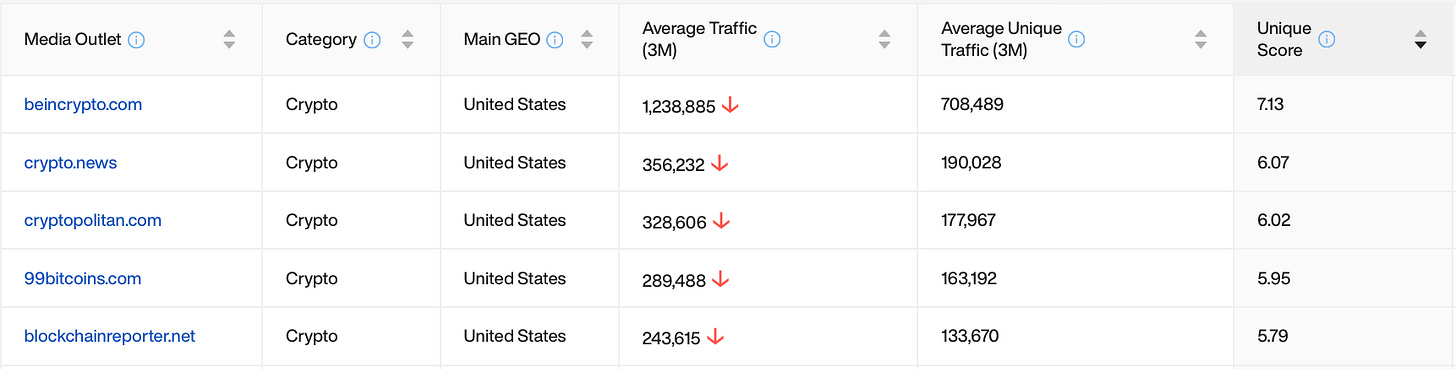
Source: Outset Media Index
BeInCrypto
Unique Score: 7.13
Average Traffic: 1.24M
Average Unique Traffic: 708K+
TDR: 0.57
BeInCrypto is one of the examples that listicles work when the outlet behind them is strong enough. The option is there, but more importantly, the readership isn’t flimsy. The numbers point to a site with real reach and enough audience separation to make a ranked article feel worth placing there, rather than just another page added for the sake of having a listicle.
TDR is also worth reading in that context. It is not the strongest engagement signal in this group, but it does not suggest traffic built mostly on the same users coming back in loops either.
The supporting context helps, too. BeInCrypto’s 11–33 reprint range and aggregator presence give the story more room to travel once it is published, which matters if the goal is not only to get a link but to have the piece show up in more than one place.
crypto.news
Unique Score: 6.07
Average Traffic: 356K+
Average Unique Traffic: 190K+
TDR: 0.53
crypto.news is one of the steadier options in the group. It is not the biggest outlet here, but it does not need to be. The profile points to a site with enough reach, enough audience separation, and no obvious sign that the traffic is being carried by the same returning readers.
The rest of the picture is fairly even. While not exceptional, the reading numbers are a little stronger than some of the other listicle-friendly names. The 5–30 reprint range and aggregator footprint also give the piece more room to move once it is published.
That makes crypto.news less of a standout on one single metric and more of a dependable pick. For a listicle-first campaign, the case is that it looks active, credible, and balanced enough to use without needing too much explanation in the media plan.
Cryptopolitan
Unique Score: 6.02
Average Traffic: 328K+
Average Unique Traffic: 177K+
TDR: 0.54
Cryptopolitan reads more like a mid-sized option that has enough audience quality to be useful for a listicle-led campaign. The traffic is smaller, but not thin, and the audience does not look like it is being propped up by the same users cycling through the site.
The up to 26 reprint range gives it another point in its favor, saying there is enough movement around the outlet to make a listicle feel less trapped on the original page.
Engagement is not the main reason to choose Cryptopolitan. The reading numbers are modest, so it works better as a clean, practical listicle option than as a place where the argument depends on deep reader attention. For a campaign that needs a credible crypto-native ranked article with some secondary movement behind it, this outlet can make sense.
99Bitcoins
Unique Score: 5.95
Average Traffic: 289K+
Average Unique Traffic: 163K+
TDR: 0.56
99Bitcoins is probably the clearest fit in the group from an editorial angle. It already sits close to the kind of reader behavior listicles are meant for: comparing options, checking rankings, and looking for beginner-friendly explanations. So the question is not really whether a listicle belongs there. It is whether the audience behind it looks strong enough to justify the placement.
The domain’s audience clears the authenticity line, the traffic is not thin, and TDR does not raise the kind of red flag that would make the numbers look hollow or overly recycled.
The trade-off is workflow. The extreme Editorial Rigidity means this is probably not the easiest outlet in the group to secure coverage there. Still, if the campaign needs a listicle in a place where the structure feels native rather than forced, 99Bitcoins is definitely worth exploring.
Blockchain Reporter
Unique Score: 5.79
Average Traffic: 243K+
Average Unique Traffic: 133K+
TDR: 0.55
Blockchain Reporter works a little differently from the other outlets in this group which prepare listicles themselves. It allows user-submitted pieces that go through editorial control so the practical side here is more important than usual.
The audience also stays just above the authenticity line, with enough traffic behind it to take it seriously and no obvious sign that the numbers are being carried by the same returning readers.
The stronger point is engagement. Compared with several other listicle-friendly publishers, Blockchain Reporter gives readers more reason to stay and move around the site. That makes it more open in how the content can be placed, but still supported by a real audience and better reading depth than some of the bigger names in the group.
The future belongs to better listicles
What we keep coming back to is that listicles make sense when they match the media outlet instead of being forced into it.
That sounds obvious, but for a long time the market got away with treating curated articles as cheap inventory first and editorial form second. That version is much harder to sustain now, which is healthy for everyone involved. It pushes this content type back toward places where it can actually do what it is supposed to do: compare, sort, simplify, and help people make a decision.
This is how we look at listicles in 2026. Not as a shortcut, not as filler, and not as something that works automatically, but as a content type that still has real search and discovery value when the media outlet, the audience, and the traffic quality all line up.
If the shortlist needs to get even narrower from here (for example, by GEO, pricing, audience shape, or anything else), Outset Media Index gives users enough room to build that kind of filtered list around their own goals.
P.S. This article originally appeared on Outset Media Index (OMI) blog.






