
Domain Authority (or DA for short) is one of those numbers people still grab almost by reflex. You open a spreadsheet, scan the media list, spot a DA column, and within seconds you already feel like you know which sites look strong and which ones don’t.
That habit is everywhere in SEO, marketing, PR outreach, guest posting, and link-building, and it is not hard to understand why. DA is fast and it gives you a way to reduce a messy question into one number you can sort.
DA is not useless by any means, but the problem is how quickly marketers let it settle the conversation. We at Outset Media Index would never throw the metric out because it still tells something real. But that’s only part of the story, and in a lot of media decisions that part is not the one people think it is.
A site can look great from a backlink angle and still be a bad bet once you start checking what’s going on:
-
Nobody’s really reading it.
-
The audience barely engages.
-
Referral paths are dead.
-
Traffic is sliding over time.
-
The GEO is irrelevant.
The authority is there, but it’s stale.
Basically, an outlet has the shape of credibility without much of the actual value. We see that kind of mismatch often enough that Domain Authority on its own stops being reassuring. OMl stops DA from sitting alone. Inside the index, this metric gets read next to others like Unique Score, Reading Behavior, Referral Traffic, GEO Breakdown, LLM Referral Share, and recent traffic movement.
Once that happens, the number becomes more honest.
What Domain Authority is and what people use it for
At the simplest level, Domain Authority is a Moz metric scored from 1 to 100. Part of the OMI methodology, it estimates the strength of a media outlet’s backlink profile, which is a meaningful insight for SEO-focused campaigns.
That helps explain why marketers keep turning to it. DA gives them a fast way to sort websites before going deeper. If you are screening outreach targets, comparing publishers, planning guest posts, or judging backlink opportunities, one such score is more than useful because it saves time and gives people a rough first layer before the more detailed work starts.
That is also why DA became so common in agency reporting. Clients see a big number and instantly read it as edge, while a smaller one tends to suggest the opposite. That makes the metric very easy to carry through spreadsheets, proposals, and campaign discussions, even if the reality behind it is usually less simple.
The main limitations of Domain Authority
It is a relative comparison tool
Domain Authority means very little in isolation. A score of, let’s say, 45 can be mediocre in one category and very strong in another. That’s why you need to place it next to actual peers in the same niche, same media type, same fight.
If a crypto publication has DA 45 and its closest competitors sit at 31, 37, and 39, the number tells one story. If those competitors sit at 63, 68, and 71, it tells another. Without the comparison, the score floats around looking more meaningful than it is.
This is also why benchmarking against DAs of 90+ is a waste of time because those usually belong to global tech giants like Google or Facebook. And those domains just can’t be your competitive frame.
Google doesn’t use it in the ranking algorithm
DA is a third-party estimate. It is Moz trying to model how authoritative a domain looks from the outside. That is a very different thing from Google handing you an internal score and saying this is how we see the site.
A lot of people still talk about DA as if it were somehow closer to Google’s logic than it really is. It can still be useful as an estimate but definitely shouldn’t be mistaken for the thing itself.
It doesn’t measure content quality
Some websites built strong link profiles years ago and still carry the benefit of that authority, even if the actual content on the site now is generic, thin, or not very good.
The reverse is also true. A lower-DA site can publish sharper, more useful, more current material and still outrank a stronger-looking domain on the right searches.
DA misleads people so easily because it looks like a site quality score, but it is not one. It tells you something about link-based authority, and that is a narrower thing than people often want it to be.
It doesn’t show whether the domain is healthy right now
A website can keep a strong DA even while its current visibility is weakening, sometimes quite badly. Its search performance may be dropping, its traffic may be shrinking, parts of the site may no longer show up properly in Google, and the audience may not be the same as it used to be.
The actual state of the site often changes much faster than the authority score, so DA can end up describing how strong the site used to be while the one you are looking at today is slipping.
For media work, it changes the whole read. If you are choosing where to pitch, where to place content, or which outlet to treat as a serious authority signal, it matters a lot whether the publication still performs like the score suggests.
How to read Domain Authority inside Outset Media Index
The simplest way to put it is that OMI doesn’t let DA get away with too much. The metric retains its weight, but also gets checked against audience, behavior, geography, referral patterns, and recent traffic movement. That makes the score harder to misuse because it can be tested from a few different angles instead of left to stand there on reputation alone.
The strongest place to start is what we would call “the golden trio”:
-
DA (how the site looks to algorithms)
-
Unique Score (how many real people are actually there)
-
Reading Behavior (what those people do once they arrive)
That combination already takes the metric out of shorthand territory and puts it back into something closer to analysis.
DA + Unique Score: The quality check
This is probably the most useful pairing to review first.
A site can look strong to algos for reasons that don’t always hold up well under human scrutiny. Old link networks, PBNs, manufactured authority, legacy backlink strength… All of that can push DA upward. It doesn’t mean the site is fake but surely means the score can be flattered.
That is why Unique Score is so relevant next to it.
In OMI, Unique Score reflects the strength of a media outlet’s unique readership on a logarithmic scale. It is built to show whether there is a real audience behind the site. If a publication shows high DA and a weak Unique Score, especially below 4, that should make you stop and double check. It can be a sign that the site carries very little actual audience weight.
Ideally, both signals should point in the same direction: strong DA, a solid Unique Score, and a site that holds up beyond the headline numbers.
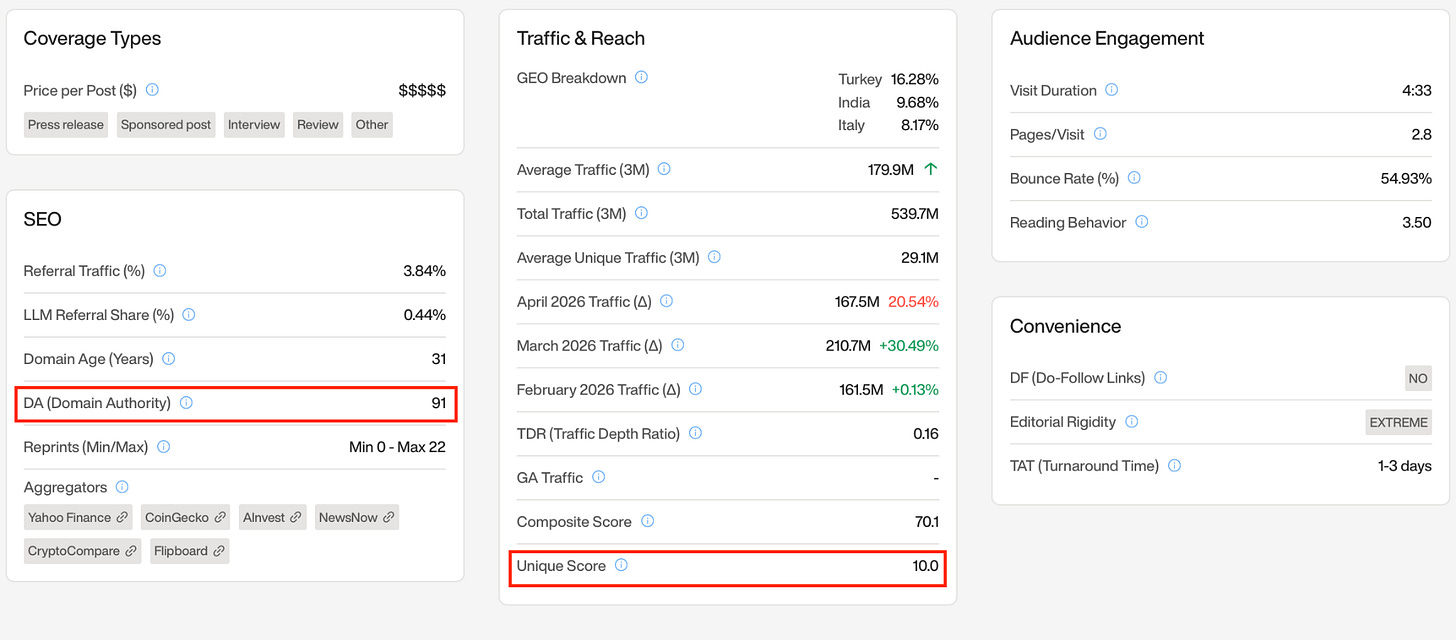
An example of the media profile with strong DA and Unique Score
DA + Reading Behavior: The authority vs engagement test
Reading Behavior purposefully addresses a question DA doesn’t even try to answer: do people actually stay with the content, or do they bounce out almost immediately?
A website can have top-tier authority, say somewhere in the 70 to 100 range, and still show very weak reading behavior. If the score there sits around 1 to 3, that changes the reading fast. The publication may still matter in some narrow SEO sense, but it behaves more like an aggregator, a link-heavy pass-through, or a place people skim and leave.
For PR or guest posting, “authoritative” is not always the same thing as “good environment for a story.” If readers do not stop, don’t read, and don’t stay, then the placement is doing a much thinner job than a high DA might suggest on its own.
When DA and Reading Behavior both look strong, the picture gets much better. A publication with both is genuinely different from the one that only has the first one, and the screenshot below shows what that looks like in practice.
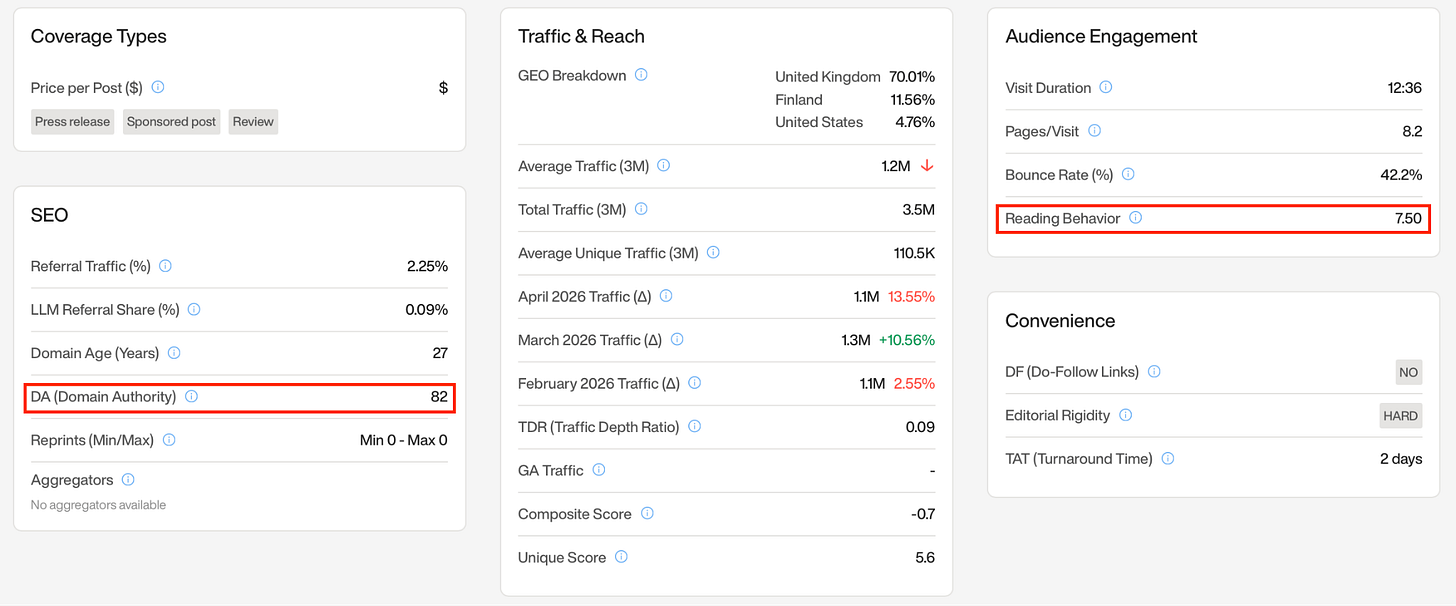
An example of the media profile with strong DA and Reading Behavior
Other useful signals
The golden trio gets most of the heavy lifting done, but a few other interesting reads come from what happens when DA gets paired with the following OMI signals:
DA + Referral Traffic: The validation duo
DA is built largely from backlinks, so one very obvious follow-up question is whether those links are alive in any meaningful way.
If a site has high DA but referral traffic is minor, that is not a great sign since it suggests the domain may have accumulated a lot of links that search tools can see while real humans barely arrive through them at all. A raw authority score won’t tell you that but it will happily let a dead link profile sit there looking impressive.
The healthier scenario is where DA and referral traffic support each other: strong authority and a noticeable stream of real users still coming in through linked pathways. That usually points to a site that functions as an actual resource, not just a domain with legacy SEO weight attached to it.
DA + Main GEO + GEO Breakdown: The relevance filter
A publication may have high DA because it built a dense backlink footprint in one country or language environment. That doesn’t mean the authority helps in every market. If your campaign is trying to rank or resonate in one GEO, and the publication’s authority is concentrated somewhere else, the score can be technically impressive and strategically irrelevant at the same time.
That is why DA gets much more telling once it sits next to Main GEO and GEO Breakdown. It is a simple check, but people skip it constantly. The authority is real only if it matters where you need it to matter.
DA + LLM Referral Share: The future-proofing pair
DA still sends you authority signals in the old web sense: search visibility, link reputation, domain strength. However, websites now get surfaced through AI tools, cited in generated responses, and reused as sources in ways that traditional SEO metrics don’t fully capture.
That is where LLM Referral Share starts to carry weight. If a site shows strong DA and relatively stable AI-driven traffic, the authority begins to look more durable. It suggests the domain holds weight in the newer answer layer of the web as well.
DA + Media Type: The niche context
As mentioned, one of the easiest ways to misuse Domain Authority is to compare it across completely different media types as if all outlets lived in the same universe. A DA of 45 may be ordinary for a big general news site and close to top-tier for a specialized crypto or finance publication.
Media Type gives the score a proper frame. You stop asking whether the number is impressive in some abstract sense and start asking whether it is strong for this kind of site. Domains are not competing with the whole internet but inside categories, niches, and audience environments.
DA + three-month traffic breakdown: The penalty signal
This is probably the pairing that makes people most uncomfortable, because it shows how easily DA can keep telling an old story after reality has changed.
A site can still carry strong DA while its actual traffic and search visibility are already collapsing. OMI’s three-month traffic breakdown forces the score to face the present.
Cointelegraph is a very clear example. According to earlier Outset Data Pulse findings, its U.S. traffic fell by 82% between July and December 2025. That was a loss of 6.65 million visits over five months and a decline nearly three times sharper than the broader U.S. crypto media market.
In early October 2025, Cointelegraph abruptly disappeared from Google search results. The data made it pretty clear this was not just a market cycle. Later, some regional editions started reappearing in Google again, which only reinforced the bigger point: search visibility can break, return, and shift unevenly even while the domain’s broader authority still looks intact on paper.
A strong DA score is not the same as a strong domain
That is probably the cleanest way to leave this. Domain Authority can still be high while the content is weak, the traffic is slipping, the links are stale, or the audience behind the domain is thinner than the score suggests.
Once you see that clearly, the metric becomes easier to use and much harder to romanticize.
What Outset Media Index really does here is remove the temptation to stop at the first reassuring number. It makes the answer for more than its authority score, which is exactly what this metric needed all along.
P.S. This article was initially published on Outset Media Index (OMI) blog.






