When I open the news feed and see a headline like “Decentralized Exchange Surpasses Bybit, Kraken, and OKX in Open Interest,” my first reaction is usually a certain degree of skepticism ( although, to be fair, I tend to be skeptical about quite a lot of things ). This market has a habit of presenting an impressive number in a report as some kind of structural victory. So, as usual, I decided to open the latest Q3 2026 report from Hyperliquid Research Collective and see what is actually going on.
At first glance, the numbers do indeed look significant and impressive. Open interest increased by 79.9% over the quarter, reaching $16.76 billion, and peaked at $18.12 billion toward the end of September. Based on the total value of open positions, the platform even surpassed major crypto exchanges such as Bybit, Kraken, and OKX, capturing an 11.7% share among the eight largest players in the market.
But once I started putting these figures together, the picture became far less straightforward. Alongside these records, the report also shows an outflow of actual capital, high leverage, and an almost complete monopoly held by a single player.
The first thing that makes me skeptical about these numbers is the attempt to present growing positions on the exchange as an influx of new, substantial capital. In the derivatives market, I consider this a rather misleading conclusion.
Open interest only reflects the total value of all outstanding positions, not the amount of actual money sitting in traders' accounts. When traders use leverage, the same thousand dollars can easily turn into ten or even twenty thousand on paper. And here's the interesting part: if we look at actual capital flows during Q3, despite all the impressive records, users withdrew $953 million more from the platform than they deposited. In other words, positions were growing on paper, while actual money was flowing out of the exchange.
To get a clearer picture of what is really happening, rather than just looking at the pretty numbers in the report, I put together the quarter's key metrics in one table ( just to be clear, I didn't really bother with the design ).
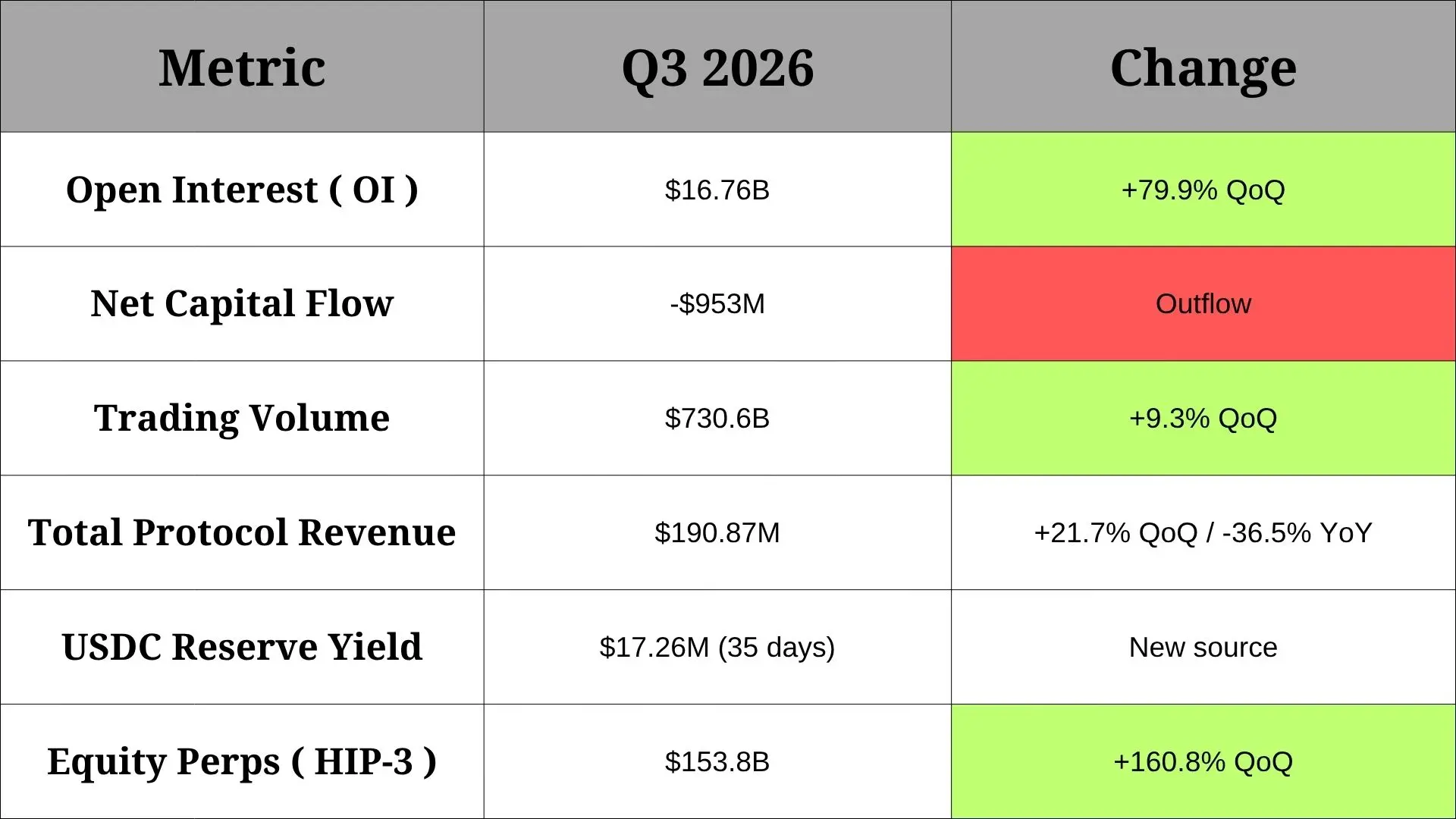
The biggest headline in the report was the $153.8 billion in quarterly trading volume generated by stock and index futures. The idea behind HIP-3 was to create an ecosystem of multiple independent mini-exchanges built on top of Hyperliquid, competing with one another. But September's statistics show something quite different: 97.5% of all trading volume went through a single player - Trade[XYZ]. In my view, this is no longer a truly open decentralized market, but rather a dangerous dependence on a single intermediary.
The ability to trade stocks on Saturdays and Sundays, when the New York markets are closed, sounds attractive only on paper. I see a serious trap here: over the weekend, prices are formed entirely within the crypto platform, without any direct connection to the underlying spot stock market. On Monday morning, when US markets reopen, a sharp price gap between Friday and Monday can wipe out leveraged traders' positions within seconds through a chain reaction of liquidations.
Any exchange operates smoothly only as long as large funds are actively buying and selling assets, providing the liquidity needed to keep the market running. In November, one of these key players - Abraxas Capital, a fund through which around $13 billion in trades had passed over two years - fully closed all its positions and withdrew its capital. We don't know the exact reasons, but the very fact that the departure of just one major fund can leave an exchange struggling to maintain sufficient liquidity for stable trading says quite a lot.
Yes, quarterly revenue increased by 21.7%. But I always prefer to look at the year-over-year picture, and there things are less impressive: revenue is down 36.5% compared to Q3 2025. What's more, half of the current quarterly growth ( $17.26 million over 35 days ) came not from trading fees, but from interest earned on USDC stablecoin reserves. Put simply, part of the exchange's financial performance was supported by passive income rather than actual demand from traders.
The fact that the platform operates through automated blockchain code without a central office does not make it invisible to government authorities. In November, Hong Kong's financial regulator, the SFC, added the exchange's website to its warning list of suspicious unlicensed platforms. This may not stop ordinary retail traders, but for large investment funds in Asia, it is a signal to stay away.
And I want to add one clarification: after reading this article, you might get the impression that I am being a little too critical of this exchange ( although, as I mentioned earlier, I would describe my position as more skeptical than anything else ). But I am not denying the obvious: Hyperliquid is growing rapidly and has already set a serious precedent in the derivatives market in terms of its pace of development. However, I am not yet ready to call it a winner over centralized exchanges or describe it using all kinds of overly optimistic labels. It is simply too early for that.
For now, it looks like a system whose success depends far too heavily on leveraged trading, reliance on a single operator, and a handful of major funds - despite the fact that actual capital was flowing out of the platform throughout the quarter. The only real way to measure the value of these records will not be during a period of impressive quarterly reports, but when the market faces its first serious crash.