
Strategy ( perhaps you previously knew the company better by its former name, MicroStrategy; its shares trade on the stock market under the ticker MSTR ) purchased 1,036 BTC for $81.9 million at an average price of $79,012 between November 2 and November 8.
Let me give you a few figures from its portfolio to help you understand the scale. The company's total Bitcoin holdings amount to 850,364 BTC (that's roughly 4% of Bitcoin's maximum supply of 21 million coins). The total acquisition cost of these holdings is $64.16 billion, with an average purchase price of $75,456 per coin. The company also holds a USD reserve of $4.77 billion.
However, despite these numbers, the company cannot exactly boast of financial success.
The latest purchase at $79,012 came amid a market downturn. At the time the report was published, Bitcoin's market price had fallen below the company's average purchase price (approximately $74,800). This means that Strategy's Bitcoin portfolio was sitting on an unrealized loss of approximately $558 million.
Over the week, the company raised $283.8 million by selling new MSTR common shares, but only $81.9 million was allocated to Bitcoin purchases. Another $188.3 million was spent by management on buying back its own STRC preferred shares, which had begun paying daily dividends. The remaining $13.6 million was allocated to the company's USD Cash reserve.
Since the beginning of October, the company has already spent $1.06 billion on these buybacks, compared to just $219.7 million allocated to Bitcoin purchases.
To cover its ongoing financial obligations, Strategy continues issuing new MSTR common shares. As a result, the amount of Bitcoin per common share is coming under pressure, which is making investors increasingly concerned. Additionally, over the past week, the company used $21.1 million from its $4.77 billion reserve to pay dividends on its preferred shares.
Strategy continues buying Bitcoin to maintain its status as one of the major whales in the crypto industry. However, in reality, the company's priorities seem to be reducing its preferred share obligations, making timely dividend payments, and supporting the price of its own preferred shares.
I also want to attach a chart of MSTR shares. As we can see, they have lost 47.11% of their value over the past year.
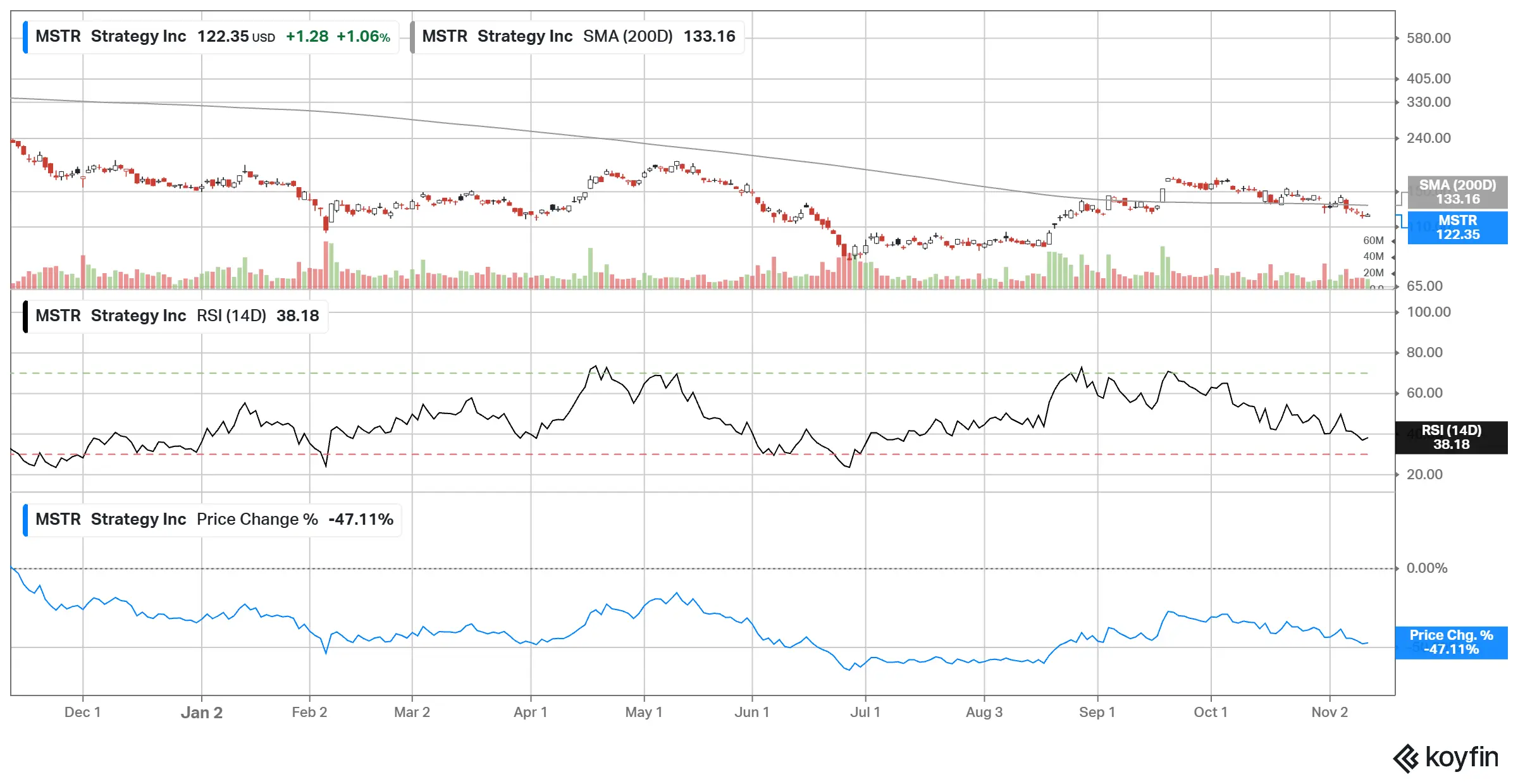
This price performance also shows that despite continuously accumulating Bitcoin, the company has been unable to deliver growth in the value of its own common shares.
Most importantly, it is worth understanding that ordinary MSTR shareholders are the ones taking on the greatest risks due to the company's rather unusual, complex, and risky financial strategy.






