
The cryptocurrency market has been experiencing a noticeable correction recently. Bitcoin, which was trading at much higher levels not so long ago, dropped to a local low of around $55,150, although it later recovered to approximately $59,952. That was, by the way, its lowest level since September 2024. The decline came amid massive liquidations of futures positions, with their total volume exceeding $2.4 billion. The overall cryptocurrency market capitalization also fell to approximately $2.05 trillion.
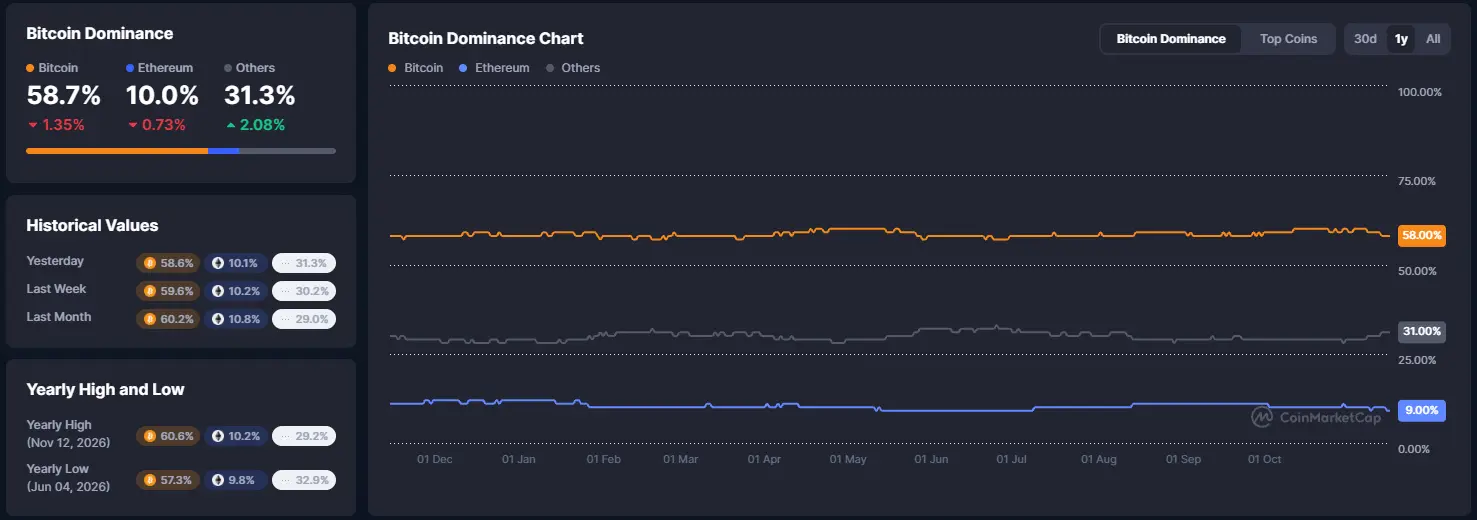
However, in this article, I want to draw your attention to something completely different. Today, I want to look at a much more interesting signal - the decline in Bitcoin Dominance ( BTC.D ) below the 60% mark. According to conventional market logic, a declining Bitcoin market share is usually interpreted as a sign of capital flowing into altcoins. However, the data from late November 2026 tells a rather different story.
On November 11, 2026, Bitcoin dominance reached its yearly peak of 60.6%. At that time, capital was concentrated in Bitcoin amid broader market instability. Today, on November 21, against the backdrop of a Bitcoin sell-off, its share of the total cryptocurrency market capitalization has fallen to 58.7%. And this raises an interesting question - is capital really flowing into altcoins? Not necessarily. There are reasons to believe that some investors have simply decided to wait out the market turbulence in stablecoins or leave the crypto market altogether.
Let me also add a brief explanation for those who are unfamiliar with the BTC.D index and what it represents. It simply shows Bitcoin's share of the total cryptocurrency market capitalization, including stablecoins. And this is precisely where an important part of the current situation becomes clear. According to BeInCrypto, alongside BTC.D falling below 60%, USDT dominance increased by 23.87% relative to its November support level, rising from approximately 6.66% to 8.25%.
All these figures point to several key processes shaping current market sentiment.
-
According to Farside Investors, US spot Bitcoin ETFs recorded approximately $3.47 billion in net outflows in November. Institutional investors were reducing their exposure amid uncertainty surrounding Federal Reserve interest rates and the broader sell-off in the US technology sector.
-
During the November correction, most altcoins fell even harder than Bitcoin. Take XRP, for example, which I covered in one of my recent articles and which lost 28.3% over a 30-day period. Even local rebounds of 2-3% in individual coins following the liquidation wave have done little to change the overall picture. The Altcoin Season Index still points to Bitcoin dominance.
-
Another factor worth mentioning is that during Bitcoin's decline, investors may have been taking profits or cutting losses and moving their funds into dollar-pegged stablecoins. Against the backdrop of a broader crypto market sell-off, this could well have been one of the reasons behind the increase in USDT dominance. Its market share can grow even while Bitcoin and altcoins continue to lose value. So, it is quite possible that the current decline in BTC.D has less to do with growing interest in altcoins and more to do with some investors choosing to wait out the uncertainty in dollar-pegged stablecoins.
For now, I would not be too quick to label Bitcoin dominance falling to the 58.7%-59.4% range, while its price remains below $60,000, as the beginning of altseason. As it turns out, a decline in BTC.D does not mean investors have suddenly fallen in love with altcoins. It is entirely possible that they have simply decided to wait out the market turbulence in stablecoins.
That is why I would keep an eye not only on BTC.D, but also on USDT dominance and the market capitalization of altcoins. What I would like to see is stablecoin dominance declining while altcoin market capitalization starts moving higher. Only then can we begin talking about a genuine rotation of capital. Until that happens, we should not confuse a flight from risk with a sudden desire to buy another altcoin during a dip. Those are two very different stories, after all.
Thank you for taking the time to read!






