
Inflation is nothing to laugh at...
In some countries suffering from unmanageable inflation rates, cryptocurrency adoption has gone through the roof as people find different ways to hedge against it. It's not exactly funny when your salary worth thousands of dollars is suddenly worth cents over night, or when buying bread is suddenly equivalent of what a Lamborghini cost the week before.
For example...
Having seen horrendous monetary policies pushed by the Nicolas Maduro dictatorship, Venezuela is currently experiencing astronomical inflation rates of >2000%. The US Dollar is officially banned in Venezuela, so one of the ways of hedging against this has been through the adoption of crypto, which is used both for remittances and as replacement to the local Venezuelan Bolivar.
Coincidentally, Venezuela has one of the highest crypto adoption rates, currently standing at 10.34%. Also, having extremely cheap and green electricity (see my article here on the 124 cheapest and greenest countries to mine in), a lot of Venezuelans have turned to Crypto mining but the government is not shy in imposing crackdowns.
But is %Crypto Adoption high in every country with high inflation?
To answer this question, I have gathered %Crypto Adoption data from here and monthly %inflation rate data from here.
In total, comparative data for 128 countries was available and I have summarized it in the table below.
128 countries ranked by %Inflation rate and with Cryptocurrency adoption data
  Rank          Country           %Inflation Rate   %Percentege of people who own Crypto
 ------ ------------------------ ----------------- --------------------------------------
     1   Venezuela                2720.00%          10.34%
     2   Sudan                    423.00%           0.91%
     3   Lebanon                  101.00%           1.03%
     4   Suriname                 54.00%            0.93%
     5   Syria                    52.43%            1.02%
     6   Iran                     43.60%            1.96%
     7   Ethiopia                 26.40%            0.98%
     8   Zambia                   24.60%            1.48%
     9   Turkey                   18.95%            2.94%
    10   Nigeria                  17.38%            6.31%
    11   Kyrgyzstan               14.60%            0.97%
    12   Haiti                    12.70%            0.94%
    13   Georgia                  11.90%            2.89%
    14   Uzbekistan               11.10%            1.03%
    15   Ukraine                  10.20%            12.73%
    16   Belarus                  9.80%             3.73%
    17   Malawi                   9.10%             0.92%
    18   Ghana                    9.00%             3.01%
    19   Brazil                   8.99%             4.88%
    20   Botswana                 8.90%             1.06%
    21   Kazakhstan               8.40%             1.73%
    22   Pakistan                 8.40%             4.10%
    23   Dominican Republic       7.88%             1.86%
    24   Uruguay                  7.30%             1.44%
    25   Togo                     6.80%             1.59%
    26   Mauritius                6.50%             2.47%
    27   Russia                   6.46%             11.91%
    28   Kenya                    6.44%             8.52%
    29   Tunisia                  6.40%             1.04%
    30   Congo                    6.23%             1.11%
    31   Madagascar               6.06%             1.09%
    32   Sri Lanka                5.70%             1.50%
    33   Iraq                     5.60%             0.93%
    34   India                    5.59%             7.30%
    35   Mozambique               5.48%             1.60%
    36   Egypt                    5.40%             1.75%
    37   United States            5.40%             8.31%
    38   Paraguay                 5.20%             1.05%
    39   Estonia                  5.00%             2.41%
    40   Poland                   5.00%             2.50%
    41   Romania                  4.95%             2.20%
    42   Lithuania                4.70%             2.58%
    43   Papua New Guinea         4.65%             0.89%
    44   Hungary                  4.60%             1.36%
    45   South Africa             4.60%             7.11%
    46   Chile                    4.50%             2.62%
    47   Jamaica                  4.40%             1.32%
    48   Iceland                  4.30%             0.99%
    49   Honduras                 4.26%             1.03%
    50   Nepal                    4.19%             1.45%
    51   Nicaragua                4.12%             1.11%
    52   Cyprus                   4.00%             1.67%
    53   Namibia                  4.00%             1.12%
    54   Philippines              4.00%             3.98%
    55   Colombia                 3.97%             6.14%
    56   Guatemala                3.82%             1.34%
    57   Peru                     3.81%             3.74%
    58   Germany                  3.80%             2.62%
    59   Tanzania                 3.80%             1.83%
    60   Canada                   3.70%             3.20%
    61   Burkina Faso             3.50%             0.94%
    62   Ivory Coast              3.50%             1.30%
    63   Moldova                  3.50%             1.35%
    64   El Salvador              3.43%             1.94%
    65   Czech Republic           3.40%             2.23%
    66   Macedonia                3.40%             1.13%
    67   Malaysia                 3.40%             3.15%
    68   New Zealand              3.30%             1.76%
    69   Serbia                   3.30%             1.74%
    70   Slovakia                 3.30%             2.57%
    71   Qatar                    3.13%             0.99%
    72   Kuwait                   3.10%             1.12%
    73   Montenegro               3.10%             1.59%
    74   Belize                   3.00%             0.90%
    75   Bulgaria                 3.00%             1.74%
    76   Cambodia                 3.00%             1.35%
    77   Norway                   3.00%             1.73%
    78   Mauritania               2.90%             1.57%
    79   Senegal                  2.90%             1.22%
    80   Spain                    2.90%             2.51%
    81   Croatia                  2.80%             1.51%
    82   Latvia                   2.80%             3.29%
    83   Benin                    2.70%             1.34%
    84   Puerto Rico              2.70%             1.25%
    85   Myanmar                  2.64%             0.91%
    86   Vietnam                  2.64%             6.12%
    87   South Korea              2.60%             3.79%
    88   Panama                   2.40%             1.99%
    89   Singapore                2.40%             9.04%
    90   Luxembourg               2.30%             1.17%
    91   Belgium                  2.27%             2.36%
    92   Ireland                  2.20%             1.72%
    93   Uganda                   2.10%             1.81%
    94   Mali                     2.00%             1.15%
    95   Slovenia                 2.00%             2.45%
    96   United Kingdom           2.00%             4.95%
    97   Cameroon                 1.97%             1.88%
    98   Finland                  1.90%             1.88%
    99   Israel                   1.90%             1.27%
   100   Italy                    1.90%             2.17%
   101   Jordan                   1.84%             1.27%
   102   Bosnia and Herzegovina   1.70%             1.37%
   103   Denmark                  1.60%             1.37%
   104   Indonesia                1.52%             2.66%
   105   Morocco                  1.50%             2.38%
   106   Portugal                 1.50%             2.37%
   107   Costa Rica               1.43%             1.49%
   108   Greece                   1.40%             1.87%
   109   Netherlands              1.40%             3.04%
   110   Sweden                   1.40%             2.26%
   111   Trinidad and Tobago      1.40%             1.17%
   112   Bahamas                  1.39%             0.91%
   113   Oman                     1.25%             0.97%
   114   France                   1.20%             3.34%
   115   Brunei                   1.10%             0.91%
   116   Gabon                    0.90%             0.91%
   117   Maldives                 0.90%             0.94%
   118   Hong Kong                0.70%             3.27%
   119   Switzerland              0.70%             1.82%
   120   Ecuador                  0.45%             2.73%
   121   Thailand                 0.45%             5.20%
   122   Saudi Arabia             0.40%             1.30%
   123   Malta                    0.30%             1.44%
   124   Bolivia                  0.20%             1.85%
   125   Japan                    0.20%             1.64%
   126   Macau                    -0.08%            0.90%
   127   United Arab Emirates     -0.38%            1.54%
   128   Rwanda                   -1.10%            1.45%
Quick Analysis
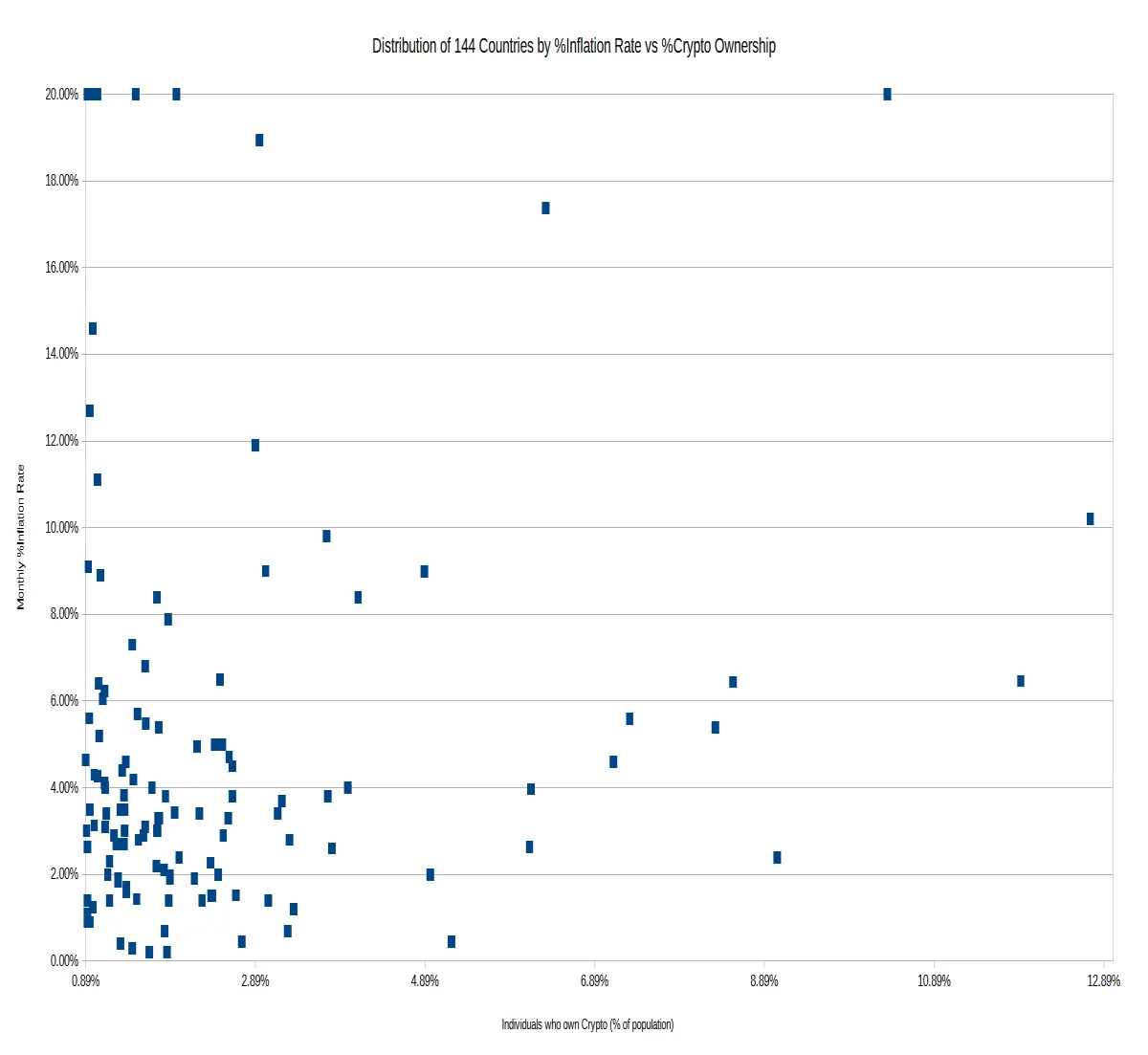
Just from glancing at the table, it is evident that this is not entirely true. Countries with very low inflation rates like Thailand, Hong Kong, The Netherlands and France have seen a lot of crypto adoption, meaning that there is another driver behind it.
At the same time, countries with very high inflation rates (over 50%!!) like Sudan, Lebanon, Syria, Iran and Ethiopia do not appear to have a lot of crypto adoption, despite the price of goods changing annoyingly fast.
I calculated an r-value (linear correlation coefficient) for the data and I got 0.3, which indicates no real statistical correlation. This is also pretty obvious from the graph below. Perhaps it is possible discern different populations in there but its a long-shot with only a couple of hundred points.
So what else is at play?
It looks like there is much more going on for crypto adoption than just using crypto as a hedge against inflation.
Perhaps crypto awareness and education is low in countries like Sudan and Ethiopia and that is why they don't use it? Or perhaps they can hedge against inflation by other means such as using gold, silver or bartering? Perhaps the % of internet users is too low for people to even know about crypto.
However, I suspect this is not the case in places like Iran and Lebanon which are very techy. Or weirdly in sketchy places like Ukraine and Russia, which have seen huge adoption rates without experiencing much inflation...let's please not link this with the dark web or for selling drugs and guns...
So what do you think? What other things are at play in crypto adoption? Looking forward to reading your comments below :)
n.b. Image Creator: PM Images, Copyright: Phil Leo / Michael Denora
Disclaimer: Being a content writer I try to get as much exposure as possible by posting my writings in different platforms. This article was originally posted on publish0x and can be found in this link.
Also, non of the content of this writing is or should be considered financial advise. I am no financial advisor, I am merely a content writer using freely available data to answer some big questions.






