
When it comes to building trust in decentralized applications, nothing kills momentum faster than sneaky MEV bots front-running, sandwiching, or extracting hidden value from users’ transactions.
Today, GetBlock is changing the game, rolling out fully MEV-protected RPC nodes, focusing on Solana, Ethereum, BNB Smart Chain, and Base. The result is the same familiar RPC workflow, but with an invisible shield against the most sophisticated on-chain predators.
Why MEV protection matters
Maximum Extractable Value (MEV) describes the profit MEV seekers can skim off every swap, NFT mint, or auction by censoring, front-running, or sandwiching transactions in the public mempool. That extra cost comes straight out of your users’ pockets and can result in higher slippage, failed transactions, or simply a worse UX overall.
For dApp developers, MEV isn’t just a backend headache, it’s a direct hit to user experience and trust. By embedding protection at the RPC layer, GetBlock ensures that users’ transactions land on-chain exactly as intended, without exposing them to predatory actors.
Under the hood: Private mempools with Merkle
Traditional defenses against MEV often involve custom middleware or other extra layers that increase the maintenance burden. GetBlock handles the protection at the network-access layer, thanks to its collaboration with Merkle.
Via this integration, transactions submitted to GetBlock’s protected endpoints are first routed through Merkle-managed private mempools:
- Public MEV bots never see pending transactions, so they can’t sandwich or re-order them.
- Merkle assembles the block privately, then delivers it to the network, no value extraction, guaranteed.
How to get an MEV-protected endpoint
For GetBlock clients on any paid shared-node tier, MEV protection is included at no extra configuration cost. To enable MEV protection on GetBlock:
- Sign in to your user account at getblock.io.
- Navigate to the Shared Nodes dashboard.
- Pick one of the mainnets: Ethereum, Base, BSC, or Solana.
- Toggle on the “MEV-Protected” option while configuring the API.
- Generate the RPC URL to use in your dApp or service.
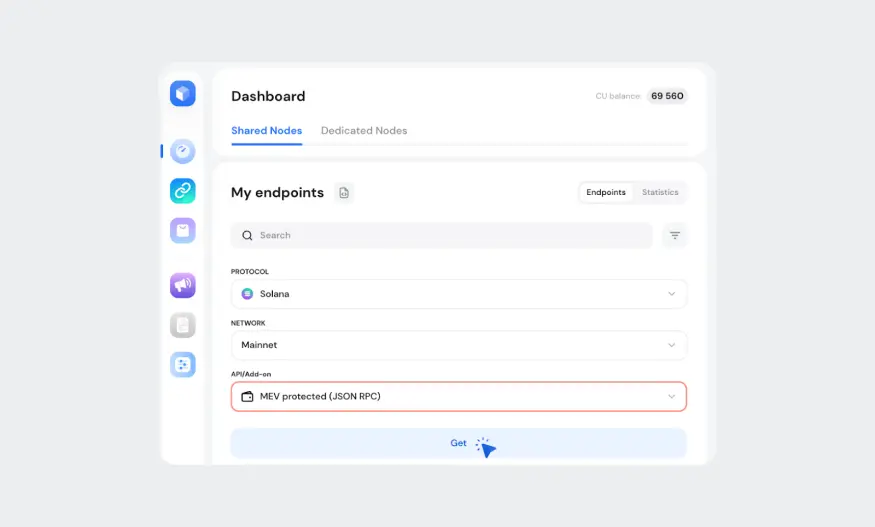
Image by GetBlock
Once you’ve completed these steps, every JSON-RPC request your application makes to that URL is automatically funneled through Merkle’s secure mempools. No additional development effort required – the protection is embedded into the endpoint itself.
Free-plan accounts do not include MEV protection by default, but upgrading is quick and painless.
Ready to fortify your dApp? Log in or sign up at GetBlock and start using MEV-protected RPC endpoints today. Your users – and your bottom line – will thank you.






