
On July 18, 2025, President Trump signed the GENIUS Act into law. It was supposed to be the moment crypto finally grew up. For the first time, the United States had a comprehensive federal framework for payment stablecoins. One year later, on July 18, 2026, the law turned one. The rules that make it work never showed up to the party.
Six federal agencies (the Treasury Department, the OCC, the FDIC, the Federal Reserve, the NCUA, and Treasury's FinCEN/OFAC joint office) all blew past the statutory deadline to finalize the regulations that turn the GENIUS Act from legislative text into operational reality. The law is real. The $314 billion stablecoin market is real. The rulebook is not.
This is not a story about bureaucratic delays. It is a story about market structure, survival math, and a 177-day countdown that will decide which stablecoins live and which ones die.
What Just Happened on July 18, 2026
The GENIUS Act (formally the Guiding and Establishing National Innovation for US Stablecoins Act) is not a suggestion. It is Public Law 119-27. Section 13 of that law gave the primary federal regulators exactly one year to publish final implementing rules through standard notice-and-comment procedures. That year ended on July 18, 2026. None of the six agencies met it.
The agencies were not idle. They published ten notices of proposed rulemaking between February and April 2026. The OCC put out its main proposal on February 25. The FDIC followed in April. FinCEN and OFAC jointly published AML and sanctions rules that same month. The NCUA drafted credit-union procedures. Comment periods closed by early June. But proposals are not rules. If you are building a stablecoin business, that distinction is the difference between knowing the road and driving on it.
Here is what each agency was supposed to deliver, and what is still missing:
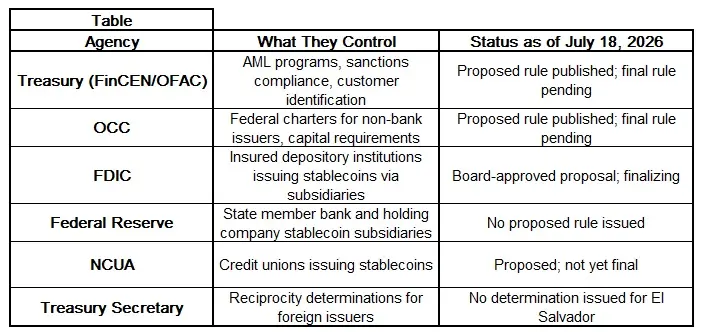
The Federal Reserve's absence is especially notable. As a primary federal payment stablecoin regulator under the statute, the Fed was supposed to coordinate on rules covering state member banks and certain holding companies. It has not even published a proposed rule yet. That gap matters because the Fed's jurisdiction covers some of the largest potential bank entrants into stablecoin issuance.
The law itself remains valid. Its effective date is the earlier of 120 days after the primary regulators issue final rules, or January 18, 2027. Because the July 18 deadline was missed, the January 18 fallback is now the hard floor. The rules may still arrive in August or September. But the compliance runway has already been shortened by whatever delay remains.
The 177-Day Countdown: What Happens Between Now and January 18, 2027
Here is the timeline every stablecoin holder should understand.
From July 18, 2026 to January 18, 2027 is 184 days. Subtract the 120-day compliance window the GENIUS Act requires between final rules and enforcement, and issuers effectively have roughly zero buffer if rules arrive in late September. If rules slip to October or November, the 120-day window will extend past January 18, but the law activates anyway. That creates a legal paradox: the framework becomes enforceable before issuers have the full preparation time Congress intended.
The milestone map looks like this:
- July 18, 2026: Statutory rulemaking deadline missed. Law remains valid. Draft proposals are the only guidance available.
- August–September 2026: Agencies may still publish final rules. If they do, the 120-day clock starts. Issuers scramble to build AML programs, reserve attestation infrastructure, and redemption mechanisms against potentially shifting text.
- October–November 2026: If final rules land here, the 120-day window pushes effective enforcement into January or February 2027. But the January 18 hard date still looms.
- January 18, 2027: The GENIUS Act activates regardless. Only permitted Payment Stablecoin Issuers may legally offer stablecoins to US users. Non-compliant issuers face escalating restrictions.
- July 18, 2028: The exchange prohibition takes effect. Digital asset platforms may no longer list non-compliant stablecoins for US persons.
The practical implication is that compliant issuers are building now against draft rules that could change. Non-compliant issuers are hoping the rules stay delayed long enough to keep operating in gray zones. And users are holding stablecoins without knowing which category their issuer falls into.
The Compliance Cost Math That Will Kill Most Stablecoin Issuers
The GENIUS Act does not just regulate stablecoins. It turns their issuers into something that looks, on paper, a lot like banks. That is not incidental. It is the architecture.
The core requirements include:
- 1:1 reserves held in cash, federally insured deposits, or short-term US Treasuries
- Regular attestations and public disclosures
- Prompt redemption at par on demand
- Senior claims for holders in bankruptcy
- Risk-based AML programs with transaction monitoring
- Suspicious activity reporting procedures
- Enhanced due diligence for high-risk customers
- Ongoing federal or state examination
The OCC proposed a $5 million capital floor for non-bank issuers. For JPMorgan or US Bancorp, that is a rounding error. For a $200 million fintech stablecoin startup, it is an existential barrier.
Add the cost of building a bank-grade AML program (estimated at $2–5 million annually for a mid-market issuer), hiring compliance officers, implementing reserve attestation infrastructure, and paying for ongoing federal examinations. A $200 million issuer with thin margins and no banking parent simply cannot absorb that stack. The math does not work.
This is why industry forecasts from 2026 consistently pair "explosive stablecoin growth ahead" with "consolidation around two to four issuers" in the same sentence. The same regulatory clarity that unlocks trillions in institutional demand prices out everyone who cannot afford to look like a bank.
The Yield Ban and the Regulation Q Problem
Here is the provision that will reshape DeFi whether regulators realize it or not. The GENIUS Act prohibits yield on payment stablecoins. If you hold a compliant stablecoin, the issuer cannot pay you interest. The logic is that yield-bearing stablecoins start to look like bank deposits, and Congress did not want to create unregulated deposit substitutes.
The problem is that banning yield on regulated products does not eliminate demand for yield. It redirects it.
From 1933 to 1986, Regulation Q capped interest rates on US bank deposits. It did not kill demand for yield-bearing savings. It redirected that demand to money market mutual funds, which operated outside the rate ceiling and grew into a $6 trillion industry. The GENIUS Act's yield prohibition is producing the same dynamic in real time.
DeFi lending protocols on Ethereum and Solana already offer 5% to 8% annual yields on stablecoin deposits. These protocols are not Payment Stablecoin Issuers under the GENIUS Act. They are not banks. They are not even issuers. They are lending markets that happen to use stablecoins as collateral. The yield ban on regulated issuers therefore creates a powerful incentive to move stablecoin capital from compliant, low-yield products into unregulated, higher-yield DeFi protocols.
The result is not a safer stablecoin market. It is a split market. Tier 1 holds your compliant, audited, 1:1-reserved stablecoins that pay zero yield. Tier 2 holds your DeFi-deployed stablecoins earning 5% to 8% in protocols with no federal oversight, no redemption guarantees, and no bankruptcy seniority. The yield ban was designed to protect consumers. It may end up herding them into the riskier tier.
Winners and Losers: The Compliance Readiness Scorecard
Not all stablecoins face the same risk. Here is how the major issuers stack up.
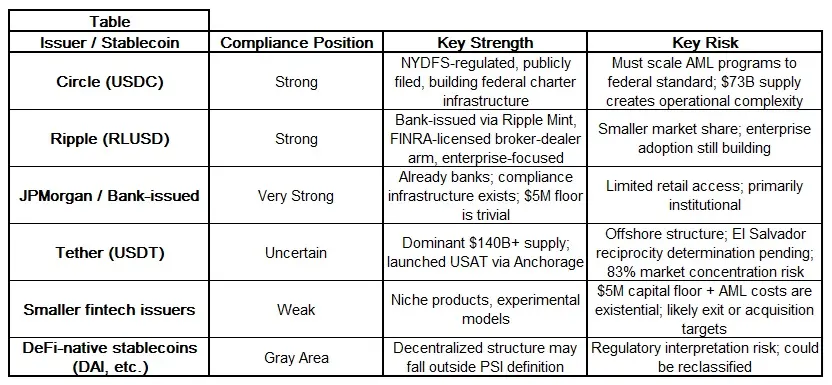
The consolidation thesis is straightforward. The $314 billion market will not shrink. It will concentrate. Circle and bank-affiliated issuers gain share. Tether's fate depends on a single Treasury determination. Everyone else faces a compliance bill they cannot pay.
What This Means for Your Wallet
If you hold USDT: You have time. The exchange prohibition does not take effect until July 18, 2028. But the path to long-term US compliance runs through El Salvador's regulatory framework being certified by the Treasury. That had not happened as of July 2026. Tether's USAT is the compliant hedge, but its supply is tiny compared to USDT. The rational move is not panic-selling USDT today. It is monitoring the reciprocity determination and understanding that USDT's US market access has a conditional expiration date.
If you hold USDC: Circle is the best-positioned crypto-native issuer for federal compliance. The company has been building toward this framework since before the GENIUS Act passed. USDC carries lower regulatory tail risk than USDT, though no stablecoin is risk-free.
If you use DeFi yield protocols: The yield ban on regulated issuers is bullish for DeFi lending demand in the short term. Capital seeking yield will migrate to protocols offering 5% to 8%. The risk is that regulators eventually notice this migration and attempt to extend oversight to DeFi protocols themselves, which would trigger a second regulatory shock.
Action steps before January 2027:
- Review which stablecoins your exchange wallet holds. Know the issuer.
- If you hold significant USDT, consider what percentage you are comfortable keeping through 2027–2028 given the reciprocity uncertainty.
- If you earn yield on stablecoins, understand whether that yield comes from a regulated issuer (banned under GENIUS) or a DeFi protocol (currently outside scope).
- Watch for the Treasury's El Salvador reciprocity determination. That single decision will move Tether's US market access more than any price chart.
The Dodd-Frank Precedent: Will They Miss Again?
There is a reason to take the missed deadline seriously beyond this single event. The Dodd-Frank Act of 2010 imposed hundreds of statutory rulemaking deadlines on regulators. The SEC and CFTC missed roughly 40% of them. The CFPB missed others. Statutory deadlines in financial regulation are targets, not guarantees.
The GENIUS Act contains no automatic fallback if agencies miss deadlines. No interim guidance framework kicks in. No temporary safe harbor protects issuers. The law simply waits.
If the OCC, FDIC, or Treasury slip again into August or September, the 120-day compliance window compresses further. Issuers will be forced to build permanent infrastructure against draft text that could still change in final form. That is expensive, risky, and exactly the kind of uncertainty that drives market consolidation faster than the law itself intended.
The honest read is that the agencies will probably publish final rules before January 18, 2027. But "probably" is not a compliance strategy. And for a $200 million issuer deciding whether to raise capital or shut down, "probably" is not good enough.
Key Takeaways
- Six federal agencies missed the July 18, 2026 statutory deadline to finalize GENIUS Act stablecoin rules. The law is valid. The rulebook is not.
- The hard enforcement date is January 18, 2027. The 120-day compliance window is already compressed.
- The $5 million capital floor and bank-grade AML requirements will force consolidation. Most small issuers cannot survive.
- The yield ban will redirect capital to unregulated DeFi protocols, creating a two-tier market rather than a safer one.
- Tether's long-term US access depends on a Treasury reciprocity determination for El Salvador that had not been issued as of July 2026.
- Circle, Ripple, and bank-affiliated issuers are best positioned. Smaller fintech issuers face existential math.
- Users should know which stablecoins they hold, monitor the reciprocity determination, and understand that January 18, 2027 is a real cliff, not a soft target.
FAQ’s
Q: Is the GENIUS Act still a law even though the rules are missing?
Yes. The missed deadline does not invalidate the law. The GENIUS Act remains in full force, with a hard activation date of January 18, 2027.
Q: Can I still buy and sell USDT in the United States?
Yes. The exchange prohibition for non-compliant stablecoins does not take effect until July 18, 2028. USDT remains fully tradable until then.
Q: Will stablecoin prices crash because of the missed deadline?
Not necessarily. The delay creates uncertainty, but it does not directly affect reserve backing or peg mechanics. Price risk concentrates around non-compliant issuers facing exit pressure.
Q: What is the difference between the GENIUS Act and the CLARITY Act?
The GENIUS Act regulates stablecoins specifically. The CLARITY Act is a broader digital asset market-structure bill covering securities classification, exchange registration, and token issuance. They are separate laws with separate timelines.
Q: Should I move all my stablecoins to USDC?
That is a personal risk decision, not universal advice. USDC carries lower regulatory tail risk under the GENIUS Act framework. But diversification across compliant issuers is generally prudent.
Q: Will DeFi protocols be regulated under the GENIUS Act?
Not directly. The Act regulates Payment Stablecoin Issuers. DeFi lending protocols are not PSIs. However, future rulemaking or legislation could extend oversight to protocols that intermediate stablecoin yield.
Q: What happens if agencies miss the January 18, 2027 date too?
They cannot. January 18, 2027 is a statutory activation date built into the law itself. It does not depend on rulemaking completion. If final rules are not published by then, the law activates with whatever guidance exists.
Disclaimer:
This article is for informational and educational purposes only. It does not constitute financial, investment, or legal advice. Regulatory frameworks are subject to change, and readers should conduct their own research or consult a qualified professional before making decisions about their stablecoin holdings.





