
Stocks have not performed well over the last 5-6 years. Many large companies have seen declines of 70 to 90%. The only sector that has driven the S&P 500 has been AI and tech (which have reached over 40% of the total market cap). Many AI stocks have seen significant gains, driven by the explosion of AI in everyday life. Among them, NVIDIA, of course. Which sector could explode in the coming years? It could be quantum computing. There's another interesting thing to consider: the potential decorrelation with the rest of the markets.
CORRELATIONS AND STORES OF VALUE
$BTC (the crypto sector) is generally positively correlated with stocks. The crypto market is much more speculative, so it experiences greater ups and downs than stocks. Risky markets perform well when there are rate cuts. While cryptocurrencies and speculative stocks rise and then lose almost all capital, $BTC accumulates value over time: it rises from 400% to over 1000% (2013, 2017, 2021, 2025) and then after about 1.5 to 2 years loses 50 to 80% (2014, 2018, 2022, 2026). Long-term macrotrends are bullish, but there is a positive correlation with stocks; in any case, let's leave aside Bitcoin's price action. Gold historically performs well during severe crises, but even then, with its long-term bullish macrotrends, it experiences long bullish and bearish phases (gold experienced a bear market that lasted over 20 years from 1980 to the early 2000s). While gold's behavior is more difficult to categorize, we can't say it's completely uncorrelated with euphoric periods.
DECORRELATION FROM TRADITIONAL MARKETS
Among the most uncorrelated assets are companies that produce war materials, for example, but also the price of gasoline. When oil rises, it generally signals an economic/political crisis. It's a very volatile asset, yet it's a kind of hedge because if BTC and stocks decline in the short term (months, even more than a year) due to serious crises, $BRENT (Oil) will almost certainly rise.

HOW WILL QUANTUM COMPUTER STOCKS BEHAVE IN THE FUTURE?
This is a very interesting topic. As you know, Bitcoin and all systems based on asymmetric cryptography (including the internet and banks) are trying to make their systems quantum-resistant because quantum computers could find solutions to mathematical problems that are currently unsolvable (even by AI) by cracking cryptography based on elliptic curves. While I believe systems will become resistant to these types of attacks, investing in the largest tech companies in the quantum sector might not be a bad idea. Think of it as a hedge on your investments. If quantum computers become established, their shares would rise significantly. They could rise in any case, even if all systems become quantum-resistant.
MAJOR QUANTUM STOCKS
Probably the largest stocks with the most exposure to quantum computers are: IBM (IBM), D-Wave Quantum (QBTS), Quantinuum (QNT), IonQ (IONQ) and Rigetti Computing (RGTI). Microsoft (MSFT), Alphabet (GOOGL) and NVIDIA (NVDA) also obviously have exposure/correlation.
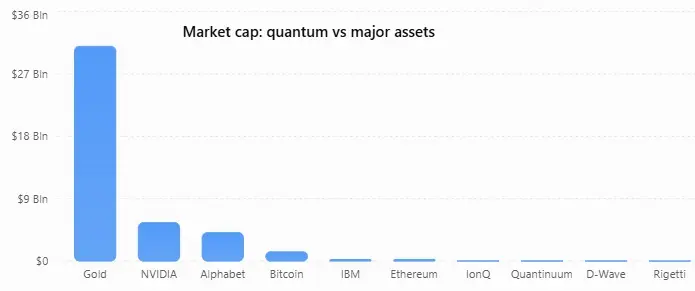
Quatinuum (QNT) went public in June 2026, making it a relatively new company. The IPO raised approximately $1.63 billion net. Quantinuum is seeking to build a full stack:
- quantum hardware;
- quantum software;
- quantum networking;
- cybersecurity/post-quantum;
- applications;
- cloud access.
This differentiates it from a company that only builds GPUs, CUDA, networking, and the software ecosystem. It also has a very interesting technology based on trapped ions. Quantinuum is betting on a technology different from IBM/Google/Rigetti. This also makes QNT interesting as a technological diversification.
IonQ (IONQ) doesn't just want to be a quantum computer manufacturer: it is building an ecosystem including:
- quantum computing;
- networking;
- sensing;
- photonics;
- hardware;
- software.
IonQ also unveiled Superion 256 (a new sixth-generation platform) and was acquired by SkyWater Technology for $1.8 billion.
NVIDIA (NVDA) has a bit of everything: graphics cards, AI, and even quantum computing. The risk is low, but it's not a small stock. It has rallied significantly over the last six years. One of the few stocks to outperform $BTC.
NVIDIA is trying to make GPUs with AI + Quantum. CUDA-Q is essentially an attempt to create CUDA for the quantum world.
IBM (IBM) is perhaps the largest "traditional" company betting on the quantum sector. IBM is investing over $10 billion in quantum computing over the next five years, across R&D, manufacturing, M&A, and the ecosystem. And above all, it has a very aggressive roadmap:
2026: quantum advantage.
2029: fault-tolerant quantum computing.
IBM also already has hundreds of organizations using its quantum infrastructure. Obviously, it's a low-risk bet, so it's less asymmetrical.
Google/Alphabet (GOOGL) achieved extremely important results in error correction with Willow. And in 2026, Google announced Quantum Echoes, which it bills as the first verifiable quantum advantage on an algorithm connected to a real-world application. Again, low risk but little upside.
D-Wave Quantum (QBTS) is highly speculative. It's particularly interesting because it uses quantum annealing, so it's not exactly the same race as IBM/Google/IonQ. The advantage is that it can focus on problems of:
- optimization;
- scheduling;
- logistics;
- machine learning;
- industrial optimization.
The risk is that quantum annealing may remain a niche technology while fault-tolerant gate-based quantum computers become the dominant paradigm. However, there's an interesting development today: the US government is investing directly in the company through the new CHIPS program.
Rigetti Computing (RGTI) is a tech casino ticket. It's interesting because it uses superconducting qubits, so conceptually it belongs to the same large technological family as IBM and Google. The interesting point is that Rigetti has received a $100 million commitment from the US government.
CONCLUSIONS
In general, we can summarize as follows:
- Low risk: NVDA, IBM, GOOGL.
- High growth, medium risk: QNT, IONQ.
- Speculative, high risk: QBTS, RGTI.
Obviously, these are my personal views on how the world might evolve over the next 5–10 years. You shouldn't sell your assets—whether companies or Bitcoin—simply because they are threatened by quantum computers; instead, consider these companies a hedge. In any case, since this does not constitute financial advice, I encourage you to do your own research (DYOR).
Article always updated with all the possibilities of on-chain farming (airdrop): Some Sites To Earn Crypto Bonus (Old & New)





