
In some countries, gold was confiscated or made illegal for private citizens to own. The most famous example is that of the United States in the 1930s, when the "Gold Confiscation Act" (1933) was enacted. During the Great Depression, President Franklin D. Roosevelt issued Executive Order 6102:
"Forbidding the Hoarding of Gold Coin, Gold Bullion, and Gold Certificates within the Continental United States"
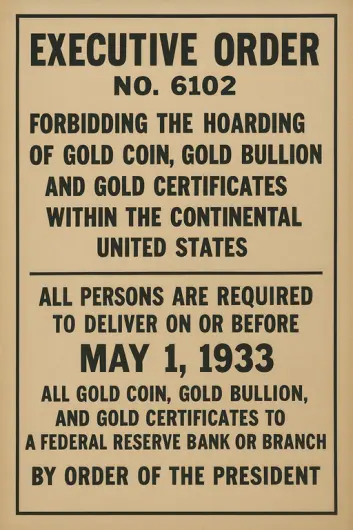
This decree prohibited American citizens from holding monetary gold (coins, bars, or gold certificates) above a small amount (about $100 at the time). Citizens were forced to surrender their gold to the Federal Reserve in exchange for dollars at a fixed price of $20.67 per ounce. Shortly thereafter, the government revalued gold to $35 per ounce, effectively devaluing the dollar and increasing the value of the federal gold reserves.
The goal was to stabilize the economy and control the money supply, since at the time the dollar was still tied to the gold standard (i.e., convertible into gold).
Anyone who failed to hand over their gold risked:
- a fine of up to $10,000 (a huge sum at the time, equivalent to hundreds of thousands of dollars today).
- up to 10 years in prison.
- both.
Not all gold was confiscated. Exempt items included: gold coins with numismatic or collector's value, small quantities, jewelry and personal ornaments, and gold used in industrial, artistic or dental work. Citizens would bring their gold to the bank, which would weigh it and record it. A certificate of deposit or equivalent banknotes would then be issued. The banks then transferred the gold to the Federal Reserve, which deposited it in the U.S. Treasury. As mentioned, in January 1934, with the Gold Reserve Act, Roosevelt officially revalued gold from $20.67 to $35 per ounce.
This meant that those who had already delivered their gold lost about 40% of their potential purchasing power. The government made a huge accounting profit, increasing its reserves and being able to issue more dollars (since the dollar was still tied to gold).
People often hid gold in their homes, gardens, or walls, and many "1933 gold" finds still occur today. Private gold ownership remained illegal until 1974, when President Gerald Ford lifted the ban. From January 1, 1975, Americans could once again freely purchase and own gold.
OTHER EXAMPLES
The United Kingdom (1960s and 1970s) also introduced restrictions on gold ownership and export for currency control purposes.
In Australia (1959–1976), holding gold without government authorization was prohibited. Even in Italy, during wars or crises, gold ownership was heavily regulated and taxed.
IS IT POSSIBLE TO DO THIS WITH BITCOIN?
A state could pass a law prohibiting or limiting the use or possession of Bitcoin (as it did with gold). Some countries have already done so, for example:
- China: transactions and mining prohibited.
- Morocco, Algeria, Nepal, Bangladesh: Bitcoin formally illegal.
- USA, France, Italy, etc.: legal but controlled by increased taxes.
Therefore, a legal "ban" scenario is possible, especially in the event of a financial crisis. Technically, Bitcoin cannot be easily "confiscated." Unlike gold (physical and traceable), Bitcoin is digital and decentralized, and no central bank controls it.
Private keys cannot be recovered or seized without the owner's cooperation. If you store Bitcoin in a non-custodial wallet, the state cannot withdraw it or freeze it like a bank account. This makes a "blanket seizure" technically very difficult, unless people store Bitcoin on regulated exchanges (which can receive blocking orders), or the state legally compels its surrender with threats and sanctions. Instead of direct confiscation, governments could:
- Make use or trade illegal (i.e., ban payments or exchanges in Bitcoin), but this would be unenforceable through private exchanges (P2P).
- Impose punitive taxation or mandatory conversion into the national currency.
- Offer a legal window to "exchange" Bitcoin for a CBDC (state digital currency) as "compensation."
In practice, the more controlled a country becomes, the easier it is to exert legal pressure, but with Bitcoin, a true technical seizure like that of gold in 1933 is highly unlikely, barring threats, sanctions, and the use of force.
Are you interested in ways to earn crypto bonus? Check it out here: Some Sites To Earn Crypto Bonus (Old & New)






