
In this article I will talk about how to start investing and in particular about ETF. Clearly it can never be exhaustive but it serves to provide the basis. I notice that many people confuse "investing" with "trading". They are very different concepts, as they are based on long-term returns even 10 years (investment) and short-term (trading). If you don't have a strategy you will lose money. It's mathematical. According to some, cryptocurrencies are not an investment because it is a market with very little history, however BTC and ETH should always be included in a diversified portfolio because it is an emerging market. Surely a memecoin/shitcoin is not an investment. Does it allow you to make money? Yes. However you cannot hold it for years.
✅For what purpose do I invest? What are your goals? Increase your money? Taking risks (gambling)? Protect myself from inflation? Have a pension? Remember that you invest to slowly grow your assets over time, not to get rich in 3 months or 1 year. You can consider yourself lucky if every year you manage to increase your assets by 5/10% per year. What you decide to invest must remain invested for a sufficiently long time horizon (at least 5 years) regardless of the rise/fall in the price
✅Optimization of spending: considering income and expenditure. If your expenses are similar to your income, you can't invest. How much money do I have? You must distinguish between money "set aside" (perhaps an inheritance, insurance, etc.) from your cashflow (difference between monthly income and expenses)
✅Investing is not trading (which is purely speculative and short-term). Long-term investment is passive (on average 10 years), trading is active (daily, weekly, monthly)
✅Type of investment: DCA (set a budget and divide it over a period of time, purchasing regular sums over time. For example 10k in 10 years, investing 1k per year: $1000/12 months) or Lump Sum (i.e. buying with a single purchase. It is a very dangerous strategy and used by very few investors in extreme market situations)
✅The market is quite efficient but it is not 100%. If you believe that an asset is terribly underpriced, this is not the case because others also think so and this balances the price (Efficient Market Theory). However, 100% efficiency does not exist, otherwise markets would be perfect
✅Assets with less expected volatility have lower returns. A guaranteed +5% is better than a very high volatility asset that could lead to greater gains but also greater losses. Higher volatility assets have less demand so the price drops (low volatility bonds yield less than high volatility ones because the yield is much safer). Expected returns on risk taken (return on volatility)
✅Expected Value: diversification. Betting on many asset classes leads to the possibility of hitting the winning "horse". Maybe many failures but some asset classes that allow me to preserve the investment. Investing in just one asset can be a recipe for disaster
✅Indices (basket of assets) are born precisely from the concept of "diversification" in the stock market. In reality they also developed in the world of cryptocurrencies (even if they never fully spread). An index can track the largest 500 American companies by market cap (Tesla, Google, etc), those that are only technological, those that are only listed on the stock exchange in economically developed countries (MSCI), sport clubs, etc.
✅Mutual Funds and ETF: passive funds track indices. There are differences between Mutual Funds and ETF. Mutual Funds trade once a day at a price based on NAV, while ETF can trade like stocks at any time during the day. This difference affects liquidity, with ETF offering more liquidity (it is easier to buy and sell). Additionally, ETF tend to have lower management costs and offer greater transparency than mutual funds.
✅They must be distinguished: Accumulation ETF (Capitalization ETF), where the dividends or interest generated by the underlying assets are not distributed to investors in the form of cash payments. Instead, those incomes are automatically reinvested in the ETF, thereby increasing the value of the ETF's shares.
This means that investors do not receive regular cash flows in the form of dividends, but rather see an increase in the value of their shares over time.
Distribution ETF (Income ETF), on the other hand, the dividends or interest generated by the underlying assets are distributed to investors in the form of payment. These payments can be made periodically, such as monthly or quarterly, so that investors receive regular cash flow from their investments in the ETF. Dividends are periodic payments made by some companies to people who hold shares of these companies and represent a distribution of the company's profits to shareholders. They can be periods, quarterly, half-yearly, etc and are credited to your account (broker used). However, the distribution of such payments may reduce the value of ETF shares in the long term.
✅What to consider? Annual fee and size of the ETF. For example, if an ETF has an expense ratio of 0.25%, it means that the investor pays $0.25 each year for every $100 invested in the ETF. Size is connected to liquidity and therefore to greater ease of buying and selling, as well as a lower spread. ETF with a larger size have greater diversification (many underlying assets), lower annual fees and lower volatility (the smaller ones are more influenced by market fluctuations)
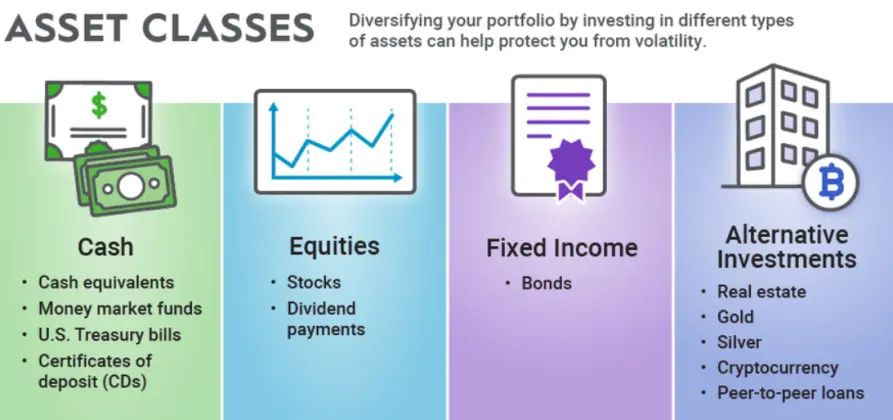
✅Exposure to ETF (Asset Class): Equity (shares of companies listed on the stock exchange, more volatile), Bonds and Debt Securities issued by governments and companies (they are much more stable and less volatile. These are conservative investments), Precious Metals ( exposure to metals such as gold, platinum, silver, etc. protect against inflation over time), Real Estate (investments in real estate but also properties, residences, offices, etc.), Money Market (treasury securities or short-term bank deposits, they are very safe and liquid), Commodities (raw materials and physical goods such as agricultural commodities such as wheat, cotton, corn but also industrial metals, oil, gold, silver). ETF identification: characterized by an alphanumeric code called ISIN (first 2 letters refer to its domicile, for example US)
✅Asset Allocation: % division of the various asset classes in which one has invested for example. A diversified portfolio should be exposed to global markets and not just the American one. Regarding the classes we can mention:
-stocks (they can be hedges against inflation because perhaps a company increases its profits during these periods. Furthermore, dividends or the healthcare sector that are less subject to inflation should be considered. Many investors also consider government bonds indexed to inflation such as TIPS in the United States as a more direct form of protection from inflation, since the value of these securities is linked to the trend in inflation rates)
-bonds (equivalent to lending money to companies and governments by receiving interest and then repaying the nominal value of the bond upon maturity. Basically they are advantageous when they have higher interest than inflation)
-crypto (inverse correlation with the dollar and positive correlation with S&P500. Main long term cryptocurrencies are only BTC and ETH)
-real estate (positively correlated with raw materials)
-commodities (hedge against inflation)
-cash (if you spend 1k a month, you should have a minimum of 3 months up to 12 months aside, therefore from 3k to 12k in liquidity for emergency situations. However, these values also depend on your cashflow, i.e. your income /monthly expenses)
✅Major ETF managers: BlackRock (through iShares), Vanguard, Fidelity, Charles Schwab, Invesco, ProShares, WisdomTree, Direxion, State Street Global Advisors (SSGA), Global
✅Choice of Broker: include Interactive Brokers, Charles Schwab, Fidelity, TD Ameritrade (now part of Charles Schwab), DeGiro, Fineco, etc They have market orders (best market price), limit orders (i.e. executed only if the asset reaches a certain price), stop loss and take profit (for trading functions)
✅Where to find ETF (It is possible to filter by fund domicile, annual fee, size)? JustETF, ETFdb, ETF.com
Are you interested in ways to earn crypto bonus? Check it out here: Some Sites To Earn Crypto Bonus (Old & New)






