
In an old article I had already talked about Kujira, when it was part of the Terra ecosystem. After the failure of Terra, Kujira built its own chain on Cosmos. Kujira 1.0 allowed you to deposit collateral (mainly Luna) and borrow Ust. Through bands it was possible to buy collateral at a discount (Luna) by becoming a liquidator. Kujira has had some problems lately but here I explain the technical functioning of the platform. In this article we see how Kujira 2.0 works.
KUJIRA ON COSMOS
Keep in mind that the good functioning of a platform does not mean going "all in" on the Kuji token (which on August 1, 2024 suffered a huge dump, due to a leveraged position liquidated to the team itself). It is true, if a platform generates fees and gains, the token will most likely do well. However, here we focus on the functioning of the platform so these are not financial advice on investing in Kuji. This protocol operates mainly in the Cosmos ecosystem, with the aim of improving the efficiency of the liquidation market. Basically I have several opportunities to use the platform:
1) Minting Usk, by depositing collateral
2) Lending/borrowing
3) Becoming a liquidator, by purchasing collateral at a discount
MINT OF USK
The minting process of Usk (United States Kujira) on Kujira is a mechanism through which users can mint new Usk, which is a stablecoin pegged to the US dollar.
To create new Usk, users must provide collateral. Typically, this collateral is in the form of other cryptocurrencies supported by the Kujira platform, such as Atom or other digital assets. Based on the market value of the collateral provided, users can create a proportional amount of Usk. The maximum amount of Usk that can be created depends on the collateralization ratio required by the protocol which can vary based on market conditions (for example, 150% means that for every 150 dollars in collateral, up to 100 Usk can be created).
The protocol constantly monitors the value of the collateral provided relative to the amount of Usk created. If the value of the collateral drops below a certain safety threshold, users are subject to liquidation (collateral is sold to maintain the stability of the system). The sale of collateral serves to cover the Usk debt, ensuring that the stablecoin remains fully collateralized. Users can also "burn" their Usk, returning it to the protocol to receive their collateral back. This process allows users to withdraw their collateralized cryptocurrencies by reducing the supply of Usk in circulation.
In some ways, Kujira works like Synthetix Network in terms of minting stablecoins. The main differences are that Kujira uses more collateral (and not just Snx), has a liquidation auction mechanism (which we will see below) and does not have the supply of synthetic assets.
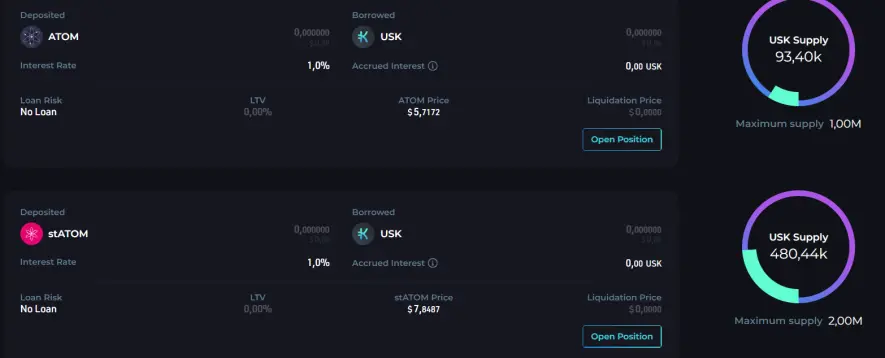
LENDING/BORROWING AND LIQUIDATION AUCTIONS
The protocol also allows you to deposit assets to receive an income and to borrow other assets.
Kujira focuses on liquidations of loan positions in DeFi platforms. When a user borrows cryptocurrency by depositing collateral, their position can be liquidated if the collateral gets close to the price of the amount borrowed. Why? Liquidations happen to protect lenders’ funds, otherwise a borrower may not have an incentive to repay the loan, leaving the platform with bad debt.
Kujira allows users to participate in these liquidations through an oracle system that manages liquidations and price feeds. The protocol uses an auction system for liquidations. When a loan is liquidated, the borrower’s deposit is auctioned off and users can bid to buy their collateral at discounted prices (compared to spot prices). This reverse auction system can help achieve fairer prices by reducing the impact of liquidations on the market. Kujira users then participate in the auction by bidding to buy the collateral at a lower price than the current market (it is possible to deposit the collateral by choosing between various discounts. The highest one allows you to buy the asset at a lower price but there is more competition).
 The auction ends when the so-called "fair price" is reached (due to the minimum price for that asset being reached or the auction expiring). The user who wins the auction buys the collateral at a discount, the borrower sees the collateral liquidated (obtains a smaller loss, i.e. the negative impact is reduced compared to a traditional liquidation). The funds obtained from the auction are used by Kujira to repay the debt (the amount that the borrower will not return, as the loan has been closed). Suppose a user has deposited Kuji as collateral and the position is liquidated. The collateral (Kuji) is auctioned with a market value of 10,000 dollars.
Max Discount 15%: The price drops to 8500 Usk
Max Discount 30%: The price drops to 7000 Usk
A user, interested in participating in the liquidation auction, can choose to bid at one of the available discount levels. If they choose the "Max Discount 30%", they will have to deposit 7000 USK to bid. If their bid is successful, they will receive Kuji at the price of 7000 USK. Users can then purchase collateral at discounted prices, potentially earning profits.
Are you interested in ways to earn crypto bonus? Check it out here: Some Sites To Earn Crypto Bonus (Old & New)






