
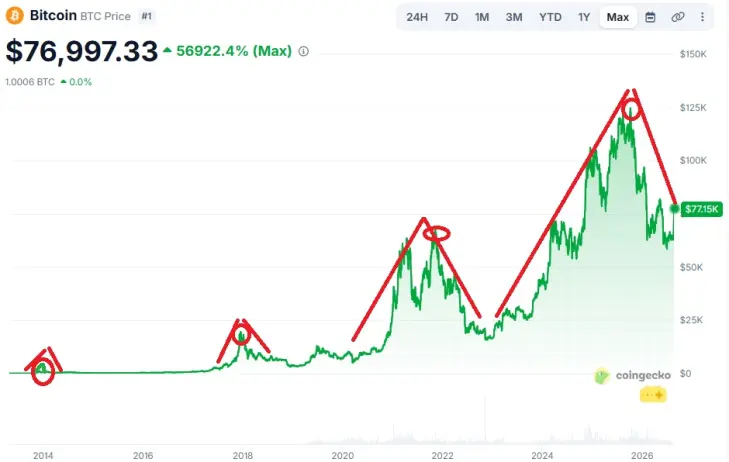
I've often found myself arguing with some users here on Publish0x (2 in particular) who are Bitcoin haters because, despite having been in the cryptocurrency sector for several years (an user in particular), they've missed the Bitcoin train and are therefore resentful. Obviously, there's always time to buy Bitcoin because we know this asset goes through phases of euphoria where it rises by 600% and then loses 50% in corrections (for example, now in 2026). In the past, the increases were enormously greater and the corrections even reached -80%, but the clear thing is that the price always makes new highs every four years (the year after the halving).
- 2013: highs of $1,100 (lows of $100 in 2014).
- 2017: highs of $19,000 (lows of $1300 in 2018).
- 2021: highs of $69,000 (lows of $15,500 in 2022).
- 2025: highs of $126,000 (currently, in 2026, the price is $77,000).
BITCON IS DIFFERENT FROM OTHER ASSET CLASSES
However, the thing to understand is that Bitcoin, as it is today, is not for everyone. Why? Not everyone can tolerate volatility. If you don't understand how Bitcoin works, don't understand that it is volatile, you risk making mistakes, especially if you think with an "equity" mindset. In stocks, drops of 20-25% are already high, but not for Bitcoin because it is still a young asset. Bitcoin rises much more during phases of euphoria and then corrects more (obviously). The differential is still positive because even considering a 4-5 year horizon, $BTC outperforms any asset. Since the bottom of the 2022 bear market, $BTC has outperformed both gold and the S&P 500 (both of these assets have performed better than ever in their history, yet Bitcoin has outperformed them. I'm talking about overall gains: by buying these three assets at the bottom of 2022, despite Bitcoin's 50% decline today, you would have outperformed both gold and the S&P 500).
The other reason Bitcoin is different is that it's also a payment currency. Stocks are prices that rise and fall based on company profits (which, however, are based on the quintessential Ponzi scheme: fiat currency that can be inflated endlessly). Bitcoin isn't just a price, it's also a decentralized currency you can use whenever and wherever you want without asking for permission (think of totalitarian states like Iran, Russia, North Korea, Venezuela, China, and all those where governments decide overnight whether to freeze your account or not. You could pay in Bitcoin or go abroad with your 24 words without anyone noticing).
IS BITCOIN AN INVESTMENT?
Yes, based on the price action of the last 17 years, Bitcoin is the best investment of the century (check here: Historical Annual Returns of Major Asset Classes: BTC Still Dominant on Indices, Stocks and Commodities ). The numbers say so, not me. But what is an investment? The most important thing that differentiates investing from speculation (trading) is time. Investments are conducted with DCA, DCA in downtrend, value averaging, etc. (for more advanced strategies, exponential moving averages can also be used.) Trading is purely speculative and has short time horizons: hours, days, weeks, months. I monitor the chart, set a limit order with a stop loss and take profit, and speculate on the rise (or fall) of the price. Fundamentals aren't important for trading: I can even trade a scam (if it has a good chart). Investment, on the other hand, is made by averaging the price over time (DCA), and the main characteristic is that it outperforms fiat currency. You can trade or invest in any asset. If I buy the S&P 500 today and sell it in 10 days as soon as it rises by 3%, I've traded. If I hold it for 5 or 10 years, it's an investment. The same applies to Bitcoin, NVIDIA, or gold.
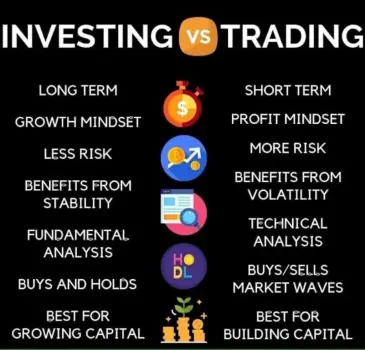
An investment is good if it protects you from inflation and allows you to generate greater wealth than you would have obtained by holding fiat in the bank (this is what Bitcoin did for 17 years). The classic definition of "investment" is the study of company fundamentals (and their balance sheets) and the release of dividends. While it's not a company (fortunately, I might add), you shouldn't be surprised that Bitcoin isn't included in this historical theory. These are 50-100-year-old economic theories; Bitcoin was born in 2009. In the modern financial landscape, Bitcoin is effectively classified as an alternative investment, comparable to a commodity or a safe haven.
Bitcoin is different because:
1) It is a currency (you don't have to ask permission to use it from governments or dictators. You can exchange it with private individuals, via peer-to-peer transactions, or in thousands of online stores, and even in real life).
2) It has real scarcity (inflation decreasing every four years and a cap of 21 million. The big difference with traditional fiat currencies is that they can be inflated with Ponzi-style issuances. If you remember, the euro was born in Europe in early 2000. Why? The fiat currencies of many countries were collapsing due to inflation and had lost enormous purchasing power. Even the dollar loses 3-4% of purchasing power annually; check the chart over the last 50 years).
3) It is unalterable mathematical/computer code (companies can cheat, modify balance sheets, etc.).
If you buy Bitcoin today and sell in 15 days (at a profit or loss), you have speculated on the price. If you buy Bitcoin and trade for years, you should evaluate your investment over the next 5 or 10 years. This is the most important thing that differentiates investing from trading.
If you're thinking of investing in companies according to the traditional definition of investing, know that it's no guarantee of success. I can currently name 100 large companies that are 50 to 90% below their price level five years ago (2021). For example, this is Nike's chart (price dropped from $169 in 2021 to $40 today):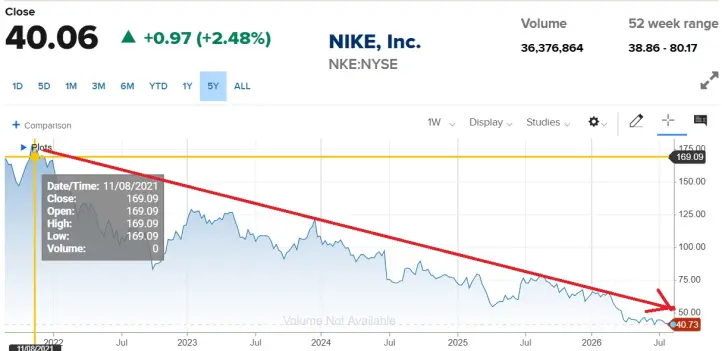
Nike pays dividends, so is -90% a good investment? To clarify, we're analyzing a five-year chart. Five years is a long timeframe to analyze whether the investment was a good one or not. I could also name Netflix, Alibaba, etc. We're talking about large companies, not local ones. All companies that, according to the traditional definitions of investing, generate profits and pay dividends. However, the price sucks. And I repeat, the timeframe considered is five years. It would be easy to demonstrate what you want by taking one day, one week, or three months, but five years is a long timeframe. However, it might seem like Nike is the only one with those performances. Let's look at PayPal (another large dividend-paying company with a balanced sheet):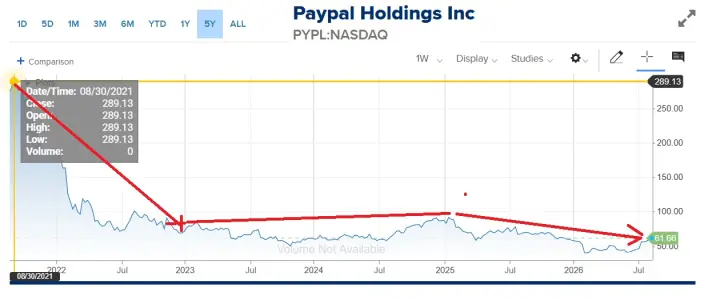
Here too (Paypal), we see that the price has dropped from $289 to today's $61 over the last five years. Which has been the best investment since 2020? Bitcoin or PayPal? Bitcoin or Nike? Bitcoin or Alibaba? The answer is obvious, and I'm not the one saying it; math dictates it. These are the declines for these NASDAQ-listed companies as of June 2026:
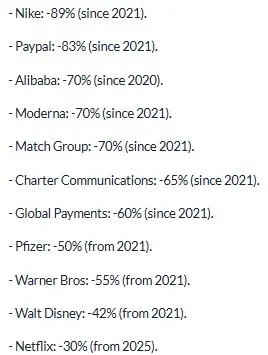
I've listed large companies; I could have listed smaller companies, which are down 99%. Since 2021, stocks have performed well only with tech and AI (which, however, is also partially connected to the blockchain sector. AI agents use the Base and Solana chains for a large portion of online payments). NVIDIA and AI companies have driven the S&P 500 to consistent highs, but the rest of the non-tech and non-AI companies have performed terribly. Yet they pay dividends, and these companies have fundamentals. You can see that these two characteristics aren't necessarily indicative of a good investment.
Another thing I'd like to emphasize is that "cryptocurrencies" are often discussed in general, and Bitcoin is lumped into this huge mix. Bitcoin is different from 99.99% of cryptocurrencies. You can't compare it to altcoins. It differs both in its technical characteristics (decentralization) and in its price action (altcoins, long-term, fall 99%. With rare exceptions). Bitcoin is programmable scarcity, altcoins have inflation and unlocks (even if they don't have a classic company behind them, they are more similar to stocks because it is possible to obtain an inflationary income but with the difference that most of them are scams). Before mixing Bitcoin with altcoins/cryptocurrencies in general, you should study both technically and analyze price action (price is crucial. An investment is good if it outperforms my fiat currency. If Nike drops 89%, what's the point of paying dividends, and would it be an investment according to classical theory? I held dollars/euros/pounds/francs).
WARREN BUFFETT'S MISTAKES
Warren Buffett is perhaps the greatest investor of all time, yet he's made serious mistakes about Bitcoin, saying a lot of bullshit that's quite laughable when reread today. I don't want to criticize him; he was over 80 when he made these quotes; it's difficult for him to understand an asset class completely different from traditional finance. Just think, over the years I've had a hard time explaining to my friends that Bitcoin can be withdrawn from exchanges, held in personal wallets, or used as a means of payment. Many people see it as a price that goes up and down like a stock, so they don't understand that BTC is computer code, not a derivative.
Buffett's mistake, however, is that he negatively influenced the mindset of many people, causing them to lose a lot of money. If you don't understand an asset, you shouldn't talk about it. Study Bitcoin, learn, then express your opinion.
These are Buffett's quotes:
- 2013: Doubts about Bitcoin's ability to become a sustainable means of payment (1 BTC = $100-120).
- 2014: “Stay away from it”; “mirage” (1 BTC = $450–700).
- 2018: “Rat poison squared”; Bitcoin “creating nothing” (1 BTC = $9.3–9.4k).
- 2019: “Bitcoin has no unique value at all” / “delusion” (1 BTC = $3.6–3.9k).
It would be too easy to make comparisons when $BTC was at $150 or $1000 so let's take the highest price of these Buffett quotes (about 9.3k) and assume to invest 10k on $BTC and the largest stock indexes:
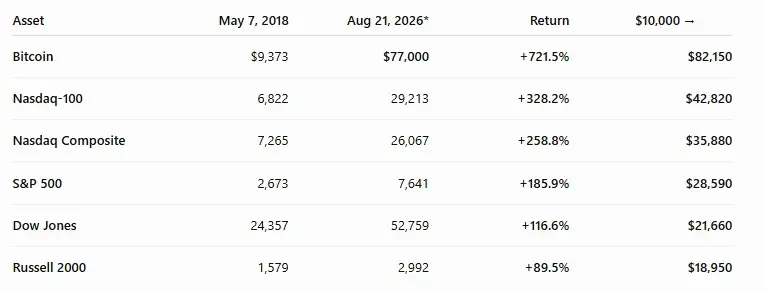
Even more interestingly, $BTC is down 40% compared to 2025. The NASDAQ100 and S$P500 are (almost) at ATH in August 2026, meaning they will enter a severe correction phase. $BTC has already corrected significantly (if we had made this table 1 year ago in 2025, the return on $BTC would have been over 1100%).
Today, 1 BTC is worth over $77k. You could have bought BTC in any year since 2009 and would be making a profit today compared to holding fiat, excluding a few months in 2025 (price from $78k to $125k). But as mentioned many times in this article, investments are made with DCAs, so if you bought at the 2021 highs ($69k), you should also have bought at $40k, $35k, and $20k (the 2022 lows), so you're now significantly making a profit against the dollar. If you bought in 2025, the same applies: if you continue your DCA, you'll most likely be making a huge profit in 3-4 years. I emphasize that past performance is no indicator of the future, but if you decide to invest in the Netflix or any other asset, you must make the same assumptions: hope that X company doesn't go bankrupt; if you invest in real estate, that your house isn't destroyed by an earthquake; if you invest in gold, that 10,000 tons of gold aren't found on another planet, etc.
Unfortunately, those who followed Buffett without studying probably didn't invest in Bitcoin. Another golden rule of investing is that you should do your own research, not follow the advice of others.
Article always updated with all the possibilities of on-chain farming (airdrop): Some Sites To Earn Crypto Bonus (Old & New)






