
When comparing investment performance across different asset classes, one metric is particularly useful: the Compound Annual Growth Rate (CAGR), which represents the average yearly return assuming all gains are reinvested. The following figures represent historical average annual returns. A long-term inflation rate of roughly 3-4% per year should be subtracted to estimate real returns. The data reveals a clear pattern: equities have historically been the strongest traditional asset class, while alternative assets such as wine, collectibles and precious metals have delivered mixed but interesting results. However, Bitcoin and Ethereum remain extreme outliers.
Crypto: The Outliers
- Bitcoin ($BTC).
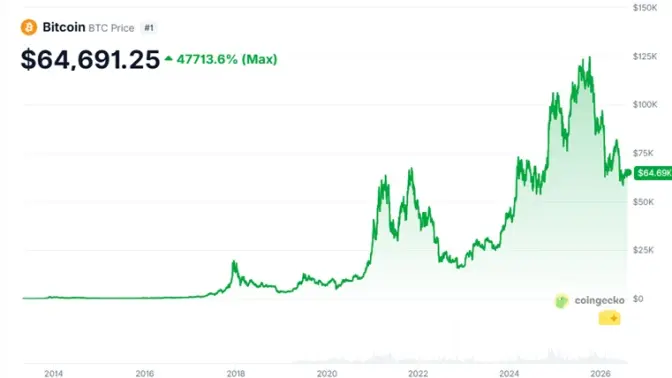
Since its early years, Bitcoin has generated returns unmatched by almost any traditional asset:
$BTC (2010-2026): ~110%.
This means that, historically, Bitcoin has more than doubled every year on average. Of course, these numbers are influenced by Bitcoin's early adoption phase and are unlikely to repeat indefinitely as market capitalization grows. Looking at shorter periods gives a more realistic picture:
BTC (2013-2026): ~65%.
BTC (2015-2026): ~55%.
BTC (2020-2026): ~35%.
Even in more mature periods, Bitcoin has significantly outperformed traditional markets.
- Ethereum ($ETH).
Ethereum shows a similar trend:
$ETH (2015-2026): ~95%.
Again, early adoption plays a major role, but even more recent periods remain exceptional:
ETH (2017-2026): ~45%.
ETH (2020-2026): ~30%.
Equity Markets: The Traditional Winners
Stocks have historically been the best-performing liquid asset class over very long periods.
- Nasdaq 100 (driven by technology companies and innovation, since 1985): ~14-17%.
It has been one of the strongest traditional indices, benefiting from companies such as Microsoft, Apple, Amazon, Google and Nvidia.
- S&P 500 (the benchmark for US equities): ~10-11%.
Over more than a century, owning a diversified basket of large American companies has been one of the most reliable wealth creation strategies.
Other Equity Indices
- MSCI USA: ~10%.
- Russell 2000 (US small caps): ~9%.
- MSCI World / ACWI / Emerging Markets: ~8-10%.
Global diversification has produced slightly lower returns than US equities but with broader exposure.
Alternative Assets and Collectibles
Beyond financial markets, several collectible categories have historically produced attractive returns, although they are usually less liquid and much harder to access.
Whisky and Wine: among alternative assets, fine alcohol has been one of the strongest performers.
- Collectible Whisky: ~10-13%.
- Liv-ex Fine Wine 100 Index: ~8-11%.
However, these markets are highly selective, with a relatively small number of bottles or producers driving a large portion of returns.
- Vintage Cars: ~8-10%.
- Luxury Watches: ~7-10%.
- Rare Stamps: ~7-8%.
Again, averages can be misleading. A few exceptional models, brands, or collections often generate most of the gains.

Precious Metals
Gold is often considered a store of value, especially during monetary uncertainty. Historical returns:
- Gold: ~7-8%.
- Silver: ~4-6%.
- Platinum: ~4-6%.
Gold has preserved purchasing power over centuries, but historically it has underperformed equities over very long periods.
Real Estate
Real estate has historically been a solid wealth-preservation asset:
- US REIT: ~9-10%.
- Residential real estate (Case-Shiller): ~5-6%.
REIT tend to outperform physical housing because they include rental income, leverage, and easier liquidity.

Bonds, Cash and Commodities
Lower-risk assets have historically delivered lower returns:
- US Bonds: ~4-6%.
- Commodity Index: ~3-6%.
- Treasury Bills: ~3-4%.
Treasury Bills have generally tracked inflation over long periods, acting more as capital preservation tools than wealth creation assets.
CONCLUSIONS
The obvious objection is that Bitcoin and Ethereum returns are heavily influenced by their early growth phase. A $1 billion asset can grow 100x much more easily than a $2 trillion asset. Future returns will almost certainly decline as crypto markets mature.
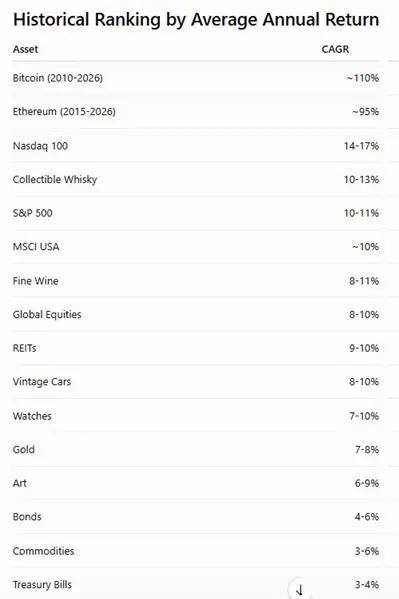
However, the historical data remains remarkable: an investor who started accumulating Bitcoin or Ethereum around 2020 through a simple DCA strategy (Dollar Cost Averaging) and held without selling would have outperformed every major traditional asset class in annualized returns.
Article always updated with all the possibilities of on-chain farming (airdrop): Some Sites To Earn Crypto Bonus (Old & New)





