
As you may know, Qubic claims to have temporarily gained control of 51% of the Monero network's mining power, allowing it to manipulate the blockchain, exclude blocks ("orphaning"), reorganize them, censor transactions, or double-spend. A 51% attack occurs when a single entity (or pool) controls more than half the computing power (hashrate) of a Proof-of-Work blockchain. As previously mentioned, the network controller can:
-Reorganize the block chain, canceling recent transactions.
-Double-spend (spend the same coins twice).
-Censor or delay transactions.
-Produce more blocks than other miners, forcing their own version of the chain to be the valid one.
However, it does not allow theft of funds directly from wallets or the modification of the protocol rules. The experiment reportedly resulted in the chain restarting with 6 reorganized blocks and approximately 60 isolated or abandoned blocks. In just two hours, Qubic mined approximately 750 $XMR, generating significant revenue in QUBIC. A portion of the tokens was then burned, while the remainder was distributed as incentives. The experiment was described as more profitable than standard Monero mining, being based on a "Useful Proof-of-Work" (uPoW) model. Qubic reportedly used a "Selfish Mining" strategy: with hash power even lower than 51%. Qubic suffered prolonged DDoS attacks, but this did not prevent mining. Luke Parker (SeraiDEX) notes that “a 6-block reorganization doesn’t mean a 51% attack was successful—the attacker may just have gotten lucky”. Other experts, such as SlowMist, believe the attack appears to have succeeded, although they question its economic viability. According to the RIAT Institute, Qubic's data could be manipulated: they argue that the numbers are difficult to verify and the calculations are inconsistent with actual block production (so it wouldn't be a true takeover).
In general, even without 51%, Qubit could find many blocks in sequence just by luck. According to independent developers and analysts, a short period of high hash power isn't enough; verifiable data is needed.
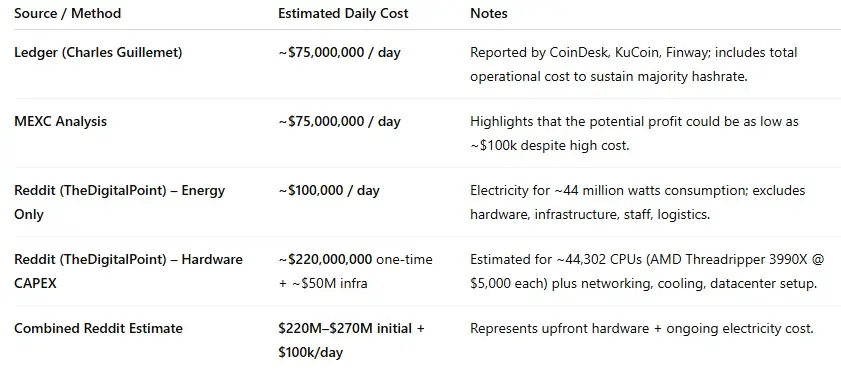
Charles Guillemet, CTO of Ledger, estimated that maintaining this hashrate would require approximately $75 million per day, generating approximately $100,000 per day. According to estimates, accumulating 50% of Monero's hashrate would require an enormously expensive CPU infrastructure:
-Approximately 44,302 CPU (AMD Threadripper 3990X) at $5,000 each, or $220 million for the hardware alone.
-Approximately $50 million for the infrastructure (housing, networking, cooling, etc.).
-The estimated energy consumption was 44 million watts, costing approximately $100,000 per day for electricity alone.
This estimate only considers energy and infrastructure; it does not address operating costs, data center rentals, personnel, logistics, etc. In any case, conservative figures or not, they indicate that this is a highly costly attack and difficult to sustain in the long term, especially if the gains (e.g., mining, double-spending) do not offset the costs.
In fact, Qubic used a unique system called “Selfish Mining” with an incentive program that I will explore in more detail in the next article!
Are you interested in ways to earn crypto bonus? Check it out here: Some Sites To Earn Crypto Bonus (Old & New)






