
In 2018, France was rocked by the "Gilets Jaunes" movement, a popular protest that initially arose against rising fuel taxes but quickly spread to broader discontent over economic and social inequality. The movement, composed largely of ordinary citizens, was characterized by its spontaneity, lack of formal leadership, and the symbolic use of reflective vests.
On January 7, 2019, French artist Pascal Boyart, known for his crypto activism, created a powerful mural titled "Liberté Guidant Le Peuple" inspired by the romantic painting by Eugène Delacroix. At the center, a modern-day Marianne leads a crowd of Gilets Jaunes protesters amidst smoke and tension. To celebrate the tenth anniversary of Bitcoin's birth (2009-2019), Boyart hid a cryptographic puzzle in the mural containing nearly 0.29 $BTC (about $1,000 at the time). The puzzle was solved in about a week.
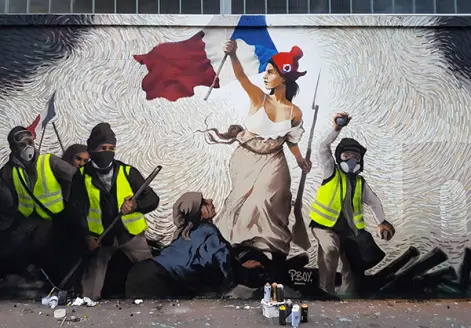
Hidden in the mural was not a private key, but a BIP39 seed phrase with 12 words (the "seed" suggestion was written in black at the top right of the mural). The words (in French) had been "hidden" using various cryptographic techniques. The first six words were hidden using the HEXAHUE cipher (each ordered pair of colors is associated with a letter of the alphabet: for example, "A" is associated with the colors green and red, "B" with the colors light blue and purple, "C" with the colors blue and red, etc., all of which formed a complete French word). The difficulty lay in figuring out which letter each color pair corresponded to (a brute-force attack was used) and then in which language (but since it was in Paris, it was presumably the creator had chosen French).

Boyart, in his Twitter post, emphasized that to solve the puzzle, simply looking at the HD photo wasn't enough; you had to go there in person. The reason is simple: to find the next six words, it was necessary to use ultraviolet light (at night).

What was obtained were nonsensical words (1 and 2) and alphanumeric combinations (3, 4 and 5+6):
1) The first two were solvable with the Caesar cipher (which shifts each letter of the alphabet by a certain number of positions: if we assume it's 3, the letter "A" becomes the letter "D", the letter "B" becomes the letter "E", etc. In the case cited, they had been shifted by 20 and 19 positions, identified through a brute force attack).
2) The next two were alphanumeric passwords (ending with =) solved with Base58 encryption using the "sha256" site and the decoding function (the algorithm is applied in reverse to the encoding function).
3) From the last sequence, the final 2 seed words were obtained using the 128bit AES algorithm with 2 encryption keys (input on the encryption method used was provided by the author himself for all those who had found the first 10).
The word order (in groups of 6) was obtained using a brute force attack:

I hope you enjoyed this cryptographic puzzle, which I always find very interesting because it teaches you how to think if you ever find yourself in similar situations (contests, but also competitions where you have to think logically to find combinations or meaningful words). I've already covered a similar puzzle here: The Legend Of Satoshi Nakamoto: Enigma With 4.87 BTC (2015)
Are you interested in ways to earn crypto bonus? Check it out here: Some Sites To Earn Crypto Bonus (Old & New)






