Cryptocurrency markets are going through one of those periods when fear seems to outweigh optimism. Bitcoin, the world's leading digital asset, has experienced a significant correction since reaching its all-time high in October 2025. However, behind this bearish environment may lie an interesting opportunity for investors who maintain a long-term perspective.
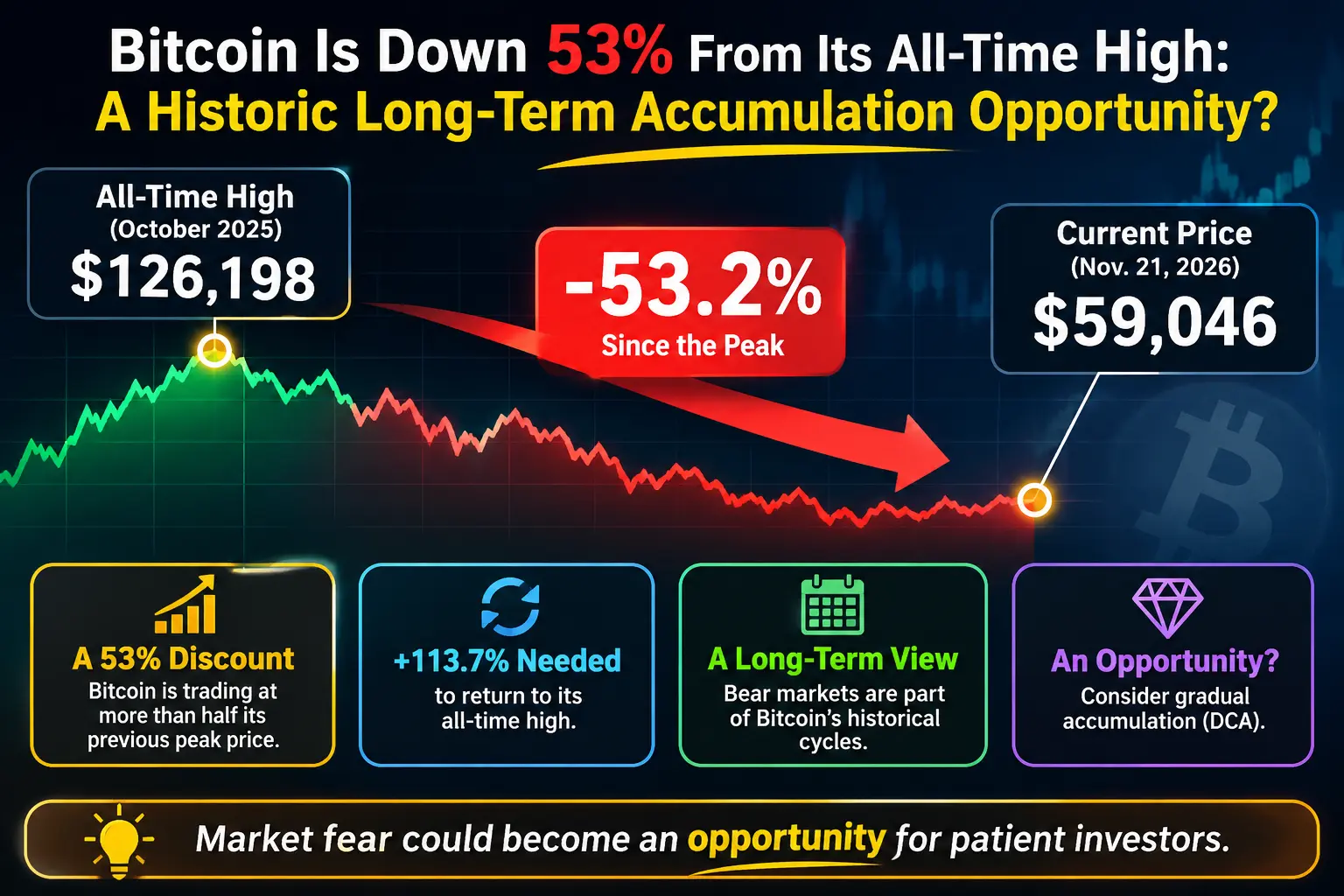
With Bitcoin trading around $59,000, the cryptocurrency has lost approximately 53% of its value compared with its previous all-time high of around $126,200. This represents a substantial discount that raises an important question for investors: could this be a good time to start accumulating BTC?
The answer is not straightforward, but there are several arguments worth considering.
1. Bitcoin Is Trading at More Than 50% Below Its All-Time High
One of the most striking aspects of the current market situation is the magnitude of Bitcoin's correction.
After reaching new all-time highs in October 2025, the market gradually lost momentum, pushing prices significantly lower. Bitcoin is now trading at approximately half the value it reached during its previous major bullish rally.
From a long-term investor's perspective, this difference deserves attention.
Buying Bitcoin at $59,000 instead of $126,000 means gaining exposure to the same asset at a price approximately 53% below its previous record.
Of course, this does not mean Bitcoin will necessarily recover its former highs, nor does it guarantee that the current price represents a definitive market bottom. Nevertheless, it creates an opportunity to consider a gradual accumulation strategy based on substantially lower prices than those seen during the previous period of market euphoria.
There is another important mathematical consideration: after falling approximately 53%, Bitcoin would need to appreciate around 114% to return to its previous all-time high.
This distinction is essential when evaluating its potential recovery.
2. Bear Markets Are Part of Bitcoin's Historical Cycles
To better understand the current situation, it is worth looking at Bitcoin's historical performance.
Throughout its history, Bitcoin has experienced significant corrections following major price peaks. During some previous cycles, these declines exceeded 75% and even reached more than 80%.
For example:
Between 2013 and 2015, Bitcoin lost approximately 85% of its value.
Between 2017 and 2018, it experienced another correction of around 83%.
Between November 2021 and November 2022, Bitcoin fell approximately 77%.
In all these cases, Bitcoin eventually recovered and went on to reach new all-time highs.
The correction following the October 2025 peak has already exceeded 50%, although it is still too early to determine whether the definitive bottom has been established.
These historical precedents do not guarantee that the same pattern will repeat. Every cycle has different economic, technological, and financial conditions. Nevertheless, they demonstrate that major corrections have historically been a recurring feature of Bitcoin's market behavior.
For investors who believe in its long-term potential, these periods may offer opportunities to increase their positions in a disciplined manner.
3. Gradual Accumulation as a Strategy Against Market Uncertainty
One of the biggest mistakes investors can make during a bear market is attempting to predict the exact moment when Bitcoin will stop falling.
Even after a correction exceeding 50%, further declines remain possible. This is why spreading purchases over time can be an interesting alternative.
This approach, commonly known as Dollar Cost Averaging (DCA), involves purchasing Bitcoin at regular intervals regardless of short-term market fluctuations.
For example, an investor with $6,000 allocated to a long-term Bitcoin investment could divide that amount into twelve monthly purchases of $500 each.
If the market continues to decline, subsequent purchases may help reduce the average acquisition price. If Bitcoin starts recovering, the investor will already have established a position at lower price levels.
This strategy does not eliminate the risk of losses, but it reduces dependence on identifying a single perfect entry point.
It can also help investors avoid emotional decisions triggered by sudden market movements.
4. Bitcoin's Fundamental Strengths Remain Relevant
The accumulation argument should not be based solely on the fact that Bitcoin has fallen significantly.
To justify a long-term investment thesis, we must also consider its underlying characteristics.
Several factors continue to support Bitcoin's relevance:
Limited supply: Bitcoin's protocol establishes a maximum supply of 21 million coins. This is one of its main arguments compared with traditional monetary systems based on the issuance of fiat currency.
Decentralization: Bitcoin operates through a distributed network that does not rely on a central authority to validate transactions.
Institutional adoption: The introduction of spot Bitcoin ETFs has made it easier for traditional investors to gain exposure to the cryptocurrency market, although institutional inflows and outflows can also contribute to volatility.
Infrastructure and security: The Bitcoin network benefits from an established infrastructure and a long operational track record that distinguishes it from many cryptocurrency projects launched in subsequent years.
These characteristics do not guarantee future price appreciation, but they help explain why Bitcoin continues to hold a prominent position in the digital financial ecosystem.
5. Is Bitcoin Approaching an Undervalued Zone?
Several indicators can help investors assess whether Bitcoin is entering a historically attractive price range.
One of the most widely followed metrics is the MVRV ratio, which compares Bitcoin's market capitalization with its realized capitalization. This indicator helps evaluate whether the current market price is relatively high or low compared with the aggregate acquisition cost of existing coins.
According to CryptoQuant data from November 19, 2026, the MVRV ratio stood at approximately 1.16, while Bitcoin's realized price was around $53,478.
This suggests that Bitcoin was still trading above its realized price, although the difference was considerably smaller than during previous periods of market euphoria.
Another interesting metric is the percentage of Bitcoin's circulating supply currently held at a loss. This figure had reached approximately 54.7%, reflecting a significant deterioration in market conditions.
These indicators suggest that the market has experienced considerable weakness. However, they should not be interpreted as definitive signals that a market bottom has been reached.
In fact, some indicators can remain in negative territory for extended periods.
They should therefore be used as complementary tools when developing an investment strategy rather than as automatic buy signals.
6. The Risks Investors Should Consider Before Accumulating Bitcoin
Although the current correction may appear attractive, it would be a mistake to interpret every major decline as a guaranteed investment opportunity.
Bitcoin remains a highly volatile asset, and several factors could prolong the current bear market.
These include Federal Reserve monetary policy decisions, global liquidity conditions, geopolitical tensions, and the performance of technology stocks.
Institutional capital flows also deserve close attention. If Bitcoin ETFs continue to experience significant outflows, selling pressure could remain elevated.
Furthermore, Bitcoin could experience additional corrections before a sustainable recovery begins.
For this reason, any accumulation strategy should rely exclusively on capital that investors do not need in the short term. Borrowing money or using excessive leverage should be avoided.
7. Looking Ahead: An Investment Perspective for 2027 and Beyond
The current situation raises an important question: is it more attractive to buy Bitcoin when everyone is celebrating new all-time highs, or when pessimism dominates market expectations?
Historically, major recovery movements have often been preceded by periods of uncertainty, capitulation, and declining investor confidence.
Investors who have managed to maintain a disciplined strategy during these episodes have had opportunities to acquire Bitcoin at prices considerably lower than those reached during subsequent rallies.
If Bitcoin's fundamentals continue to develop and institutional and technological adoption keep advancing, current price levels could eventually represent an interesting accumulation zone for investors with a multi-year investment horizon.
Nevertheless, different market scenarios must be considered, and investors should be prepared for a recovery that may take longer than expected.
Conclusion: Market Fear Could Become an Opportunity for Patient Investors
Bitcoin's decline of more than 50% from its all-time high has dramatically changed market sentiment. What once appeared to be an almost unstoppable bullish trend has turned into an environment dominated by uncertainty.
However, long-term investors may interpret the situation from a different perspective.
Buying Bitcoin at a discount of more than 50% compared with its previous highs could represent an interesting opportunity to build positions, particularly when combined with a gradual accumulation strategy and disciplined risk management.
The objective should not be to identify the absolute market bottom, but rather to take advantage of periods of weakness to progressively improve the average acquisition price.
Perhaps the greatest opportunity in bear markets is not knowing exactly when they will end, but having the patience and discipline to invest when most market participants have lost confidence.
Bitcoin could take months or even years to recover its previous all-time highs. But that is precisely why investors considering this asset over a longer time horizon should begin looking at the current environment not only through the fear of further declines, but also through the opportunities that intelligent long-term accumulation may offer.