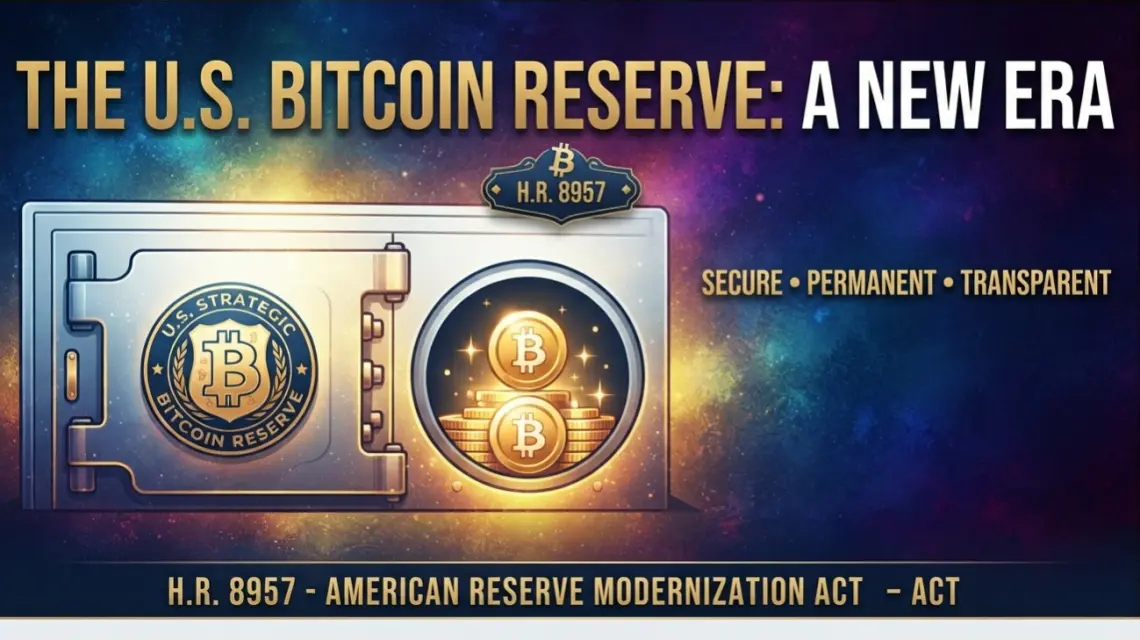
A key piece of legislation aimed at permanently establishing a U.S. Strategic Bitcoin Reserve has taken an important procedural step forward.
On November 24, 2026, the House Financial Services Committee formally reported H.R. 8957, the American Reserve Modernization Act of 2026, and placed it on the Union Calendar as Calendar No. 789. This action makes the bill eligible for a full House floor vote.
What the Bill Does
Introduced by Rep. Nick Begich (R-Alaska) with bipartisan co-sponsorship from Rep. Jared Golden (D-Maine), the legislation would convert the Strategic Bitcoin Reserve — originally created by executive order in March 2025 — into permanent federal law.
Under the bill:
The Treasury Secretary would be required to establish a Strategic Bitcoin Reserve within 180 days of enactment.
A separate Digital Asset Stockpile would be created for other cryptocurrencies held by the government.
Bitcoin placed in the reserve could not be “sold, swapped, auctioned, encumbered, or otherwise disposed of for any purpose” for a minimum of 20 years.
Federal agencies would be required to report their digital asset holdings, and the reserve would be subject to transparency measures, including proof-of-reserve reporting.
The 20-year lockup is the centerpiece of the legislation. It is designed to prevent future administrations from quickly liquidating the government’s Bitcoin holdings, which currently total an estimated 306,000 to 328,000 BTC (primarily from criminal and civil forfeitures), valued at roughly $18–20 billion at current prices.
Path to This Point
The House Financial Services Committee approved the bill on September 16 by a party-line vote of 28–21, with all Republicans in favor and all Democrats opposed. Ranking Member Maxine Waters offered an amendment that was rejected along the same lines.
Next Steps and Challenges
While the bill is now eligible for a floor vote, no date has been scheduled. Time is limited: the current 119th Congress is expected to adjourn around early January 2027, leaving only a few weeks for House passage, Senate consideration, and a presidential signature.
If the bill fails to pass before the end of the session, it would need to be reintroduced in the next Congress.
Supporters view the measure as a way to provide long-term certainty for the U.S. government’s Bitcoin holdings and signal institutional commitment to the asset. Critics, primarily Democrats on the committee, have raised concerns about locking up assets for such an extended period and the broader implications of treating Bitcoin as a strategic national reserve.
The advancement of H.R. 8957 marks one of the most significant legislative efforts to date aimed at formalizing Bitcoin’s role in U.S. national policy.