
Moving deeper into March, you would think that we have set ourselves up for a good run in the next few months.
But the markets are not doing well, with prices dropping below some support levels we thought were cemented. Still, this is the crypto market, and year on year growth has been improving - and we’ve been through a lot worse.
There’s no way to ascertain why the prices have dropped, but all we can do is hang tight. Things are still happening in the space - and damn, how things are happening.
In this week’s first news roundup, we have follow ups to the IOTA hack, Ripple’s CEO talking about Bitcoin and Ethereum’s energy consumptions and banking officials finally giving DLTs the attention that it is due.
Let’s hop in then.
1. IOTA Founder David Sønstebø will Pay Back $1.97 million to Those Who Suffered from Hack
The IOTA team describing the attack and how it plans to move forward.
Recently, some IOTA Trinity Wallet users revealed that they had lost funds, which quickly became news as it turns out that it was not a small subset of users who had suffered. Early figures so about a dozen or so wallets being affected, but now that total stands at 46.
In total, about $1.97 million had been stolen. IOTA’s David Sønstebø has said that he would compensate for their losses by distributing about 8.52 million MIOTA tokens from his own pocket.
A flaw in the wallet is what allowed for these funds to be stolen. IOTA officials, who to their credit were quick to pounce on the situation, turned off the network so that they could assess and deal with the problem. The shutdown caused quite a stir, as IOTA is no small project, and is one that many are hopeful about.
The hack has unsurprisingly affected prices. IOTA, once a top 10 token, is now ranked 24 with a market cap of about $520 million. This alone is not a big deal - sure, IOTA has lost some price, but it’s down to what they’re building.
The bigger concern if such problems would ever occur again. Assuming it doesn’t, IOTA is still in a pretty good position for the future, being associated with some big names in the automobile industry and with some interesting solutions on the horizon.
2. Ripple Partners with Mexico’s Largest Crypto Exchange, as Brad Garlinghouse Criticizes Bitcoin and Ethereum for Energy Consumption
Ripple has partnered with Mexico’s largest cryptocurrency exchange, Bitso. The exchange, which has been backed by Coinbase, Digital Currency Group, Pantera Capital and Ripple, is looking to leverage Ripple’s remittance solutions, of which Mexico deals with numbers of about $36 billion annually.
Bitso’s head of finance, Bárbara González Briseño, lauded having the “world’s largest liquidity of Mexican pesos to digital assets and are MoneyGram’s key exchange partner for remittances into Mexico" through the partnership with Ripple.
Ripple CEO’s Brad Garlinghouse is often in the news, with him having talked to numerous people in the financial industry and really pushing for incumbents to adopt DLTs so that traditional systems can become SWIFT 2.0, as he likes to say.
Earlier this month Garlinghouse received a little attention for saying that Bitcoin and Ethereum consumed too much energy. He tweeted the following,
It’s true, Bitcoin and Ethereum consume quite a bit of energy, but the statements on these tend to be exaggerated. On top of that, Ethereum is soon making the switch to Proof-of-Stake (PoS), and there are clean energy solutions being developed for Bitcoin. That’s not downplaying the fact that they consume energy, but only saying that this is something that people are keeping in mind.
3. Central Bank Officials are Finally Starting to Acknowledge DLTs

The MIT Bitcoin Expo Agenda. Source.
So you’ve probably seen a lot of attention in the media being directed towards Central Bank Digital Currencies (CBDCs). These are digital versions of a national currency linked to a blockchain. China’s into it, Sweden’s into it - and to be honest, there are many more countries thinking about releasing a CBDC too.
Banking authorities are finally beginning to see the benefits of blockchains, and it’s good to see that they are at least considering the technology. However, as a recent report by the Bank for International Settlements (BIS) indicates, there are still doubts about the technical architecture and design.
This is what was discussed at a panel at the recent MIT Bitcoin Expo, where individuals from the International Monetary Fund (IMF), Federal Reserve Bank of Boston and MIT Digital Currency, as well as a former Bank of England official, talked about central banks releasing their own digital currency.
The consensus from these panel members was that banks were not approaching the development of blockchain-based systems without testing the technology. Sonja Davidovic of the International Monetary Fund (IMF), after talking about the hype surrounding the technology said,
The result of that is that we've seen central banks that are directly engaging with it without going through the proper process of testing the technology in a proof of concept, selecting vendors through an open bidding process, and having a request for proposals.
At least the tech is getting its much due attention from the incumbent world, even if they are proceeding cautiously. There was a time when it was mocked and casually dismissed.
4. HoneyWell and Boeing are Tracking $1 Billion worth of Boeing Assets on the Blockchain
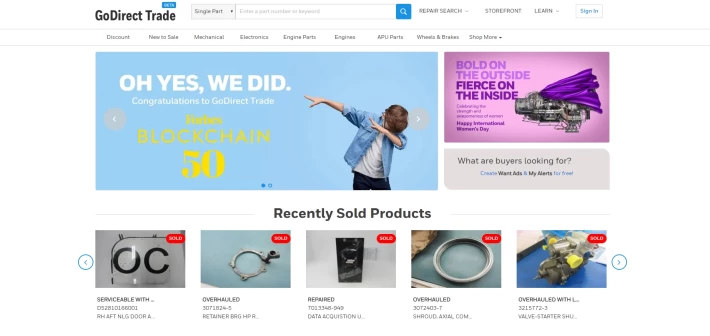
The GoDirect Trade platform. Source.
Lastly, we have an interesting bit of news related to Boeing, which has already shown a lot of interest in the blockchain.
In a previous news roundup, I talked about how Walmart had joined Hyperledger. So has Boeing, and it looks like it is turning out well for the company and the space. The announcement was made at the recently held Hyperledger Global Forum
Forbes reports that Boeing has added more than $1 billion worth of excess airplane parts to GoDirect Trade, a blockchain platform that verifies the authenticity and safety of products. This platform was designed by HoneyWell, which itself is a major aerospace and engineering company. Honeywell has used Hyperledger Fabric to build GoDirect Trade. Apparently, Boeing took 2 minutes to set up a digital store front on the platform.
It’s similar to how other supply chain platforms are bettering the industry - instead of relying on paper trails and human intervention, we can leverage smart contracts and code to ensure data accuracy and reliability.
5. French Court Recognizes Bitcoin as a Legal Financial Instrument

(Source)
In what is the most optimistic news this week, as the Commercial Court of Nanterre, in a case related to French crypto exchange Paymium and UK based BitSpread, declared Bitcoin as a legal form of money, as it had to deliberate whether cryptocurrencies where a legal form of tender to settle the specifics of the case.
The court considered a dispute regarding holdings of Bitcoin, declaring it to be a consumer loan. This is a monumental decision of course and should influence lawmaking in the years to come.
I particularly wanted to mention this story because it follows a string of positive regulations and decisions made in recent weeks, including those in India, South Korea and Germany. It really does feel like cryptocurrencies are gaining greater legitimacy - and very quickly.
Whatever the market’s numbers might be now, it shows that the market is seriously being treated as an asset class - which bodes very well for investors in the long run.
That’s it for today. Stay tuned for more news soon!





