
Today we talk about the third crypto in terms of capitalization immediately after bitcoin and ethereum, it is about ripple.
What is Ripple and how does it work?
Ripple was born in 2013 and today represents one of the most important alternatives compared to the Ethereum and Bitcoin cryptocurrencies. Like many other cryptocurrencies of this type, Ripple is an alternative cryptocurrency that exists only on the internet.
Let's see together all the main important features of Ripple, trying to carefully understand what Ripple is and how it works and what are the most important differences that XRP brings.
The increase in both the price and the capitalization of Bitcoin has allowed many other cryptocurrencies to stand out. One of these is obviously Ripple. Thanks to the increase in investments in the world of cryptocurrencies, Ripple was one of the first markets to benefit from it.
Ripple is a technology that allows banks to send payments in real time through a financial network.
It is therefore a product where banks can meet the demand for faster, lower cost and on-demand global payments for any type and quantity of payment. The result is that therefore through this technology it is possible to obtain new investment opportunities, lower processing costs and an overall better consumer experience.
Through the use of Ripple, the bank can therefore obtain new customers and increase its profits through differentiated products and services. Ripple can also decrease the bank's back office costs through a process to allow for international payments.
Currently 15 of the largest international banks are working with Ripple. There are as many as 30 active integrations with coverage of 87% of currency pairs, to date, nine countries are using Ripple.
Ripple is both the name for a digital cryptocurrency (XRP) and for the network where the currency is transferred. It is an open source distributed system.
The main goal of Ripple is, according to the website, is to allow people to use financial services without too high delays or commissions.
Ripple therefore allows money to "flow freely", solving the problem of institutions and banks that make the flow of money more difficult with commissions and processing delays. The main goal of Ripple is to create a digital currency by taking advantage of Bitcoin's approach to money, allowing money to function as information works with the internet.
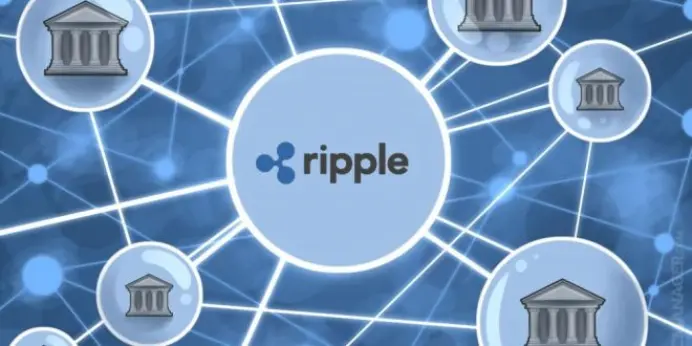
Ripple: short history of cryptocurrency
Ripple was invented by Chris Larsen and Jed McCaleb. The term Ripple refers to the cryptocurrency founded in 2013.
From 2013 onwards, the cryptocurrency has been adopted by various investment banks and other financial institutions, in order to take advantage of the advantages introduced by this cryptocurrency.
Ripple simplifies the payment process by creating completely transparent point-to-point transfers, where banks do not have to pay taxes.
To say that therefore Ripple is a simple cryptocurrency would be too obvious. The Ripple is in fact much more: it is a cryptocurrency studied and oriented for the banking world.
However this does not prevent the possibility of investing in Ripple's cryptocurrency: the XRP. So let's see in detail the cryptocurrency XRP.
Ripple XRP
Just as it works for Bitcoin, Ripple is also based on a completely open source network. The network is in fact editable by the creators, obviously according to the rules established by the network.
The Ripple network is therefore composed of three elements:
- Cryptocurrency (XRP) Ripple
- Banks
- Network
Cryptocurrency experts love to describe Ripple as a system of banks and financial intermediaries, since the Ripple system is essentially based on trust.
Ripple: differences with Bitcoin
The differences between Ripple and Bitcoin are many. They are in fact two extremely different cryptocurrencies. Bitcoin is in fact first and foremost a cryptocurrency, while Ripple is more a network for banks that need to make money transfers in different currencies, where Ripple is used as the main currency.
The deepest difference between these two cryptocurrencies (XRP and BTC) is that Ripple has a central network, while Bitcoin is decentralized. Ripple may therefore not be considered a true "free cryptocurrency" but something that exploits cryptocurrency technology to offer a solution very similar to "traditional" payment methods.
The offer of the currency is very different. Bitcoin has a cap set at 21 million, while Ripple is only at 100 billion.
Is Ripple Better Than Bitcoin? It obviously depends on the type of use. We don't believe that Ripple is much better than Bitcoin due to the lack of decentralization of its network. Ripple can currently boast a good part of its fame due to the great interest from the banks.
Other articles 'Discovering the Crypto'
https://www.publish0x.com/cryptoearnings/discovering-the-crypto-bitcoin-xpjnoyv
https://www.publish0x.com/cryptoearnings/discovering-the-crypto-ethereum-xxowqmr
https://www.publish0x.com/cryptoearnings/discovering-the-crypto-litecoin-xvrwkqq




