![What is Qtum (QTUM)? [A Comprehensive Guide to Understanding QTUM]](https://www.publish0x.com/img/66012.webp?action=resize&ar=1&enc=webp&inv=0&ori=1&st=1&up=1&w=1140&signature=cc5f77ad79d204603076202d3222109d9a4b15eb293ca425cf42dcde2b855b23)
Distributed Ledger Technologies have promised much in the way of revolutionizing existing industries, but resolution of the technical challenges, a preliminary step before the mass adoption of technology, has burst the bubble of overly enthusiastic proponents.
Present in the smart contracts space, and the blockchain niche as a whole, are several obstacles, from such challenges as social acceptance to technical barriers, the solutions for which are yet to be designed such that global scale use is possible.
Both Bitcoin and Ethereum have laid the groundwork for the era of decentralization. However, even with both having been around much longer than newer projects, neither has managed to effectively solve technical issues that would no doubt accelerated adoption had it been solved. To their credit, developers on both networks have proposed some exciting solutions that have already been tested and the prospects look good for both.
In the intervening time, however, multiple teams have launched their own networks with their own distinct solutions to solving the problem of scalability, performance, integration accessibility with existing systems. These projects have had the fortune of learning from the developments made by other networks and have tailor made solutions with the possession of more knowledge.
Qtum (QTUM) is such a project, an enterprise focused smart contracts platform that skirts around some of the pitfalls experienced by Ethereum, a similarly focused platform. We examine the vision with which QTUM was designed, the technical aspects of the project that separates it from its competitors, and the prospects it holds in what is a very crowded niche.
The History of Qtum (QTUM)
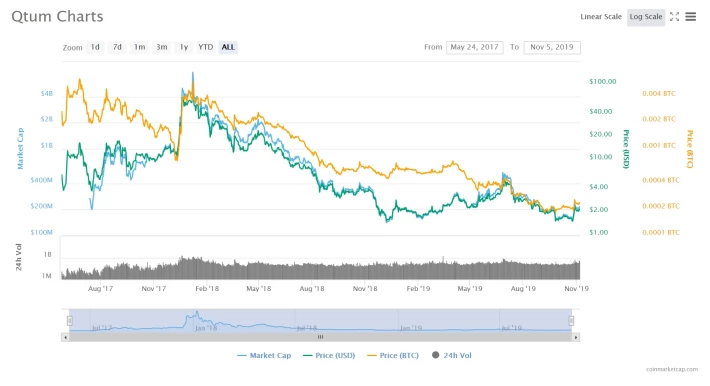
Source: https://coinmarketcap.com/currencies/qtum/
Pronounced “Quantum”, Qtum was founded by Patrick Dai, Jordan Earls and Neil Mahi in 2016, and was born with the intention of being a global project that acts as a “bridge between the Bitcoin and Ethereum communities.” Dai has experience working with other blockchain and technology companies, including having been the Chief Technology Officer (CTO) of the VeChain project and Product Developer and Manager for Alibaba.
Qtum conducted its ICO in March 2017, raising $15 million in 5 days. The development team made swift progress following the ICO: in June 2017, they released the first testnet, followed by a second testnet in August. The next month saw the release of the mainnet.
The project also features some prominent names as backers, including Roger Ver, early Bitcoin investor and Bitcoin Cash (BCH) proponent, Anthony Di Iorio, co-founder of Ethereum, and Xu Star, CEO of OKCoin. Several of the Qtum’s team members and backers have deep experience with blockchain technology. This, combined with the fact that the platform is a sort of amalgamation of Bitcoin and Ethereum (which we describe in detail below), is likely a reason behind the project’s rapid deployments.
The Purpose of Qtum (QTUM)
In a nutshell, Qtum combines aspects of both Bitcoin and Ethereum, taking Bitcoin’s Unspent Transaction Output (UTXO) model and Ethereum’s smart contract functionality to serve as a secure and utilitarian platform for business-grade use cases. Ethereum is more versatile than Bitcoin, offering smart contract functionality at the cost of security, while Bitcoin is more secure, but its code less flexible. Qtum acts as a middle ground. Qtum uses a Proof-of-Stake consensus mechanism, which by now is well known to be more efficient and network friendly than Proof-of-Work.
The specific goals of Qtum all nearly have to do with enterprises. The team describes the value proposition of the Qtum framework as having to do with organizational information and value transfer logistics automation. The specific benefits include trust, economic viability, interoperability, performance, scalability and much more.
There are a few technical aspects to Qtum that are worth noting. The network design draws heavily from both Bitcoin and Ethereum.
First, the network makes use of a Decentralized Governance Protocol (DGP). This allows specific blockchain settings to be modified using smart contracts. This features helps in the maintenance of the blockchain, without causing network disruption. Modifiable parameters include the network’s block size limit and gas prices for operational code running on the network.
Second, the Abstract Account Layer (AAL) is one technique that Qtum uses to boost performance on the network. It separates applications from the protocol layer. This way, applications do not affect the performance of the blockchain, with the team also saying that this will “add more smart contract capability in the future.”
On the subject of smart contracts, Qtum’s x86 Virtual Machines supports several different languages, including C, C++, Rust and Python. Supporting several popular programming languages, the team rightly says, will facilitate the mainstream adoption and development of smart contracts.
Qtum’s white paper comprehensively describes the technical architecture of the project.
Qtum 2.0 Brought Several Improvement Proposals
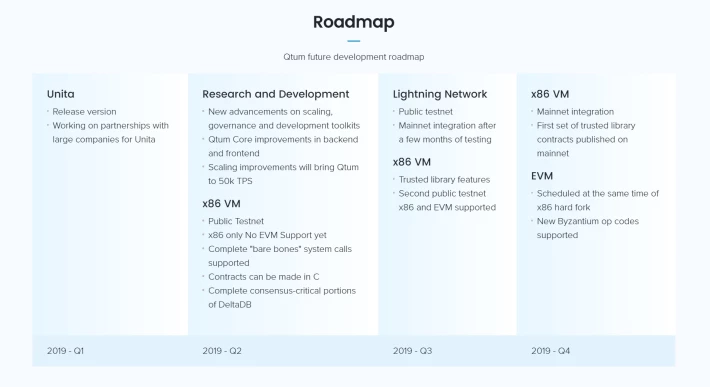
Source: https://qtum.org/en
The team recently released Qtum 2.0, which would bring several improvements to the network. The Qtum Improvement Proposals (QIPs) will be implemented via a hard fork, the first since the launch of the mainnet. Among other changes, the QIPs will bring signature verification to the output script of contract transactions, an upgrade of the Qtum EVM to Ethereum’s Constantinople EVM, and adjustments to the difficulty algorithm. Stability and performance improvements will also be a part of the upgrade.
The upgrade was first activated on the testnet on September 20, 2019, before being activated on the mainnet on October 17. The team also notes that future updates to the x86 virtual machine, private assets, and smart contract staking may require hard forks.
Potential Challenges
Qtum faces no particularly unique challenge, rather the difficulties it might face may have to do in finding a foothold in a niche that is very crowded. Why should businesses choose the Qtum blockchain for its solution when there are several others? Sure, Qtum has some interesting solutions going for it, and is backed by a strong team and set of advisors, but those other projects, for the most part, do as well.
Convincing enterprises that it is a good solution to their issues will be a challenge in the face of this, but the team does have members who have experience in this area. Investors will have to wait a while to see how the project fares and whether or not it can triumph over its competitors.
Partnerships
The project focuses strongly on making itself available on cloud computing services, much like the Stratis blockchain, a Blockchain-as-a-Service platform that also delivers solutions for enterprises. Qtum is collaborating with both Google Cloud and Amazon Web Services, with the latter particularly receiving a lot of attention from media outlets.
Other partnerships include with Chinese video portal company Baofeng and Zeux, a fintech banking solution company. The latter made it possible to spend QTUM at Apple Pay and Samsung Pay Point-of-Sale services.
Competitors
There ought not to be any surprise when we say that Qtum has several competitors, the most obvious being Ethereum. There are several other projects that are vying for its throne, like EOS (EOS), TRON (TRX) and Ziliqa (ZIL). The list is quite long and each bring with its own unique solutions, whether it be a different consensus mechanism, a greater focus on the dapp environment or simply a different target market with its solutions.
Ethereum itself, which has already formed an incredible level of enterprise connections, is set for a few major upgrades in the next few years. Ziliqa’s network has demonstrably proven to have high performance. Competitors either employ savvy technical solutions or smart business strategies to gain a foothold in the ‘real-world smart contract application’ use case.
Given that this is a very crowded space, judging Qtum’s potential is an unsure task. There is going to be much development between now and global application of these proposed technologies - for all of these projects. Much of the development is still in the early stages and the full potential of all of the projects cannot be accurately estimated at this stage.
Qtum’s success will likely have a strong connection with how it fares in its particular target market - enterprises and industries like insurance, medicine, supply chain and logistics, and cross-organization endeavours. For those interested, however, Qtum is working hard to give enterprises a reason to consider its platform.
Conclusion
The concept of marrying the best of both Bitcoin and Ethereum is an interesting one, and if successfully executed in the long run, holds a lot of promise for the Qtum blockchain. To the team’s credit, they have rapidly deployed updates and regularly update the community on the status of the development.
As an investment opportunity, however, that remains an open ended question. Investors who like to invest in a few different tokens in each niche may consider investing in QTUM, but then some would argue that there are others which are just as likely to become go-to smart contract platforms for businesses.
This being the case, perhaps it is just best for investors to watch the development of the project and how it is actually being applied in real world use cases. 2020 will be a landmark year for cryptocurrencies for many reasons and Qtum will certainly be among the many projects that vy for the attention of incumbents.






